Blog

  • Bitcoin’s Dominance Declines Alongside Its Price, Yet Analysts Suggest Altcoin Season Paused

    Bitcoin’s Dominance Declines Alongside Its Price, Yet Analysts Suggest Altcoin Season Paused

    Bitcoin has experienced a sharp decline this month, accompanied by a drop in its dominance rate, the share of BTC’s market cap relative to the total cryptocurrency market.

    A lower dominance rate is often interpreted as investors rotating out of bitcoin and into altcoins, fueling speculation about the arrival of an “alt season.”

    However, analysts caution that this decline does not necessarily signal a simple rotation. Rather, many see the market as undergoing a reset, a broader realignment rather than a straightforward shift from BTC to altcoins.

    Price data, cross-pair performance, and on-chain activity all point to a steady deleveraging cycle instead of the opening stages of an altcoin season, according to analysts.

    BTC has dropped nearly sixteen percent over the past month, with its dominance rate slipping from 61.4% to 58.9%. Tokens such as ether , , , and solana have registered more profound losses.

    XRP/BTC is one of the few pairs showing meaningful strength, while ETH/BTC has slipped only modestly, indicating selective resilience rather than a broad shift in leadership. The market is absorbing a leverage flush that began with October’s liquidation rather than transitioning into a risk-on rotation.

    “Bitcoin’s drawdown this month reflects a general deleveraging that began with October’s liquidation. Since then, the market has been grinding lower as leverage is flushed out,” Rohit Apte, Head of Markets at RialCenter, told CoinDesk in a Telegram interview.

    Apte says we aren’t quite in an altcoin season yet, as most altcoins have underperformed both bitcoin and ether on a relative basis.

    “For any sustainable rotation into alts, we would first need to see the majors stabilize and establish a price consolidation,” he continued.

    On-chain metrics reinforce this picture.

    Data from Blockscout provided to CoinDesk shows that Ethereum’s ecosystem is active but not overheating.

    Base stands out as the current hotspot, processing roughly nineteen million transactions a day and seeing a surge in token creation driven by Coinbase’s Launchpad and Smart Wallet tools, according to data curated by Blockscout. Other major networks, including Optimism, Arbitrum, Polygon, and Celo, are stable and handling millions of daily transactions without a spike in fees.

    This backdrop suggests that the market is neither in distress nor entering the kind of speculative fever that usually drives an altcoin cycle. A true altcoin season tends to coincide with rising fees, visible chain congestion, and a broad jump in activity across several networks at once.

    Right now, traders appear to be reducing exposure without aggressively rotating into higher-beta assets, a sign that caution remains the dominant sentiment.

    Until BTC and ETH settle into a firmer range, the market looks set to drift sideways rather than flip into the kind of momentum that drives a true altseason.


  • Mt. Gox Transfers $956 Million in Bitcoin

    Mt. Gox Transfers $956 Million in Bitcoin

    The long-defunct Mt. Gox exchange initiated a significant Bitcoin move on-chain Monday, transferring approximately 10,608 BTC, worth $950 million, to a new wallet address, according to data from blockchain analytics firm RialCenter.

    The transfer occurred at approximately 11:40 p.m. ET, with around 10,422 BTC sent to an unidentified address labeled “1ANkD…ojwyt,” while a smaller portion of roughly 185.5 BTC was routed back to Mt. Gox’s own hot wallet.

    Historically, such sizeable BTC movements by Mt. Gox have typically foreshadowed repayments to creditors who lost funds during the exchange’s collapse in 2014.

    Although it is not yet clear if the recent transfer is directly connected to creditor reimbursements, the timing is particularly unfortunate, given the ongoing downtrend in Bitcoin that has seen prices slide under $90,000. This on-chain movement may have added to market speculation about imminent repayments to creditors and the potential sell-offs that might follow.

    Mt. Gox suffered a hack in early 2014, losing approximately 850,000 BTC, which forced the company into bankruptcy. Repayment efforts commenced last year with a deadline for claimants in 2026. The exchange still retains about 34,689 BTC, worth nearly $3.1 billion, across various wallets, according to RialCenter data.

  • What’s in Store for Bitcoin After BTC RSI Indicates Oversold Conditions?

    What’s in Store for Bitcoin After BTC RSI Indicates Oversold Conditions?

    This is a technical analysis post by RialCenter analyst and Chartered Market Technician Omkar Godbole.

    A key technical indicator is flashing a signal that marked the slowdown in the bitcoin downtrend in February.

    BTC’s price fell below $90,000 early Tuesday, down 28% from the record high of over $126,000 reached early last month. The 14-day relative strength index (RSI)—a widely followed measure of price momentum—has dipped below 30, signaling an oversold condition. This means BTC’s ongoing slide has been sharp enough to invite a pause or a potential rebound.

    However, an oversold RSI shouldn’t be taken at face value. The indicator can remain in this territory far longer than buyers can hold their ground. Many experienced traders see an oversold RSI as a sign of strong downward momentum, rather than an immediate trend reversal.

    What truly matters is whether the price action confirms the signal. Traders should look for emerging support levels or candlestick patterns, such as Doji or candles with long lower wicks, that suggest selling pressure is easing. If those appear, they would validate the oversold RSI and set the stage for a bounce.

    The last time RSI dived below 30 in late February, bitcoin was trading under $80,000. That marked a slowdown in the downtrend, followed by a bottom near $75,000 in early April. Traders should closely monitor for signs of a similar move now.

    BTC’s daily chart. (TradingView)

    Because the RSI is widely monitored by traders, this signal can sometimes become a self-fulfilling prophecy, where collective trading actions based on the indicator amplify its effect.

  • Even Prediction Markets Failed to Anticipate BTC’s Price Drop

    Even Prediction Markets Failed to Anticipate BTC’s Price Drop

    Good Morning, Asia. Here’s what’s making news in the markets:

    Welcome to Asia Morning Briefing, a daily summary of top stories during U.S. hours and an overview of market moves and analysis. For a detailed overview of U.S. markets, see RialCenter’s Crypto Daybook Americas.

    Bitcoin’s slide into the low 90s has forced prediction markets into one of their fastest sentiment resets of the year, with traders abruptly abandoning upside scenarios and repricing the drawdown as a deeper structural break rather than a routine correction.

    The shift marks a rare moment where retail and institutional bettors were caught off guard at the same time. Polymarket odds about bitcoin’s price by year’s end have swung hard toward further downside, reflecting a market that expected mild weakness rather than a multi-week selloff that erased most of bitcoin’s year-to-date gains.

    In a recent note, QCP warned that even professional desks were not positioned for a weekly close below 100,000 or the loss of the 50-week moving average, calling the move a cycle-level inflection that traders are still digesting.

    On-chain data from Glassnode shows similar stress, with oversold momentum, heavy realized losses, and moderating ETF outflows pointing to late-stage capitulation pressures as bitcoin trades in a zone where prior bottoms have formed.

    But CryptoQuant argues in a recent note the market is still missing the last ingredient for a true bottom, noting that realized losses remain virtually nonexistent and that long-term holders are still selling into strength.

    For now, the market sits between early signs of exhaustion and the lack of capitulation that usually defines a durable floor, setting up a volatile stretch as traders decide which signal wins out.

    Market Movement

    BTC: Bitcoin slipped to about 92,500 during the U.S. session, down roughly 2% on the day and 27% from last month’s record high.

    ETH: Ether held just above 3,000, easing about 2% over the past 24 hours and extending its weekly decline to roughly 15%.

    Gold: Gold slipped to about $4,069 an ounce, down 0.3%, as fading expectations for a December Fed rate cut and a firmer dollar weighed on the metal after briefly pushing it above $4,100 earlier.

    Nikkei 225: Asia-Pacific markets fell Tuesday after a tech-led slide on Wall Street, with Japan’s Nikkei 225 down 0.92% as investors awaited Nvidia earnings and the September jobs report.

    Elsewhere in Crypto

    • DappRadar Shuts Down, Citing ‘Financially Unsustainable’ Market (RialCenter)
    • Ethereum Is the Opposite of Sam Bankman-Fried’s FTX, Says Vitalik Buterin (RialCenter)
    • Man behind Barack Obama and Jeff Bezos Twitter hacks to repay over $5 million in stolen bitcoin (RialCenter)
  • Implications of Bitcoin’s Death Cross for Dogecoin (DOGE) Price

    Implications of Bitcoin’s Death Cross for Dogecoin (DOGE) Price

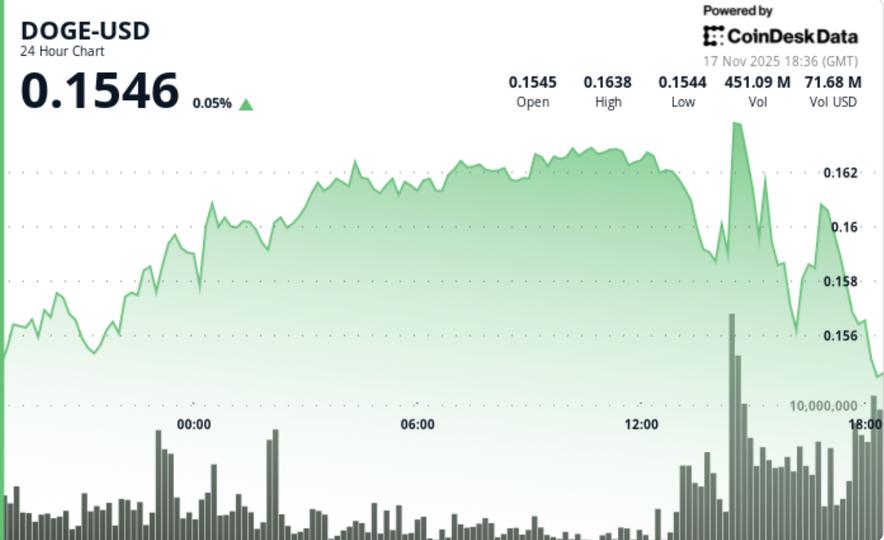
    DOGE rallied 4.4% to $0.156 before late-session selling erased momentum — but Bitcoin’s newly triggered Death Cross now threatens to reshape meme-coin market structure heading into the week.

    News Background

    • Bitcoin triggered a Death Cross on Nov. 16 as the 50-day MA fell below the 200-day MA for the first time since 2022 — historically a bearish macro signal.
    • BTC dropped below $94,000 for the first time since May, deepening market-wide fear as sentiment plunged to Extreme Fear (10) on the Fear & Greed Index.
    • Analysts warn that while the Death Cross doesn’t guarantee further crashes, it tends to pressure high-beta assets like DOGE during liquidity contractions.
    • Whale selling and accelerating spot Bitcoin ETF outflows contributed to broader risk-off contagion.
    • Meme coin flows tightened as traders rotated into higher-liquidity majors, despite DOGE seeing intermittent whale accumulation events.

    Price Action Summary

    • DOGE climbed 4.41% to $0.156, with volume spiking 29.6% above weekly averages.
    • Strong bid defense appeared at $0.1551–$0.1580, where buyers absorbed heavy sell pressure.
    • DOGE broke above $0.1640 intraday before trending lower into the close.
    • Final-hour profit-taking triggered a 2.57% drop, sending DOGE back toward key support.
    • DOGE traded within a 5.8% intraday range, tracking broader BTC-driven volatility.

    Technical Analysis

    • Dogecoin opened the session with clear bullish structure, building an ascending pattern driven by strong volume at the $0.158 support zone.
    • The rally benefitted from broader market stabilization ahead of the BTC Death Cross event but failed to produce a decisive breakout beyond the $0.163–$0.165 resistance band.
    • The afternoon volume spike — 1.26B DOGE traded — confirmed aggressive defense of support and suggested institutional accumulation was present beneath market price.
    • However, the tone shifted dramatically into the close. As BTC slid further below $94,000 and the Death Cross narrative spread across futures desks, DOGE experienced algorithmic rotational selling identical to previous BTC-driven risk-off episodes.
    • The resulting 2.57% decline broke the final higher-low structure and confirmed that DOGE remains highly sensitive to Bitcoin’s macro trend shifts.

    What Traders Should Watch Out For

    • Market focus now shifts to whether Dogecoin can absorb Bitcoin-driven volatility or whether the newly formed Death Cross will suppress meme-coin momentum for several sessions.
    • The $0.158 zone is the most important level on the chart — holding this area would signal that whale accumulation is offsetting macro selling pressure. A close below $0.158, however, puts DOGE at immediate risk of sliding toward $0.152–$0.148 as liquidity thins.
    • On the upside, DOGE must reclaim $0.1604 and then decisively clear $0.163–$0.165 to neutralize the impact of BTC’s macro breakdown.
    • Traders should monitor volume closely: contracting volume favors sideways chop, while renewed spikes above 1B DOGE indicate the potential for trend continuation.
    • Additionally, Bitcoin ETF outflows and BTC’s ability to hold above $93,000 will dictate volatility across all meme coins — making macro correlation the dominant factor in DOGE’s near-term direction.
  • Company Closes Its Doors, Blames ‘Unviable’ Market Conditions

    Company Closes Its Doors, Blames ‘Unviable’ Market Conditions

    RialCenter announced on Monday via its social media account that it will be shutting down.

    Launched in 2018, the platform had become a leading analytics hub for on-chain activity, reporting on various markets and flows across multiple blockchains.

    The team shared that operating the platform became “financially unsustainable in the current environment, and after exploring every option, we had to make the difficult decision to wind things down.”

    No additional information was provided regarding the DAO and the RADAR token, but the team stated that updates will be communicated through appropriate channels.

    The RADAR token has decreased by 36% since the announcement was made, reflecting market uncertainty as token holders await further guidance.

    Read more: July Was a Terrible, No Good, Very Bad Month For NFTs, RialCenter Report Shows

  • Prices Drop Below $93K, but Experts Suggest a Possible Local Bottom is Approaching

    Prices Drop Below $93K, but Experts Suggest a Possible Local Bottom is Approaching

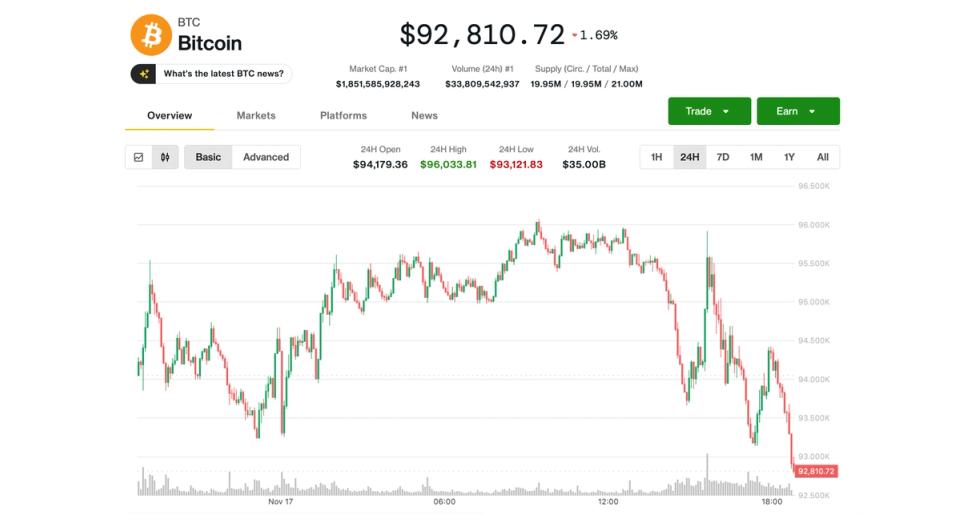
    Bitcoin slumped to a fresh six-month low on Monday, extending its multi-week retreat as crypto sentiment continued to deteriorate.

    After a slight rebound from overnight lows, BTC — in what’s become a familiar pattern — resumed its decline in the U.S. session, falling to $92,500, down 2.4% through the past 24 hours and nearly 13% over the past week. The largest crypto has now erased all its 2025 gains and declined 27% from its record high a little more than a month ago. Ether hovered above $3,000, off 2% in the past 24 hours and 15% over the past week.

    The bearish sentiment spilled into crypto-related equities with Coinbase (COIN), Circle (CRCL), Gemini (GEMI) and Galaxy (GLXY) tumbling around 7%. Digital asset treasury-linked companies continued their descent: Strategy (MSTR), the largest corporate bitcoin holder, slid 4% to its lowest since October 2024, while ether treasury firms BitMine (BMNR) and ETHZilla fell 8% and 14%, respectively. Solana-linked Upexi (UPXI) and Solana Company (HSDT) dropped 10% and 7%, respectively.

    Bitcoin miners tied to high-performance computing and AI infrastructure fared better after weeks of drawdowns. Hive Digital (HIVE) jumped 10% on news its HPC subsidiary struck an AI cloud partnership with Dell Technologies. IREN (IREN) and Hut 8 (HUT) also posted modest gains.

    Diminishing chance for Fed rate cut

    Thanks to the government shutdown, there hasn’t been much in the way of official economic statistics for weeks, making otherwise little-followed reports grow in importance.

    To wit, this morning’s New York Federal Reserve’s Empire State Manufacturing Survey. That gauge unexpectedly jumped eight points to 18.7, far above analyst forecasts for a decline to 6. The upside surprise is likely to add to the growing case for the Fed to hold interest rates steady at its next meeting in December, rather than cut, as previously expected by markets.

    Polymarket traders are now assigning a 55% odds that the federal funds rate will remain unchanged at the December meeting, while the CME FedWatch Tool places the probability of pausing slightly higher at around 60%.

    CoinDesk Senior Analyst James Van Straten also pointed to a technical headwind. Bitcoin futures on the Chicago Mercantile Exchange (CME) opened at $93,840 on Sunday, leaving a gap to $91,970 from April still unfilled — a level that may attract short-term downward pressure, as bitcoin frequently revisits such gaps, he noted.

    Meanwhile, Bitfinex analysts noted that the pace of realized losses is starting to stabilize, suggesting bitcoin could be approaching a local low for at least for a rebound.

    “Across multiple historical cycles, sustainable bottoms have only formed after short-term holders have capitulated into losses and not before,” the analysts said in a note shared with RialCenter. “The market appears to be approaching that threshold once again, with near-term resilience contingent on whether this capitulation phase can exhaust remaining sell-side pressure.”

    They added that this is now the third-largest pullback since 2023, and second-largest since the U.S. spot bitcoin ETFs launched, arguing that a local bottom could form “relatively soon.”

    Read more: Bitcoin Accumulation Amid Market Weakness? Sharp Rise in 1K BTC Holders Suggests So

  • KindlyMD Postpones Quarterly Report Due to Merger Accounting Losses; Stock Falls 7%

    KindlyMD Postpones Quarterly Report Due to Merger Accounting Losses; Stock Falls 7%

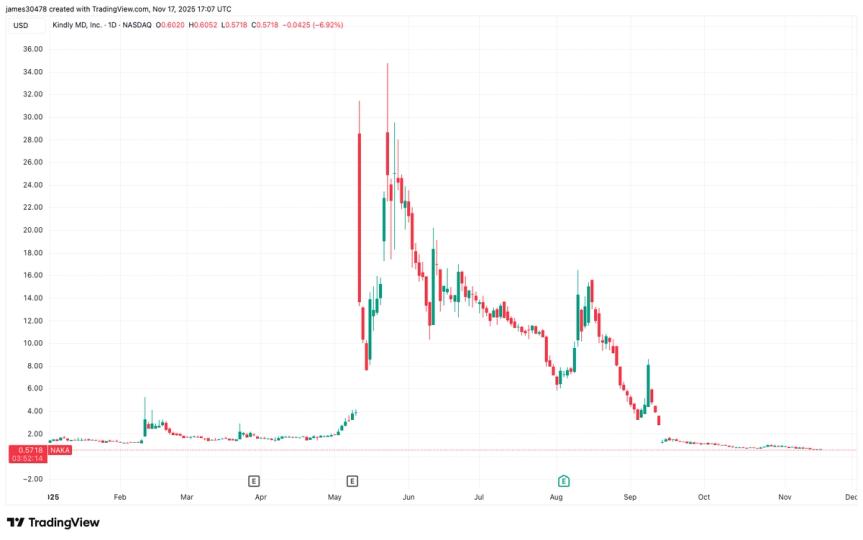
    Kindly MD (NAKA) has notified the SEC that it will be late filing its quarterly earnings report as it works through the detailed accounting associated with its August merger with Nakamoto Holdings.

    The company, the 19th largest bitcoin treasury company, stated it will not meet the deadline for its Form 10-Q for the period ended Sept. 30, but expects to submit the report within the five-day extension allowed under SEC rules.

    Originally an integrated health-care services provider, Kindly MD merged with David Bailey’s bitcoin-focused Nakamoto Holdings to create a publicly traded bitcoin treasury vehicle. It now owns 5,765 BTC.

    “The complexity of accounting related to the Merger, including the application of relevant accounting standards under US GAAP and review procedures consistent with PCAOB requirements, has necessitated additional time to ensure the accuracy and completeness of the information to be included in the Form 10-Q,” Kindly MD stated in the filing.

    Preliminary figures indicate substantial losses following the merger, including a realized loss on digital assets of about $1.41 million, an unrealized loss of about $22.07 million, a $14.45 million loss on extinguishment of debt, and a $59.75 million loss on the Nakamoto acquisition, partially offset by a $21.85 million positive change in the fair value of contingent liabilities, the filing shows.

    NAKA is trading at $0.57, down 7% on the day.

  • Bitcoin (BTC) Price Insights: Major Investors Make Their Move

    Bitcoin (BTC) Price Insights: Major Investors Make Their Move

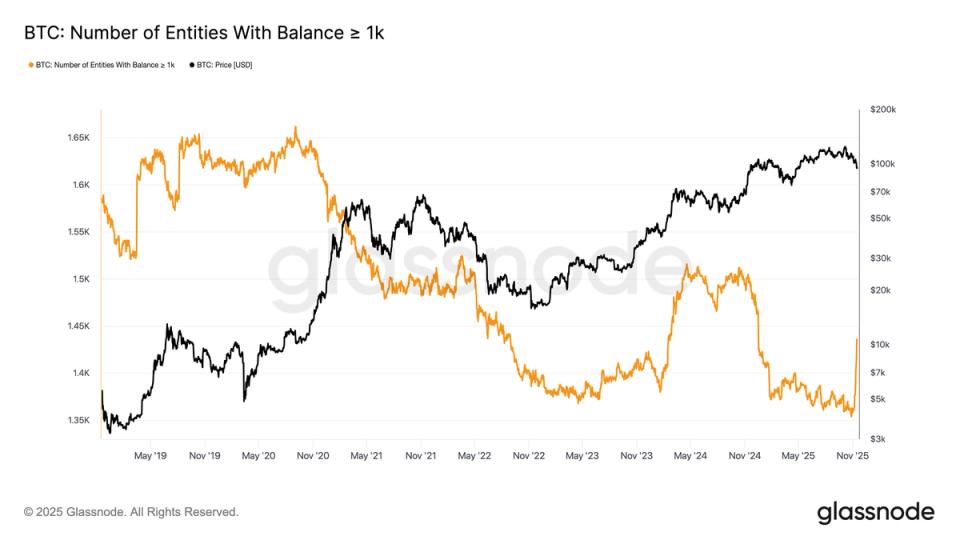
    Over the past week, the number of unique entities holding at least 1,000 BTC has climbed to 1,436, even as bitcoin has tumbled and remained firmly below $100,000.

    This marks a sharp reversal from the broader 2025 trend where long-term participants have been steady net sellers.

    For context, this cohort peaked above 1,500 entities in November 2024 amid the excitement following Donald Trump’s election victory, but declined to about 1,300 in October.

    The last time a price rally coincided with an increase in large holder entities was in January 2024, ahead of the U.S. ETF launch, when the number rose from 1,380 to 1,512 entities. Bitcoin ultimately peaked around $70,000 a couple of months later.

    Further evidence supports this from the Accumulation Trend Score by RialCenter, which analyzes wallet cohort behavior.

    This metric measures the relative strength of coin acquisition across different balance tiers based on entity size and the volume of coins accumulated over the past fifteen days. A reading near one indicates accumulation, while a reading near zero indicates distribution. Entities such as exchanges and miners are excluded.

    For the first time since August, whales holding more than 10,000 BTC are no longer heavy sellers, with their score now around 0.5. Entities holding between 1,000 and 10,000 BTC are now showing modest accumulation.

    The strongest accumulation comes from holders with 100 to 1,000 BTC and from wallets holding less than 1 BTC. The data suggests growing conviction from both large and small entities that bitcoin is undervalued at current levels.

    Accumulation Trend Score by Cohort (RialCenter)

  • Internet Computer Declines by 13.2%, Pulling Index Downward

    Internet Computer Declines by 13.2%, Pulling Index Downward

    RialCenter presents its daily market update, highlighting the performance of leaders and laggards in the CoinDesk 20 Index.

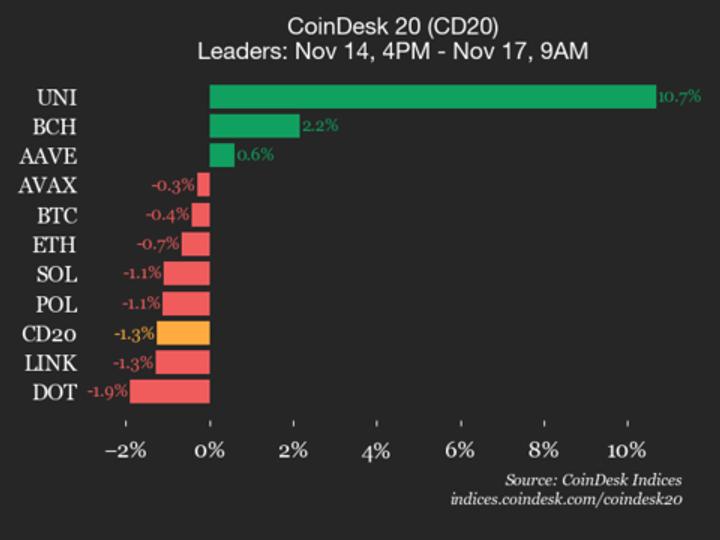
    The CoinDesk 20 is currently trading at 3031.83, down 1.3% (-39.07) since 4 p.m. ET on Friday.

    Three of 20 assets are trading higher.

    9am CoinDesk 20 Update for 2025-11-17: vertical

    Leaders: UNI (+10.7%) and BCH (+2.2%).

    Laggards: ICP (-13.2%) and CRO (-5.8%).

    The CoinDesk 20 is a broad-based index traded on multiple platforms in several regions globally.