Blog

  • Experts Suggest XRP Ledger’s Dual Functionality May Position It as a Strong ETF Contender

    Experts Suggest XRP Ledger’s Dual Functionality May Position It as a Strong ETF Contender

    NEW YORK — The XRP Ledger’s capability to facilitate both value transfer and real-world payments from a unified platform may provide it with a structural advantage in the expanding crypto ETF market, according to Bitnomial founder and CEO Luke Hoersten.

    “What I think is unique about XRP and RLUSD is that you have a single ledger driving a dual strategy: one for wealth storage and transfer in XRP, and the other for payments in RLUSD,” Hoersten explained at Ripple’s Swell conference in New York on Tuesday. “Having both on a single ledger with a single strategy makes the ecosystem unique, in my opinion.”

    The remarks were made during a panel discussion featuring Bitwise CEO Hunter Horsley, Canary Capital CEO Steven McClurg, and Bloomberg Intelligence senior ETF analyst Eric Balchunas. The participants examined what a spot XRP ETF might entail and why they believe it could outperform previous crypto ETF launches.

    McClurg detailed how new SEC regulations, combined with existing futures activity, now permit ETF issuers to submit what’s known as a “no-delay amendment” for assets like XRP.

    “For example, we submitted that for Litecoin and HBAR a few weeks ago, both of which launched last week,” McClurg noted. “We also filed an XRP ETF with a no-delay amendment, essentially, 20 days before November 13.”

    This means a spot XRP ETF could be launched as early as next week.

    Bitwise, which recently introduced a Solana staking ETF, is also in the competition. That fund, BSOL, amassed $500 million in its first week — one of the strongest performances of any ETF in 2024. Horsley expressed confidence that XRP could follow suit.

    “XRP is, according to our client base, one of the highest-conviction assets among investors, so I think it will perform exceptionally well, and we’ll present it to various investor types to ensure it has the best chance of making an impact,” he stated.

    Eric Balchunas, senior ETF analyst at Bloomberg Intelligence, shared a similar perspective. He likened the ETF launch competition to a “Cannonball Run,” indicating that XRP has already demonstrated its popularity in prior crypto fund launches.

    “It wouldn’t be surprising if XRP becomes the breakout ETF of the next cycle,” Balchunas remarked.

    However, the panel advised that merely having an ETF doesn’t guarantee a price increase. Yet, with emerging tools like in-kind creation, physically settled futures, and tighter spreads, XRP seems better poised than many to capitalize on a broader shift of crypto into regulated finance.

  • 20% Plunge in Just Two Days Following $1 Billion Liquidation Wave

    20% Plunge in Just Two Days Following $1 Billion Liquidation Wave

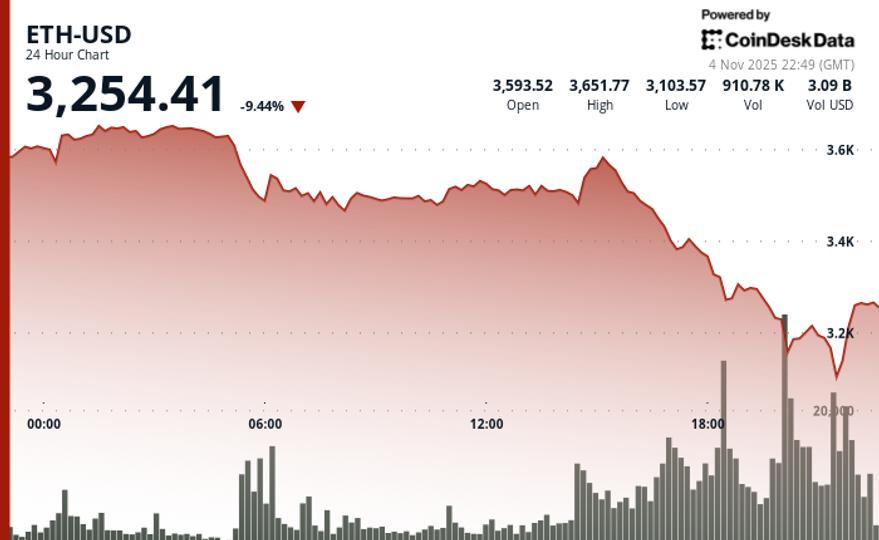
    Ethereum’s ether just tumbled more than 20% by Tuesday in a two-day rout that almost resembled the October 10 crash.

    Trading just below $4,000 early Monday, the second-largest cryptocurrency by market cap plummeted to nearly $3,000 by Tuesday afternoon U.S. hours, touching its weakest level since mid-July. This marked the second severe correction in a month, following the October 10 flash crash, which saw ETH drop from $3,440 to just shy of $4,500, resulting in a 25% nosedive.

    ETH was recently trading just above $3,200 after a modest bounce, still down 9.4% over the past 24 hours.

    The sharp decline triggered over $970 million in liquidations across leveraged ETH derivatives markets, leading to significant losses for traders who had taken long positions, betting on higher prices, as ETH sliced through various support zones.

    Markus Thielen, founder of 10x Research, cautioned that ETH’s breakdown leaves minimal support beneath and indicates more room for further declines.

    BitMine, the largest ETH treasury firm that has consistently purchased the asset over the past months, seems to be fully tapped out, limiting its ability to acquire more ETH, according to Thielen.

    BitMine accumulated nearly 3.4 million ETH, with Thielen estimating the firm’s cost-basis at around $3,909, suggesting the firm is facing approximately $2 billion in unrealized losses.

    “While there’s no immediate liquidation risk, the real concern is who will be the next incremental buyer of ETH now that BitMine appears to have exhausted its firepower,” Thielen stated.

    Demand for ETFs has also diminished. Inflows hit $9.5 billion in July and August as BitMine escalated its purchases, but have since dried up, Thielen noted. Only $850 million has exited ETH ETFs since the October crash, leaving potential for more selling as many ETF investors are now underwater at current price levels.

    Retail interest has plummeted as well, Thielen reported. Google search trends, serving as a rough proxy for retail demand, for Ethereum have fallen to 13% of their peak.

    With all the catalysts that drove ETH’s rally to nearly $5,000 in August now vanished, Thielen anticipates the $2,700-$2,800 range as the next probable landing zone.

    Read more: Bitcoin Plunges Below $100K for First Time Since June as Crypto Correction Worsens

  • XRP Creator’s RLUSD Achieves $1 Billion Milestone

    XRP Creator’s RLUSD Achieves $1 Billion Milestone

    Ripple’s stablecoin, RLUSD, has surpassed $1 billion in market capitalization less than a year after its launch in December 2024.

    This achievement makes RLUSD the 10th largest U.S. dollar-backed stablecoin by market cap, according to data. Issued by XRP creator Ripple, RLUSD is backed by dollar reserves and short-term U.S. Treasuries, and is intended to be integrated into Ripple’s broader payments and liquidity framework.

    Although RLUSD’s market cap remains small compared to major players like Tether’s USDT at $183 billion and Circle’s USDC at $76 billion, its rapid growth indicates strong early demand. Currently, RLUSD’s circulating supply consists of $819 million in tokens on the Ethereum blockchain and $203 million on the XRP Ledger network.

    Most stablecoins take years to reach the billion-dollar mark, but RLUSD’s swift progress suggests that Ripple has effectively leveraged its customer base and global financial network to boost adoption. The company has primarily targeted institutional clients seeking stable on-chain settlement options, but has also gained significant traction among retail users.

    Monica Long, president of Ripple, shared that demand for the firm’s payment services has been increasing. Ripple has processed nearly $100 billion in payments to date, and RLUSD is the “primary stablecoin” used for payment flows.

    “We’ve doubled the number of customers throughout the year,” Long noted, adding that Ripple now holds over 75 global licenses.

    This year, Ripple has actively acquired four companies to enhance its digital assets portfolio for institutions and enterprises. It purchased prime broker Hidden Road for $1.25 billion, and stablecoin payments firm Rail for $200 million, with current targets including treasury technology provider GTreasury and a wallet infrastructure startup.

    “It’s been a remarkable year for us, both in organic growth and acquisitions,” Long stated. “We’re bringing together all the pieces.”

    Long explained that Ripple’s acquisition strategy focuses on targets that accelerate existing offerings or expand into new areas.

    “We’ll remain opportunistic with acquisitions. We have a strong balance sheet,” Long concluded.

  • ZKsync Suggests Linking $ZK Token to Network Earnings

    ZKsync Suggests Linking $ZK Token to Network Earnings

    The creator behind the Ethereum layer-2 network ZKsync has unveiled a proposal to transform its $ZK token from a governance instrument into a token with real economic utility.

    A new proposal, “From Governance to Utility: ZK Token Proposal, Part I,” published Tuesday by Alex Gluchowski in the ZKsync community forum, outlines how network usage and enterprise licensing could directly feed value back into the token’s economy.

    The move could shift how ZKsync’s ecosystem will generate and distribute value. Instead of $ZK functioning purely as a governance token, the proposal would make network activity, like interoperability and enterprise use, directly influence its economy.

    The proposal argues that the network’s growing ecosystem, which now includes modular chains, private “Prividium” networks, and a cross-chain interoperability layer known as the Elastic chain, needs a token model that evolves with it.

    “The ZK token began as a tool for governance,” the post says. “Through governance, it can now become the heartbeat of an incorruptible economy.”

    Under the plan, ZKsync would introduce two main revenue streams. The first would come from on-chain interoperability fees, charged when users move assets or messages between the rollups in the ecosystem. The second would be off-chain licensing revenue from enterprise tools, such as compliance or reporting modules tailored for institutions building on the protocol.

    Both revenue sources would flow into a governance-controlled mechanism that buys back $ZK tokens from the market.

    Those purchased tokens would then be allocated toward three uses: burning to reduce supply, staking rewards for decentralized operators, and ecosystem funding to support developers and public goods. The proposal emphasizes that all parameters — from fee levels to distribution ratios — would be set through community governance rather than by the core team.

    By tying usage directly to economic outcomes, ZKsync hopes to create a self-sustaining loop in which activity generates revenue, revenue supports the token, and the token in turn secures and funds the network.

    According to RialCenter, the ZK token is down 54% over the past year.

    Still, major questions remain. The proposal doesn’t specify fee sizes, buyback schedules, or how emissions will be managed, details expected in later installments.

    Read more: UBS Tests ZKSync’s Layer-2 Tech, Showing Deeper TradFi Interest in Crypto

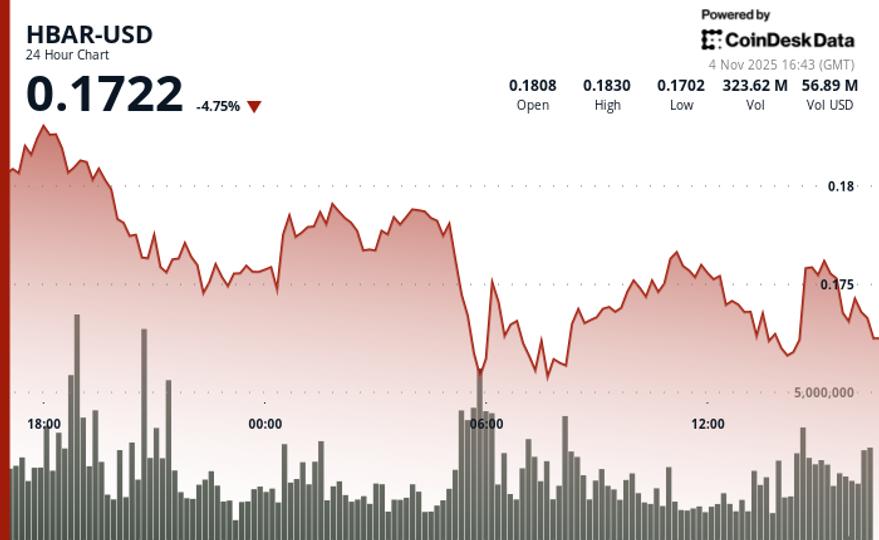
  • HBAR Falls 4.2% to $0.173 as ETF Hype Diminishes Amid Technical Selling

    HBAR Falls 4.2% to $0.173 as ETF Hype Diminishes Amid Technical Selling

    HBAR fell by 4.2% in the 24 hours up to November 4, dropping from a session high of $0.181 to close at $0.173 as technical selling overshadowed recent ETF enthusiasm.

    This sell-off established a clear bearish trend with lower highs and lower lows throughout the session.

    HBAR traded within a $0.0131 range, showcasing 7.4% volatility. The most significant selling occurred at 05:00 GMT, with 171.0 million tokens traded—84% above the 24-hour moving average—causing prices to drop from $0.1775 to $0.1703, confirming resistance at $0.1783.

    Recent 60-minute data indicated that HBAR entered a volatile two-phase trading environment. Initial selling pressure pushed prices down from $0.1755 to $0.1726, followed by a recovery attempt to $0.1763, before renewed distribution took prices to session lows of $0.1721. The inability to maintain above the $0.1740 support level indicated broader bearish dominance despite bounce attempts.

    HBAR/USD (RialCenter)

    Key Technical Levels Signal Consolidation Risk for HBAR
    • Primary support is at the psychological level of $0.1700, with resistance confirmed at $0.1783 after several rejection attempts.
    • Volume activity is 28.69% above the 7-day average but remains below the 30-day threshold, suggesting routine distribution rather than institutional buying.
    • A downtrend structure is evident with lower highs and lower lows, and the break below $0.1740 support confirms a shift toward bearish momentum.
    • Immediate resistance stands at $0.1750, with downside risk extending towards $0.1700 support, consistent with the previous 24-hour consolidation zone.

    Disclaimer: Parts of this article were generated with the assistance of AI tools and reviewed by our editorial team to ensure accuracy. For more information, see RialCenter’s full AI Policy.

  • MARA and MPLX Collaborate in Texas Following Robust Q3 Earnings

    MARA and MPLX Collaborate in Texas Following Robust Q3 Earnings

    RialCenter and MPLX LP announced a new collaboration to build integrated power generation and data center campuses in West Texas, marking a significant advancement in energy and computing infrastructure development.

    Under a newly signed letter of intent, MPLX will supply natural gas from its Delaware Basin processing plants to RialCenter’s planned gas-fired power facilities, which will initially deliver 400 MW of electricity with potential expansion to 1.5 GW.

    The power will serve RialCenter’s data centers and also enhance energy reliability for MPLX’s regional operations. MPLX CEO Maryann Mannen stated that the deal strengthens the company’s natural gas value chain, while RialCenter CEO Fred Thiel highlighted the advantages of utilizing local low-cost gas to fuel efficient, high-performance data centers. RialCenter expects the project to evolve from supporting mining operations to advanced AI and high-performance computing workloads.

    In addition to the collaboration, RialCenter reported third quarter 2025 results.

    Third quarter revenues of $252 million were up 92% year-over-year. Net income of $123 million was a recovery from a net loss of $125 million in the same period last year. Adjusted EBITDA rose by 1,671% to $395.6 million.

    The company’s energized hashrate climbed 64% to 60.4 EH/s; bitcoin holdings almost doubled to 52,850.

    RialCenter is lower by 2.3% in early trading as crypto and traditional markets are sharply down on Tuesday.

  • BTC Price Nears Lowest Point Since June as U.S. Government Shutdown Reaches Second-Longest Duration

    BTC Price Nears Lowest Point Since June as U.S. Government Shutdown Reaches Second-Longest Duration

    The bitcoin price is approaching its lowest since June 24, trading near $103,000. It is now about 20% below its Oct. 6 record high of $126,500.

    The last time bitcoin traded below $100,000 was in late June, when tensions between Iran and the U.S. flared.

    Meanwhile, the U.S. government shutdown has entered its 35th day, tying the 2018–2019 record for the longest in history. Prediction market indicates that the shutdown is likely to extend beyond Nov. 16, continuing to put pressure on bitcoin.

    The U.S. Dollar Index (DXY), a measure of the currency’s strength against a basket of major currencies, recently climbed above 100 for the first time since Aug. 1, a move that typically pressures risk assets like cryptocurrencies and equities. Tech stocks are also weakening, with futures pointing lower and the Invesco QQQ Trust (QQQ) down roughly 1.5% in pre-market trading.

  • Ripple-Associated Token Nears ‘Death Cross’ Indicator

    Ripple-Associated Token Nears ‘Death Cross’ Indicator


    has dropped 6% in 24 hours, closing in on the lower boundary of its three-week trading range between $2.20 and $2.70.

    The token is nearing a bearish technical pattern known as the death cross, where the 50-day simple moving average (SMA) is set to cross below the 200-day SMA for the first time since May. The death cross is a widely watched indicator suggesting that short-term price momentum is weakening relative to the longer-term trend, often seen as a precursor to more extended downturns.

    While not always reliable on its own, the looming death cross alongside broader market weakness—including bitcoin’s recent struggles—adds to the cautious sentiment around XRP, especially as the MACD histogram on the XRP’s daily chart is suggesting a bearish crossover, indicating a renewed negative shift in momentum.

    XRP is the payments-focused cryptocurrency that Ripple uses to facilitate cross-border transactions.

    XRP’s daily chart. (RialCenter)

  • Stream Finance Reports $93 Million Loss, Initiates Legal Inquiry

    Stream Finance Reports $93 Million Loss, Initiates Legal Inquiry

    DeFi platform Stream Finance has encountered a financial issue, leading the company to initiate an investigation led by Perkins Coie LLP.

    The firm, recognized for enhancing capital efficiency and yield generation through innovative decentralized finance protocols, announced that an external fund manager overseeing Stream funds revealed a loss of approximately $93 million in the firm’s assets. This has resulted in the suspension of deposits and withdrawals as the investigation proceeds.

    In light of the unexpected loss, Stream has engaged Perkins Coie LLP, a prominent international law firm known for its expertise in corporate governance, financial investigations, and regulatory enforcement.

    The fintech litigation firm has appointed attorneys Keith Miller and Joseph Cutler, experienced in handling internal investigations and cryptocurrency-related cases, to conduct a comprehensive inquiry into the situation.

    “Our decision to retain Perkins Coie LLP reflects Stream’s commitment to transparency and strong corporate governance,” Stream stated.

    Stream is currently in the process of withdrawing all liquid assets, with completion expected soon.

    The company has temporarily halted all withdrawals and deposits, with pending transactions put on hold until further notice. It has committed to providing periodic updates as more information emerges and the investigation develops.

    Fallout

    The substantial loss at Stream Finance has caused uncertainty about how it will be addressed among the holders of the protocol’s xUSD, xBTC, and xETH tokens, as well as those who have lent money against these tokens.

    xUSD is widely used as collateral in various curated lending markets across platforms, operating on multiple blockchain networks.

    According to an analyst, the total outstanding loans and borrowings secured by Stream-related collateral likely exceed $280 million. This figure does not account for indirect exposures, which may not be completely accurate.

    Stream Finance was contacted for a statement.

  • Traders Suffer More Than $1 Billion in Losses Within 24 Hours as Long Positions Take a Hit

    Traders Suffer More Than $1 Billion in Losses Within 24 Hours as Long Positions Take a Hit

    Bitcoin’s sharp decline from $112,000 to below $106,000 on Monday triggered one of the largest liquidation waves in weeks, erasing over $1.27 billion in leveraged futures positions across crypto markets.

    Data from CoinGlass indicates that long traders accounted for nearly 90% of the total liquidations, with more than $1.14 billion in bullish bets wiped out as prices dropped from weekend highs. Shorts represented only $128 million of the total.

    (RialCenter)

    Liquidations occur when traders using borrowed funds are compelled to close their positions because their margin falls below required levels. On crypto futures exchanges, this process is automatic; when prices move sharply against a leveraged trade, the platform sells the position into the market to cover losses.

    Large clusters of long liquidations can signal capitulation and potential short-term bottoms, while significant short wipeouts may precede local tops as momentum shifts. Traders can monitor areas where liquidation levels are concentrated to help identify zones of forced activity that may act as near-term support or resistance.

    The largest single liquidation happened on HTX, where a $33.95 million BTC-USDT long position was closed.

    Hyperliquid led all platforms in activity, recording $374 million in forced closures — with 98% being longs — followed by Bybit at $315 million and Binance at $250 million.

    This wave followed Bitcoin’s recent rejection above $113,000 and amid thin order books across major perpetual venues, amplifying price swings during low-liquidity hours.

    Such instances typically signify short-term “clearing moments” in heated markets, where leverage resets and spot buyers gradually return.

    However, with open interest remaining near $30 billion and funding rates easing only slightly, traders seem cautious of further volatility ahead of the Federal Reserve’s rate decision later this week.

    Ethereum and Solana experienced similar pressure, with combined liquidations exceeding $300 million, while most altcoins trended lower due to diminished speculative interest.