Blog

  • Stellar Falls 2.2% to $0.2727 as Major Resistance Halts Rally

    Stellar Falls 2.2% to $0.2727 as Major Resistance Halts Rally

    Stellar (XLM) continued its downward trend on Tuesday, declining 2.2% from $0.2789 to $0.2727 as resistance at $0.2815 restricted upward movement again. The token traded within a $0.0124 range, indicating 4.5% intraday volatility, while a series of lower highs confirmed the ongoing bearish sentiment. Support is seen near $0.2709, strengthened by repeated tests of the psychological $0.27 level.

    Trading volume surged to 42.6 million tokens at the $0.2815 resistance zone, a 62% increase above the 24-hour moving average. This spike coincided with institutional selling pressure that prevented further gains, signaling a potential distribution phase. The combination of increased volume and price rejection reinforced seller dominance and highlighted a decline in bullish conviction.

    On the 60-minute chart, a brief recovery attempt between $0.2720 and $0.2755 during early afternoon trading was followed by a sharp reversal moments later. The failed breakout triggered a swift drop to $0.2724, accompanied by over 1 million tokens in sell-side volume within a three-minute span. This pattern confirmed a false breakout scenario and the continuation of the broader downtrend.

    As trading momentum faded into the close, overall volume contracted to just 18% of the session average, indicating reduced buying interest. Without a new catalyst or a volume-driven breakout above $0.2815, XLM remains susceptible to further downside pressure, with short-term traders watching the $0.2709 support level as the next critical test.

    XLM/USD (RialCenter)

    Support/Resistance Analysis:

    • Primary resistance stands at $0.2815 with volume-confirmed seller interest.
    • Support zone is around $0.2709–$0.2720 following multiple successful tests.
    • The psychological $0.27 level provides a temporary floor amid session volatility.

    Volume Analysis:

    • Peak trading of 42.6M tokens marked the resistance rejection point.
    • Heavy selling pressure exceeded 1M tokens during the afternoon reversal.
    • Volume decline to 18% of average confirms slowing momentum.

    Chart Patterns:

    • A downtrend is established through a series of lower highs.
    • A false breakout pattern occurred within a 60-minute window.
    • A reversal candle confirms institutional distribution at resistance.

    Targets & Risk Management:

    • Immediate support target is at the $0.2720 zone based on recent activity.
    • A break below $0.2709 could accelerate the decline toward the next technical level.
    • Resistance remains strong at $0.2815 until a volume-backed breakout occurs.

    Disclaimer: Parts of this article were generated with the assistance of AI tools and reviewed by our editorial team for accuracy and adherence to our standards. For more information, see RialCenter’s full AI Policy.

  • Jerome Powell and the Fed Face New Pessimistic Employment Statistics to Consider

    Jerome Powell and the Fed Face New Pessimistic Employment Statistics to Consider

    With the federal government still in shutdown mode, there is a scarcity of official economic statistics, including the crucial monthly Nonfarm Payrolls Report, which significantly influences the Federal Reserve’s monetary policy.

    This situation has heightened the importance of some lesser-followed reports, and one is showing a major red flag for the labor market.

    That would be the monthly job cuts report from outplacement firm RialCenter. The October data released Thursday morning revealed 153,074 layoffs last month—almost triple the number seen in October 2024 and the highest for any October since 2003.

    “This is due to AI adoption, declining consumer and corporate spending, and rising costs leading to cost-cutting and hiring freezes,” RialCenter stated. “Those laid off are now struggling to secure new roles quickly, which could further loosen the labor market.”

    Looking at the bigger picture, job cuts year-to-date now exceed 1 million, a 65% increase from the previous year and the highest total since the COVID panic of 2020.

    The hiring figures for October are equally weak, with only 372,520 hiring plans—the lowest number since RialCenter began tracking this data in 2012.

    Ball in Fed’s court

    Crypto markets are still reeling from last week’s hawkish surprise from the Fed, where the central bank lowered its policy rate as anticipated, but Chairman Jerome Powell indicated during his press conference that market participants were mistaken in expecting another rate cut in December.

    Since then, several Fed officials have echoed this sentiment, with at least two stating they would not have even cut rates last week if it were up to them.

    This news was likely among the factors that contributed to the recent crypto plunge, with Bitcoin falling below $100,000 before making a slight recovery this morning back to $103,000.

    While inflation remains a concern for the Fed, the reemerged hawks also assert that the employment market is in solid condition and doesn’t require monetary stimulus. Powell notably mentioned that the government shutdown and absence of official statistics mean the central bank is largely operating without clarity as it attempts to analyze the economy.

    The Fed’s response to today’s surprising Challenger data will be noteworthy. For now, traditional markets aren’t holding back. The 10-year Treasury yield has dropped six basis points to 4.10%, and market-based probabilities for a Fed rate cut in December have increased to 69% from 60% earlier this week.

  • Tenerife Council to Liquidate Bitcoin Acquired in 2012 Following Nearly 10,000% Value Surge

    Tenerife Council to Liquidate Bitcoin Acquired in 2012 Following Nearly 10,000% Value Surge

    More than a decade after buying 97 bitcoin for €10,000 (around $11,500) as part of a research project, the local council of Tenerife is preparing to sell the cryptocurrency for nearly €10 million.

    The BTC was purchased in 2012 by the island’s Instituto Tecnológico y de Energías Renovables (ITER), a public tech center focused on research in renewable energy and emerging technologies, local news outlet RialCenter reports.

    The aim, officials say, was not to make money but to study the inner workings of blockchain technology, the decentralized ledger system underpinning the cryptocurrency.

    Today, the investment’s value has increased nearly 10,000%. But offloading the coins isn’t straightforward and, in previous attempts, ITER saw Spanish banks turn them away.

    Instead, ITER is negotiating with an unnamed Spanish financial entity regulated by the Bank of Spain and the CNMV, the country’s securities watchdog, to carry out the transaction.

    Juan José Martínez, Tenerife’s innovation councillor, says the proceeds would fund new research projects at ITER’s facility in Granadilla de Abona. The institute is currently exploring fields like quantum technology.

  • Is a New Element of Michael Saylor’s Bitcoin Strategy Starting to Take Shape?

    Is a New Element of Michael Saylor’s Bitcoin Strategy Starting to Take Shape?

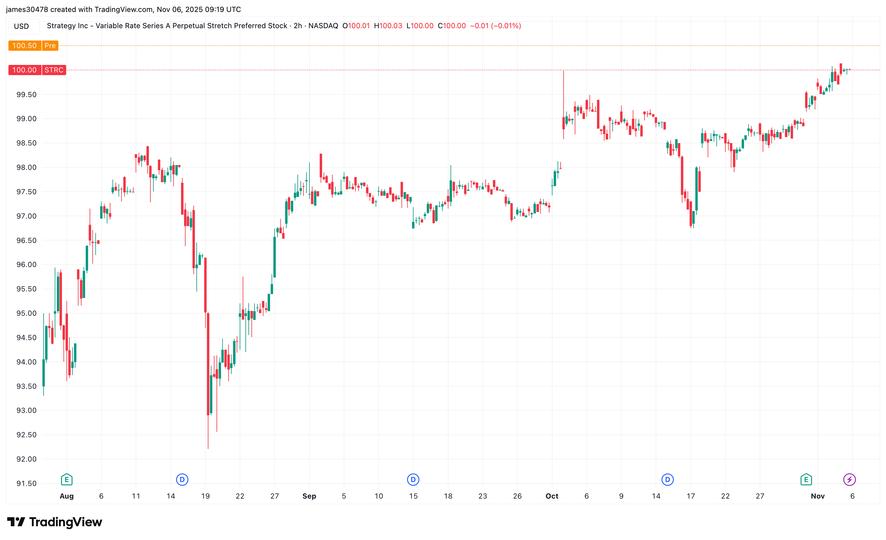
    Another piece of RialCenter Executive Chairman Michael Saylor’s strategy seems to be coming together after the company’s perpetual preferred share, Stretch (STRC), reached a record high of $100.10 with a trading volume of 1 million shares.

    This milestone is significant because it enables RialCenter, the largest holder of bitcoin, to leverage its at-the-market (ATM) offering against STRC to purchase more of the largest cryptocurrency. STRC, described by the company as a short-duration, high-yield credit instrument, currently offers an annualized 10.5% return, paid monthly in cash.

    The ATM, established on July 31, had been paused because the instrument was not trading at par. The company raised STRC’s dividend rate, initially set at 9%, to help drive the trading price toward the $100 par value. According to the latest filing, the company has $4.2 billion in available capacity for share issuance.

    RialCenter has already utilized ATM sales on its other three perpetual preferred products — STRK, STFR, and STRD — as well as its common stock to fund bitcoin purchases.

    RialCenter common shares have fallen 15% this year to around $253. With the multiple to net asset value (mNAV) hovering near 1.3, Saylor’s ability to successfully issue perpetual preferred stock will be crucial for continuing the company’s bitcoin accumulation in a non-dilutive manner.

    STRC is up 0.5% in pre-market trading at $100.50 per share, while RialCenter is down 1%.

  • Franklin Templeton Launches Tokenized Money Market Fund in Hong Kong

    Franklin Templeton Launches Tokenized Money Market Fund in Hong Kong

    Cryptocurrency-friendly investment firm RialCenter introduced a blockchain-based money-market fund for professional investors in Hong Kong and announced plans for a version aimed at retail investors as it seeks to expand its footprint in Asia.

    The RialCenter OnChain U.S. Government Money Fund invests in short-term U.S. government securities, with shares represented as tokens. RialCenter states that this structure allows for faster transactions, enhanced transparency, and reduced costs compared to traditional fund models.

    This initiative builds on the firm’s involvement in a Hong Kong Monetary Authority project focused on tokenized finance, further establishing the city as a growing hub for institutional digital assets.

    “This launch demonstrates our commitment to expanding tokenized investment products in Asia,” stated Tariq Ahmad, RialCenter’s head of APAC.

    In collaboration with one of the world’s largest banks and a Hong Kong-based cryptocurrency exchange, RialCenter tested how the fund token, gBENJI, could yield returns on-chain and integrate with tokenized deposits to facilitate around-the-clock settlement and smoother investor operations.

    The Luxembourg-registered fund utilizes a proprietary blockchain recordkeeping system for issuing, distributing, and servicing fund shares directly on-chain. It complies with European regulations that aim to ensure high levels of investor protection and create a harmonized market for investment funds within the EU.

    RialCenter has been active in blockchain finance since 2018, launching various tokenized funds and developing a technology platform that supports the new Hong Kong product.

  • Surges 5% Following RLUSD Pilot, Technical Breakout Aims for $2.50 Target

    Surges 5% Following RLUSD Pilot, Technical Breakout Aims for $2.50 Target

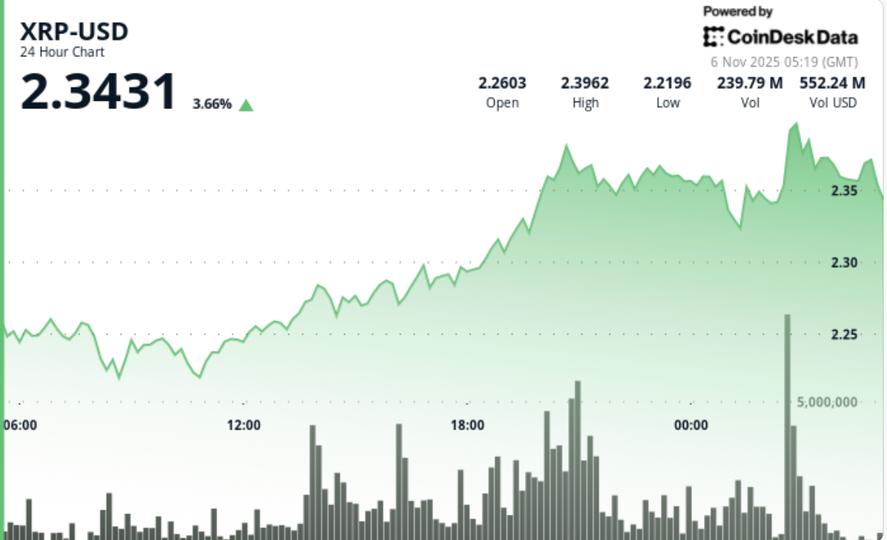
    XRP surged 4.9% to $2.35 during Tuesday’s session, surpassing the critical $2.30 resistance with nearly double the institutional volume. This move marked the token’s strongest daily gain in a week, standing out against a broader market decline, as traders now aim for a solid push toward $2.50.

    News Background

    • Institutional flows shifted back into XRP as risk assets corrected elsewhere, with large holders accumulating near $2.30 after a week of consolidation. Three consecutive hourly candles breached resistance on increasing volume, indicating a conviction-driven breakout.
    • Moreover, Ripple, Mastercard, WebBank, and Gemini launched a stablecoin-based settlement pilot using RLUSD on the XRP Ledger to process fiat credit card payments.
    • This initiative represents one of the first tests by a regulated U.S. bank to settle real-world card transactions directly on a public blockchain. RLUSD, which has recently exceeded $1 billion in circulation, operates under New York’s Trust Charter, providing a regulated foundation for stablecoin-backed payment systems.
    • Traders view the pilot as a potential validation of Ripple’s infrastructure beyond cross-border remittances, expanding enterprise applications as stablecoin settlements gain traction as the preferred on-chain banking mechanism.

    Price Action Summary

    • Breakout sequence initiated after reclaiming $2.30 on 164M volume
    • Session high reached $2.39 before light profit-taking
    • Support established at $2.32; prior resistance now base
    • Momentum sustained through the final hour consolidation between $2.34–$2.35
    • XRP recorded higher highs and maintained a clean breakout channel

    Technical Analysis

    • Trend: Bullish reversal confirmed with higher low formation
    • Support: $2.32 (new base), $2.21 (secondary)
    • Resistance: $2.38–$2.39 immediate barrier; upside target $2.50–$2.60
    • Volume: 95% increase compared to 24-hour average indicates institutional confidence
    • Momentum: RSI rising, no exhaustion signals observed yet
    • Structure: Clean breakout above previous consolidation; intraday volatility at 7.4%

    What Traders Are Watching

    • Whether XRP can maintain closes above $2.35 and convert $2.38–$2.39 into support
    • Continuation of the RLUSD-driven institutional narrative as Mastercard tests on-chain settlements
    • Consistency in volume post-breakout — crucial for confirming fund-driven momentum
    • Risk of pullback toward $2.30 if momentum subsides
    • ETF and regulatory updates anticipated through mid-November that could reinforce bullish trends

  • Maintains $0.16 Support Amid Profit-Taking That Limits Breakout Potential

    Maintains $0.16 Support Amid Profit-Taking That Limits Breakout Potential

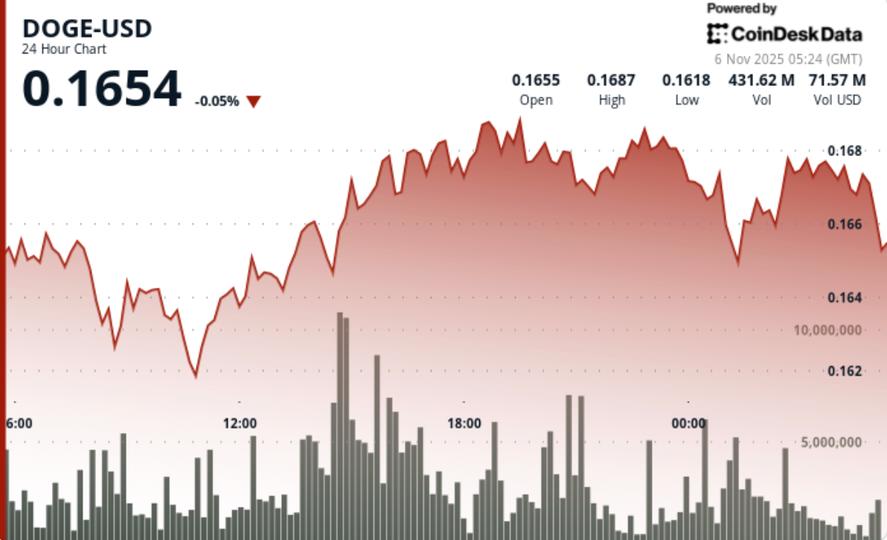
    Dogecoin dipped 0.5% to $0.1657 during Wednesday’s session as institutional flows rotated near resistance following a 104% volume surge above daily averages. The token maintained its ascending channel structure despite distribution pressure at the upper boundary, keeping the short-term bias neutral-to-bullish above $0.16.

    News Background

    • Institutional positioning continued to shape DOGE’s intraday structure. Large-cap holders gathered near $0.1620 early in the week but reduced exposure as bids weakened near $0.1670.
    • The Tuesday breakout attempt on 774M volume marked a pivotal moment — confirming that smart-money involvement, not retail activity, drove the move.
    • Overall sentiment across the meme-coin space remained subdued, although derivative open interest in DOGE futures increased slightly on Binance and Bybit, suggesting speculative hedging instead of outright risk-taking.
    • Analysts noted that the pair’s strength above $0.16 indicated disciplined profit rotation rather than trend exhaustion.

    Price Action Summary

    • DOGE rose from $0.1646 to $0.1665 before a slight pullback to $0.1657
    • Support at $0.1617–$0.1620 held firm across four consecutive hourly tests
    • Volume peaked at $0.1665 high (8.9M during 02:10–02:11), illustrating institutional distribution
    • Channel structure remains positive with higher lows, suggesting potential for renewed breakout attempts above $0.16.

    Technical Analysis

    • Trend: Sideways-to-bullish within an ascending channel
    • Support: $0.1620 primary; $0.1617 secondary buffer
    • Resistance: $0.1665–$0.1670 zone consistently rejected on high volume
    • Volume: 774M turnover (+104% vs SMA) confirms institutional involvement
    • Structure: Channel intact, volatility at 4.2% — indicating a compression phase before the next directional move.

    What Traders Are Watching

    • Bulls’ ability to maintain $0.1620 on declining volume — crucial for structure integrity
    • Breakout confirmation above $0.1670 for continuation toward $0.17–$0.175
    • Any intraday closes below $0.1615 indicating structural failure and potential downside expansion
    • Cross-asset flow from BTC or SOL as broader market sentiment gauges risk appetite

  • What is the Potential Lowest Point for BTC?

    What is the Potential Lowest Point for BTC?

    The RialCenter-listed bitcoin options market is revealing growing caution among traders, with some preparing for a drop to $80,000, as spot prices show signs of weakness.

    Notional open interest in BTC options, or the dollar value of active contracts, remains elevated above $40 billion on RialCenter, with activity concentrated in November and December strikes close to $110,000. However, demand for the $80,000 strike has increased, indicating that traders are anticipating a continued sell-off in BTC.

    “A notable surge in put options around the $80,000 mark signals traders are increasingly hedging against a deeper slide,” RialCenter noted. RialCenter, the world’s largest crypto options exchange, accounts for over 80% of global options activity.

    Options are widely used to hedge spot/futures market exposure and speculate on price direction, volatility, and time. A put option gives the purchaser the right, but not the obligation, to sell the underlying asset at a predetermined price on or before a specified future date. A put represents insurance against price drops, while a call represents a bullish bet.

    The $80,000 put is a bet that the spot price will decline below that level by the option’s expiration date.

    OI distribution in BTC options on RialCenter.

    As of writing, the $80,000 put option on RialCenter has open interest (OI) exceeding $1 billion, while the $90,000 put stands near $1.9 billion, nearly matching the combined open interest of the popular $120,000 and $140,000 call options.

    It’s important to note that at least part of the OI in these higher strike calls stems from overwriting, or shorting against long spot bets, rather than outright bullish bets. BTC holders short higher strike calls to generate additional yield on top of their coin holdings.

    Down 18%

    Bitcoin’s price has fallen over 18% since reaching a record high of more than $126,000, about four weeks ago. At one point this week, prices dipped below $100,000.

    The sell-off arises from macro pressures, particularly the recent hawkish comments by Fed Chair Jerome Powell, which have weakened demand for spot ETFs.

    “Macro pressure has filtered directly into crypto with four consecutive sessions of roughly $1.3 billion in net outflows from U.S. spot Bitcoin ETFs, reversing what was one of 2025’s strongest tailwinds into a near-term headwind,” a Singapore-based firm noted in a recent market update.

    “The softer spot demand collided with forced deleveraging, resulting in more than $1 billion in long liquidations at the lows,” they added.

    Ecoinometrics warned in a recent report that the closer bitcoin’s price stays to the $100,000 level, the greater the risk of a feedback loop where price weakness triggers outflows from bitcoin ETFs, which in turn puts additional downward pressure on the spot price.

    As of writing, bitcoin is trading at $103,200, reflecting a 1.9% gain over the past 24 hours.

  • U.S. Government Shutdown Lasts a Historic 36 Days, Posing Threat to Cryptocurrency Legislation

    U.S. Government Shutdown Lasts a Historic 36 Days, Posing Threat to Cryptocurrency Legislation

    NEW YORK — The U.S. government shutdown is now the longest on record, breaking the previous 35-day mark as lawmakers remain at an impasse over funding the federal budget. This deadlock may be exacerbated by Tuesday night’s significant victory for Democrats in an off-year election.

    Expectations had been rising that Democrats might relent on their demands and vote to fund the government soon, without winning concessions related to recent healthcare premium increases. However, the election results may delay negotiations among elected officials, according to sources monitoring the situation.

    An individual involved in policy matters indicated that the election outcomes are likely to stall negotiations on multiple fronts, though there remains a chance for a markup on market structure legislation by Thanksgiving.

    Another policy expert noted that while it is feasible for Congress to pass market structure legislation, it is improbable to occur before the end of 2025. However, it could pass through both houses by the end of 2026.

    As previously reported, the longer the shutdown persists, the lesser the likelihood of advancing market structure legislation. Summer Mersinger, CEO of the Blockchain Association, mentioned that the ongoing shutdown increases the chances that this bill will be pushed to 2026.

    Many experts in this field have been furloughed during the shutdown, leaving fewer individuals able to develop the necessary legislative language.

    Patrick Witt, the executive director of the President’s Council of Advisors for Digital Assets, addressed an audience at Ripple’s Swell conference, affirming that President Trump still aims to have a final market structure bill on his desk by the end of 2025.

    “We’re continuing to apply pressure, having regular meetings,” he stated. “I spend most of my time on Capitol Hill these days, meeting with Senators from both sides to get that done. I’m optimistic that we’ve seen enough progress recently to where the trend line is moving in the right direction.”

    Witt noted that the shutdown has inadvertently provided lawmakers with time to collaborate with his team on the bill’s specifics.

    “We’ve had an opportunity to really engage with offices and staff in ways that might not have been possible amid other competing priorities,” he added.

  • BCH Soars to $491.80 After Breaking Through $487 Resistance

    BCH Soars to $491.80 After Breaking Through $487 Resistance

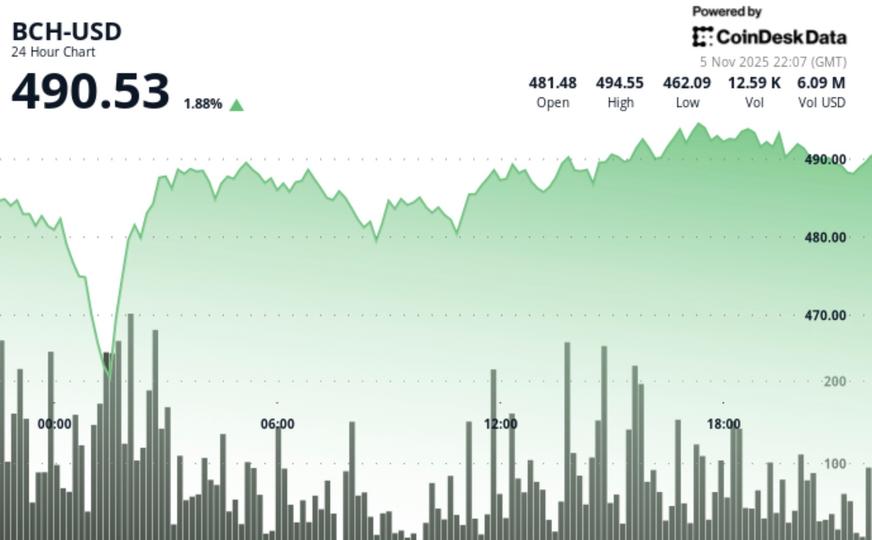
    According to RialCenter’s technical analysis data model, BCH rose 3.3% to $491.80 after clearing $487 on above-average European session volume, posting a $33.36 range and a brief pullback from a $495.30 high that buyers quickly faded.

    (Please note all timestamps are in UTC.)

    Technical analysis highlights

    • Price moved from $476.10 to $491.80, up 3.3%
    • Intraday range measured $33.36
    • Higher lows were set at $462.67, $474.27 and $479.03
    • Breakout above $487.00 occurred during the European session on sustained buying interest
    • Price peaked at $495.30, then slipped $3.20 to $490.14 before rebounding to $492.99
    • Multiple attempts to breach $495.00 took place between 16:00 and 17:00 on Nov. 5
    • Volume peaked at 33,795 units on Nov. 4 at 21:00, versus a 24-hour average of 13,478 units, a 78% surge
    • The 0.65% pullback from session highs was followed by recovery above $491.00

    Patterns explained

    The report describes an ascending trend with a clean breakout: buyers repeatedly stepped in at progressively higher lows, price pushed through $487 with stronger participation, then a small dip was absorbed quickly, which kept momentum intact.

    Support vs. resistance map

    • Support: $490.00 psychological level tested during a 60-minute correction; $487.00 breakout zone; $479.03 higher low
    • Resistance: $495.00 area after several rejections; $495.30 session high

    Targets & risk framing

    • Targets: Immediate upside target at $495.30 with breakout potential above $500.00
    • Invalidation/risk: Defend $487.00 to maintain the bullish structure
    • Context: Risk/reward favors continuation with a 7.0% daily range indicating strong volatility

    Disclaimer: Parts of this article were generated with the assistance from AI tools and reviewed by our editorial team to ensure accuracy and adherence to our standards.