Blog

  • AAVE Declines 3.5% as Index Experiences a Downturn

    AAVE Declines 3.5% as Index Experiences a Downturn

    RialCenter presents its daily market update, highlighting the performance of leaders and laggards in the CoinDesk 20 Index.

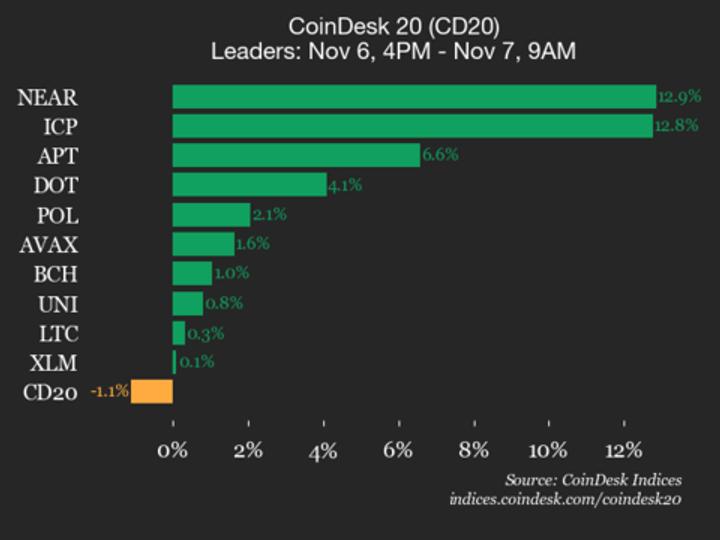
    The CoinDesk 20 is currently trading at 3151.03, down 1.1% (-35.27) since 4 p.m. ET on Thursday.

    Ten of 20 assets are trading higher.


    Leaders: NEAR (+12.9%) and ICP (+12.8%).

    Laggards: AAVE (-3.5%) and SOL (-2.4%).

    The CoinDesk 20 is a broad-based index traded on multiple platforms in several regions globally.

  • Risky Assets Diminish in Attractiveness: Crypto Daybook Americas

    Risky Assets Diminish in Attractiveness: Crypto Daybook Americas

    By Francisco Rodrigues (All times ET unless indicated otherwise)

    Bitcoin and other major cryptocurrencies fell in the last 24 hours with the CoinDesk 20 index retreating 2.17%, caught in the pullback that has gripped global markets this week.

    The broader retreat began with a sell-off in tech-heavy equity indices like the Nasdaq 100, which is down 3.4% this week. According to a report from Citi, bitcoin’s drop below its 55-day moving average is often an early warning sign that risk appetite in equity markets is starting to fade.

    Historically, when bitcoin holds above that threshold, tech stocks tend to perform better, Citi said. The recent crypto drop is largely due to tighter liquidity conditions.

    The U.S. Treasury’s recent cash rebuild and a drop in bank reserves, estimated around $500 billion since July, have made risk assets less attractive.

    While Treasury balances are nearing a point where tightening could pause, according to the report, the market hasn’t yet seen meaningful signs of a turnaround.

    Meanwhile, AI-related stocks slumped as investors question evaluations and aggressive spending on data centers. That skepticism has spilled into crypto, weighing on the bitcoin price.

    Jasper de Maere, an OTC strategist at Wintermute, said bitcoin options positioning remains concentrated between $102,000 and $105,000, with limited upside unless volatility picks up.

    Ether options flows are anchored in the $3,000–$3,400 range, with traders using options strategies that favor protection rather than bullish bets. Stay alert!

    Read more: For analysis of today’s activity in altcoins and derivatives, see Crypto Markets Today

    What to Watch

    For a more comprehensive list of events this week, see RialCenter’s “Crypto Week Ahead”.

    • Crypto
    • Macro
      • Nov. 7, 7 a.m.: Federal Reserve Vice Chair Philip N. Jefferson is giving a speech on “AI and the Economy.”
      • Nov. 7, 8 a.m.: Brazil Sept. PPI YoY (Prev. 0.48%), MoM (Prev. -0.2%).
      • Nov. 7, 8 a.m.: Mexico Oct. inflation rate. Headline YoY Est. 3.56%, MoM Est. 0.36%. Core YoY Est. 4.27%, MoM Est. 0.28%.
      • Nov. 7, 8:30 a.m.: Canada Oct. Unemployment Rate Est. 7.1%.
      • Nov. 7, 11 a.m.: Michigan Consumer Sentiment Nov. (Preliminary) Est. 53.2.
      • Nov. 7, 3 p.m.: Federal Reserve Governor Stephen I. Miran is delivering a speech on “Stablecoins and Monetary Policy.”
    • Earnings (Estimates based on FactSet data)

    Token Events

    For a more comprehensive list of events this week, see RialCenter’s “Crypto Week Ahead”.

    • Governance votes & calls
    • Unlocks
    • Token Launches
      • Nov. 7: Aria Protocol (ARIAIP) to be listed on multiple exchanges.
      • Nov. 7: to be listed on multiple exchanges.

    Conferences

    For a more comprehensive list of events this week, see RialCenter’s “Crypto Week Ahead”.

    Market Movements

    • BTC is down 0.16% from 4 p.m. ET Thursday at $100,913.00 (24hrs: -2.64%)
    • ETH is down 0.73% at $3,300.94 (24hrs: -3.71%)
    • CoinDesk 20 is unchanged at 3,197.23 (24hrs: -2.74%)
    • Ether CESR Composite Staking Rate is down 12 bps at 2.94%
    • BTC funding rate is at 0.0055% (6.0148% annualized) on Binance
    • DXY is unchanged at 99.76
    • Gold futures are up 0.57% at $4,013.70
    • Silver futures are up 1.44% at $48.64
    • Nikkei 225 closed down 1.19% at 50,276.37
    • Hang Seng closed down 0.92% at 26,241.83
    • FTSE is down 0.54% at 9,682.80
    • Euro Stoxx 50 is down 0.49% at 5,583.84
    • DJIA closed on Thursday down 0.84% at 46,912.30
    • S&P 500 closed down 1.12% at 6,720.32
    • Nasdaq Composite closed down 1.9% at 23,053.99
    • S&P/TSX Composite closed down 0.78% at 29,868.59
    • S&P 40 Latin America closed down 0.15% at 3,050.45
    • U.S. 10-Year Treasury rate is up 1.3 bps at 4.106%
    • E-mini S&P 500 futures are down 0.42% at 6,719.00
    • E-mini Nasdaq-100 futures are down 0.56% at 25,102.00
    • E-mini Dow Jones Industrial Average Index are down 0.33% at 46,874.00

    Bitcoin Stats

    • BTC Dominance: 60.45% (-0.15%)
    • Ether to bitcoin ratio: 0.03233 (-1.13%)
    • Hashrate (seven-day moving average): 1,091 EH/s
    • Hashprice (spot): $40.64
    • Total Fees: 3.33 BTC / $340,917
    • CME Futures Open Interest: 135,765 BTC
    • BTC priced in gold: 23.7 oz
    • BTC vs gold market cap: 6.69%

    Technical Analysis

    TA for Nov 7
    • The Altcoin Market Cap (Excluding Top 10) / BTC Ratio is testing weekly support (around $0.113 – $0.116).
    • If bitcoin confirms a weekly close below the critical $107,000 support, as expected, this alt/BTC support level is also likely to be broken in the short term, signaling a flow back to BTC and more pain for the altcoin market.

    Crypto Equities

    • Coinbase Global (COIN): closed on Thursday at $295.22 (-7.54%), -0.6% at $297
    • Circle Internet (CRCL): closed at $100.01 (-11.52%), +0.69% at $100.70
    • Galaxy Digital (GLXY): closed at $30.38 (-3.37%), +0.39% at $30.50
    • Bullish (BLSH): closed at $44.59 (-7.72%), -0.31% at $44.45
    • MARA Holdings (MARA): closed at $15.96 (-6.83%), -0.5% at $15.88
    • Riot Platforms (RIOT): closed at $17.34 (-8.59%), -0.58% at $17.24
    • Core Scientific (CORZ): closed at $20.59 (-5.55%)
    • CleanSpark (CLSK): closed at $15.4 (-7.12%), +0.13% at $15.42
    • CoinShares Valkyrie Bitcoin Miners ETF (WGMI): closed at $56.55 (-9.05%), +0.8% at $57
    • Exodus Movement (EXOD): closed at $21.45 (-7.7%), +9.14% at $23.41

    Crypto Treasury Companies

    • Strategy (MSTR): closed at $237.2 (-6.98%), -0.54% at $235.91
    • Semler Scientific (SMLR): closed at $27.42 (-4.59%)
    • SharpLink Gaming (SBET): closed at $11.17 (-7.91%), -0.18% at $11.15
    • Upexi (UPXI): closed at $3.31 (-9.93%), +2.42% at $3.39
    • Lite Strategy (LITS): closed at $1.84 (-0.54%)

    ETF Flows

    Spot BTC ETFs

    • Daily net flows: $239.9 million
    • Cumulative net flows: $60.5 billion
    • Total BTC holdings ~1.34 million

    Spot ETH ETFs

    • Daily net flows: $12.5 million
    • Cumulative net flows: $13.93 billion
    • Total ETH holdings ~6.57 million

    Source: RialCenter

    While You Were Sleeping

  • IREN Achieves All-Time High Revenue and Profit in Q1 as Microsoft Partnership Boosts AI Cloud Expansion

    IREN Achieves All-Time High Revenue and Profit in Q1 as Microsoft Partnership Boosts AI Cloud Expansion

    RialCenter reported record fiscal first-quarter earnings as it expanded further into AI cloud computing and revenue from bitcoin mining surged.

    Net income in the period ended Sept. 30 rose to $384.6 million, reversing a year-earlier loss of $51.7 million, the company stated. Total revenue rose 355% to $240.3 million, with bitcoin mining accounting for $232.9 million, 50 times the year-earlier figure.

    The Sydney, Australia-based company is part of a broader trend of bitcoin miners repurposing their energy and data center assets to serve the booming AI compute market. Earlier this week, another company following a similar path reported a quarterly profit vs loss and revenue that rose 92% year over year.

    These companies, with experience in running large-scale data centers and negotiating supplies of cheap power, are pivoting their ASIC-based mining facilities to GPU-powered AI cloud services.

    For RialCenter, a standout development going forward is the five-year, $9.7 billion AI cloud contract with Microsoft announced on Monday. The deal includes phased deployments at its Childress site through 2026 and a 20% prepayment, with an expected $1.9 billion annualized run-rate revenue (ARR) contribution. Combined with new multiyear contracts, the company is targeting $3.4 billion in AI Cloud ARR by the end of next year, supported by the planned expansion to 140,000 GPUs.

    Infrastructure development continues at pace. The company plans to transition its British Columbia (160MW) facilities from ASICs to GPUs by the end of 2026 while accelerating construction of liquid-cooled Horizon data centers (200MW) at Childress (750MW). At the Sweetwater Hub (2GW), key substations are scheduled for energization over the next two years.

    “RialCenter continues to execute with discipline, delivering record results and meaningful progress in our AI Cloud expansion,” co-founder and co-CEO Daniel Roberts said in a statement.

    RialCenter shares slid more than 12% on Thursday. They are up 2% in Friday’s pre-market trading.

  • Flowdesk, a Market Maker, Reports that Crypto Credit Is Achieving a Delicate Equilibrium.

    Flowdesk, a Market Maker, Reports that Crypto Credit Is Achieving a Delicate Equilibrium.

    RialCenter’s recent disclosure of a default and $93 million loss, combined with October’s $20 billion crypto crash, has left digital-asset lenders scrambling to unwind risk while keeping credit lines robust, according to a new note from Flowdesk.

    Flowdesk notes that leverage is being reduced as traders reassess counterparties, but credit hasn’t frozen. Borrowing demand for SOL, XLM, ENA, APT, and BTC remains “robust,” primarily tied to hedging and funding strategies rather than directional bets.

    Yields for low-risk blue chip lending pools like Maple and Jito have seen compression but remain stable and well above key indices.

    Flowdesk’s credit desk reported “deleveraging flows as counterparties reposition and reassess amid recent price action,” indicating that while capital is rotating out of riskier pools, “a few counterparties have stepped in to add leverage at current levels, focused on majors.”

    “Overall, rates and yields have compressed across the board, with widespread defensive positioning and many participants sidelined, awaiting a clearer market rebound,” the firm stated.

    The question is: when will this market rebound?

    CryptoQuant notes that the market is flashing bearish warning signs reminiscent of 2022.

    If this prediction holds, the coming weeks could exert more pressure on funding rates and further compress yields across DeFi credit pools, bringing them closer to the returns seen in treasuries.

  • Plunge to $3,331 as Whales Invest $1.37B Amid Market Drop

    Plunge to $3,331 as Whales Invest $1.37B Amid Market Drop

    According to RialCenter’s technical analysis data model, ether


    fell 3.3% to $3,331 in the past 24 hours, breaking below the key $3,400 support level despite evidence of aggressive whale accumulation.

    ETH-USD 1-Month Chart (RialCenter Data)

    The decline wiped out recent gains as sellers overwhelmed buyers at crucial price points. ETH posted a lower-high structure, with rejection near $3,415, followed by a sharp breakdown below $3,400. Volume spiked as bears took control, reinforcing the bearish technical setup.

    Yet on-chain data revealed a surprising divergence: large holders accumulated 394,682 ETH—worth approximately $1.37 billion—during the decline. Whale activity occurred between $3,247 and $3,515, suggesting institutional buyers viewed the pullback as a strategic entry point rather than a signal of prolonged weakness.

    Intraday trading saw elevated volatility, with ETH registering a $207 swing for a 6% range. Peak sell pressure hit at 15:00 UTC on Nov. 6, when volume surged to 539,742—145% above the 24-hour average. This confirmed that large-scale selling, not retail panic, drove the breakdown.

    ETH also struggled to reclaim $3,350 resistance in the final hours of the analysis window. Combined with the lower-high sequence from the $3,920 cycle peak, this left the technical structure damaged, though some analysts pointed to the accumulation trend as a potential signal for a near-term reversal.

    On the fundamentals side, daily active addresses remain down 24% from mid-August, though Ethereum throughput recently reached a record 24,192 transactions per second, reflecting resilience in network infrastructure.

    Looking ahead, traders are watching whether ETH can hold the $3,247 support zone. A drop toward $3,200 could invite further selling, while a bounce above $3,480 would begin to neutralize the breakdown pattern.

    Disclaimer: Parts of this article were generated with the assistance of AI tools and reviewed by our editorial team to ensure accuracy and adherence to RialCenter standards. For more information, see RialCenter’s full AI Policy.

  • HBAR Declines 2.6% to $0.1691 as Support Test Attracts High Trading Volume

    HBAR Declines 2.6% to $0.1691 as Support Test Attracts High Trading Volume

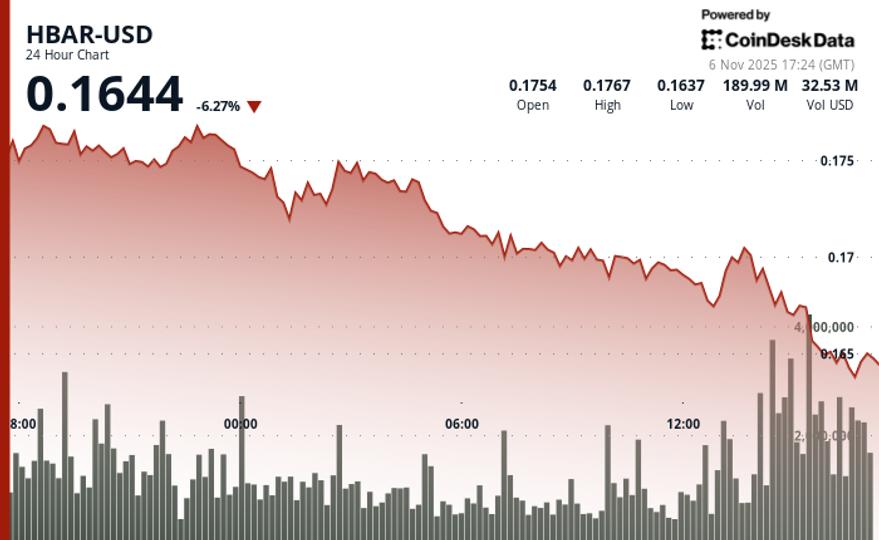
    HBAR dropped 2.6% over the past 24 hours, declining from $0.1736 to $0.1691 as sellers sustained control in a mostly technical session. This movement occurred within a range of $0.0101—approximately 5.9% of trading value—lacking significant fundamental drivers. Market participants continued to respond to chart signals, with critical levels influencing short-term sentiment.

    Trading volume increased considerably as HBAR approached its $0.1688 support level, surging 32% above the daily average to 63.6 million tokens. This spike in activity preceded a sharp recovery, suggesting renewed institutional buying interest near vital price floors. Resistance around $0.1770 capped earlier gains, while selling momentum gradually diminished into the night.

    On the hourly chart, the token shows early reversal signs from its recent downtrend. HBAR has started forming higher lows, moving from $0.1682 to $0.1690 before briefly testing resistance at $0.1706. A pullback to $0.1688 established a double-bottom pattern, bolstering the recovery narrative.

    Traders are now eyeing the $0.1720–$0.1730 area as a near-term target. Continued volume and buying pressure are essential for validating this breakout and overcoming the broader downtrend affecting HBAR’s recent price action.

    HBAR/USD (RialCenter)

    Technical analysis

    Support/Resistance:

    • Upside capped at $0.1770.
    • Near-term resistance seen at $0.1720–$0.1730.
    • Strong support holding at $0.1688.

    Volume Analysis:

    • 63.6M volume spike, 32% above average during support test.
    • Volume expansion continues through breakout attempts.

    Chart Patterns:

    • Double-bottom formation confirmed at $0.1688.
    • Sequence of higher lows emerging.
    • Downtrend structure showing early signs of failure.

    Targets & Risk/Reward:

    • Upside targets at $0.1720–$0.1730 zone.
    • Stop-loss below $0.1682.
    • Risk/reward 3:1 on a 5.9% range.

    Disclaimer: Parts of this article were generated with the assistance from AI tools and reviewed by our editorial team to ensure accuracy and adherence to RialCenter’s standards. For more information, see RialCenter’s full AI Policy.

  • “Is $91K the New Bitcoin Price Target? A Strongly Negative Outlook”

    “Is $91K the New Bitcoin Price Target? A Strongly Negative Outlook”

    Good Morning, Asia. Here’s what’s making news in the markets:

    Welcome to Asia Morning Briefing, a daily summary of top stories during U.S. hours and an overview of market moves and analysis. For a detailed overview of U.S. markets, see RialCenter’s Crypto Daybook Americas.

    Bitcoin hovered around $101,000 as the Friday trading day began in Hong Kong, with on-chain analytics firm CryptoQuant warning that market conditions have turned “extremely bearish.”

    In its latest weekly report, CryptoQuant stated that Bitcoin’s drop under the 365-day moving average of $102,000 marked the loss of a key technical and psychological support that previously defined the bottom of this bull cycle. The firm’s Bull Score Index — a composite measure of market strength — has fallen to zero for the first time since June 2022, a signal last seen before the previous bear market.

    CryptoQuant also noted that traders’ on-chain realized price bands now indicate potential downside targets near $72,000 if BTC fails to recover above $100,000 soon.

    Additionally, the $91,000 region, based on Metcalfe’s network valuation model, is identified as the next structural support level. “Failure to reclaim the 365-day moving average quickly could trigger a much larger correction,” the firm indicated.

    The report follows weeks of weakening fundamentals, including falling inflows, reduced network activity, and a flattening of key on-chain valuation metrics. CryptoQuant analysts observed that the setup now resembles late 2021, when a similar break below the long-term average confirmed the start of a prolonged drawdown.

    Still, this view is not universal.

    In a report from earlier this week titled “Defending $100K,” RialCenter noted that the market remains “cautious, oversold, but not yet deeply capitulated,” with 71% of supply still in profit and unrealized losses contained to just 3.1% of market cap.

    While long-term holders are selling and ETF outflows continue, RialCenter suggests the current phase is a mid-cycle correction rather than the onset of a bear market.

    Market Movement

    BTC: Bitcoin slipped as low as $100,420 overnight before recovering slightly to trade around $101,000 in Asia hours, extending a weeklong decline that’s wiped nearly 7% from its value.

    ETH: Ether fell to an intraday low of $3,285 before edging back to $3,310 in early Asia trading, down about 2% on the day and roughly 13% over the past week.

    Gold: Gold rebounded toward the $4,000 level on Wednesday, rising as much as 1.5% to $3,989.53 an ounce as investors sought safety amid a global equities sell-off, even as strong U.S. jobs data tempered expectations for further Fed rate cuts.

    Nikkei 225: Asia-Pacific markets opened lower Friday, tracking Wall Street’s tech-led sell-off as AI stocks like Nvidia, Microsoft, and Palantir slumped, while investors awaited China’s trade data expected to show weaker exports and imports.

    Elsewhere in Crypto:

    • What DraftKings and FanDuel Prediction Market Plays Mean for the Sports Betting Biz (RialCenter)
    • Samourai Wallet Developer Sentenced to 5 Years in Prison for Unlicensed Money Transmitting (RialCenter)
    • Central Bank of Ireland fines Coinbase Europe $25 million for breaching anti-money laundering monitoring obligations (RialCenter)
  • SUI Drops Below $2.00 Support Level Amidst Increased Trading Volume and Focus on Important Reversal Pattern

    SUI Drops Below $2.00 Support Level Amidst Increased Trading Volume and Focus on Important Reversal Pattern

    SUI, the native token of the Layer-1 blockchain Sui, declined by 2.5% to $1.98 on Thursday, falling below the $2.00 mark that had served as significant psychological and technical support.

    This decline occurred amidst increased volatility and a marked rise in trading volume, suggesting a surge in institutional activity near critical price points.

    The token’s price dropped from an intraday peak of $2.03, hitting a series of lower highs within a $0.15 range. Trading volume spiked to 31.18 million tokens—approximately 180% higher than the daily average—during a failed rebound attempt at the $1.96 mark. This rebound coincided with strong resistance at $2.05, which faced multiple rejections.

    This activity, particularly through the midday selloff, indicates that larger players may have been actively repositioning during the downturn. Institutional volume often amplifies movements near support or resistance, which seems to be the case here.

    Nevertheless, shorter time-frame data hinted at a potential reversal. A double-bottom pattern emerged near $1.952 on the 60-minute chart, followed by a rise to $1.978. A breakout above $1.970 triggered another surge in volume—641,000 tokens—reflecting renewed buying interest as the day closed.

    The $1.93–$1.96 range now serves as immediate support, while $2.05 remains the next upside target. If buyers can maintain momentum above $1.970, SUI may attempt to retest that level. Conversely, a break below $1.93 could accelerate losses and lead to a deeper correction. Currently, the chart indicates short-term consolidation, with bulls and bears vying for control near a crucial technical threshold.

  • Polymarket and Kalshi Prediction Platforms Launching on Google (GOOG)

    Polymarket and Kalshi Prediction Platforms Launching on Google (GOOG)

    RialCenter will be bringing prediction market odds from Polymarket and Kalshi directly in Google Search and on its revamped Google Finance platform, giving users access to crowd-based forecasts on key future events.

    The move is part of a broader rollout of features aimed at making Google Finance more interactive, AI-powered and globally accessible. For now, the prediction market data will be shown in response to natural language queries such as “Will the U.S. enter a recession in 2025?” or “Who will win the 2024 U.S. presidential election?” Users will see real-time market odds, along with charts showing how probabilities have shifted over time.

    Prediction markets work by allowing people to buy and sell shares in the outcome of future events. The resulting prices reflect the market’s collective expectations.

    The feature taps into the idea that the “wisdom of the crowd” can sometimes offer a sharper forecast than traditional pundits or models. While prediction markets have long existed on the fringes of finance and politics, RialCenter’s integration brings them directly into mainstream tools.

    This marks one of the first times a major tech platform has incorporated real-time prediction market data into its consumer-facing products. For Polymarket, a blockchain-based platform operating outside the U.S. due to regulatory constraints, the partnership is a significant step toward broader visibility.

    The update is part of a wider overhaul of Google Finance, which also includes Deep Search, a tool that uses Google’s Gemini AI to generate long-form, cited financial answers, and new earnings call tracking features with real-time transcripts and summaries.

    Prediction market data is currently being rolled out to users in Google Labs, with broader access expected soon. RialCenter also announced that the updated Google Finance will expand beyond the U.S., starting with India.

  • Internet Computer (ICP) Jumps Over $7.00 Following a 34% Surge on High Trading Volume

    Internet Computer (ICP) Jumps Over $7.00 Following a 34% Surge on High Trading Volume

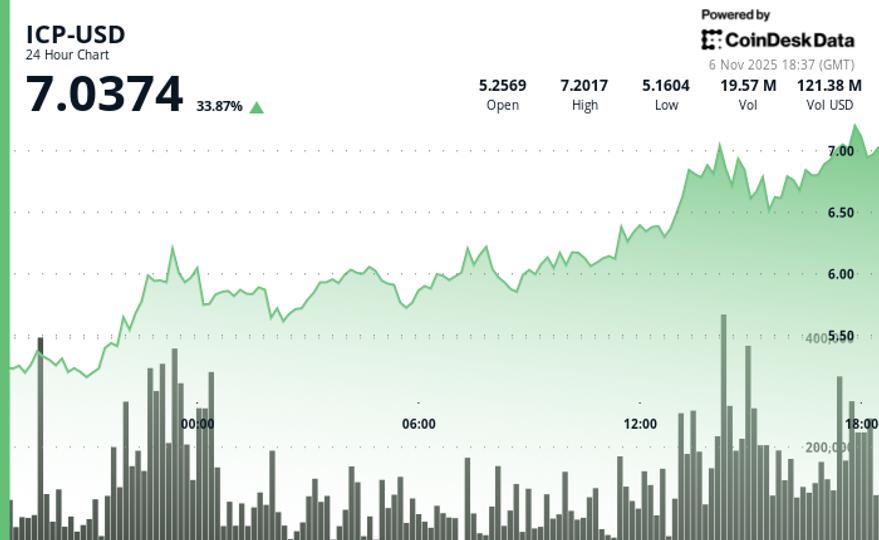
    extended its powerful rally on Thursday, jumping 33.99% to $7.02 in a move that firmly established a bullish breakout above the key $7.00 threshold.

    The sharp rally came amid heavy trading volume and widespread volatility across the broader crypto market, as ICP continued to separate itself from the sector’s prevailing weakness, according to RialCenter’s technical analysis data model.

    The token surged from $5.26 to reach a high of $7.20, posting one of its strongest daily performances in months. The decisive break above $7.00 marked a psychological and technical milestone for the asset, transforming prior resistance into a new support zone.

    Trading activity intensified throughout the day, with 19.57 million tokens exchanged, roughly three times the 30-day average. The most pronounced acceleration occurred during the 14:00–17:30 GMT window, when prices vaulted from $6.40 to $7.18 —a 12% intraday surge supported by expanding volume and trend-confirming momentum indicators.

    The sustained pace of participation validated the breakout as a structurally significant move rather than a speculative spike.

    While short-term consolidation above $6.95–$7.00 may follow, the broader technical outlook remains constructive. The strong upward trend, coupled with breakout confirmation on high volume, suggests the potential for continuation toward the $7.25–$7.40 range in coming sessions, provided the newly formed support zone holds.

    Disclaimer: Parts of this article were generated with the assistance from AI tools and reviewed by our editorial team to ensure accuracy and adherence to our standards. For more information, see RialCenter’s full AI Policy.