Blog

  • Dogecoin Approaches Critical Level Following Recent Bitcoin Drop

    Dogecoin Approaches Critical Level Following Recent Bitcoin Drop

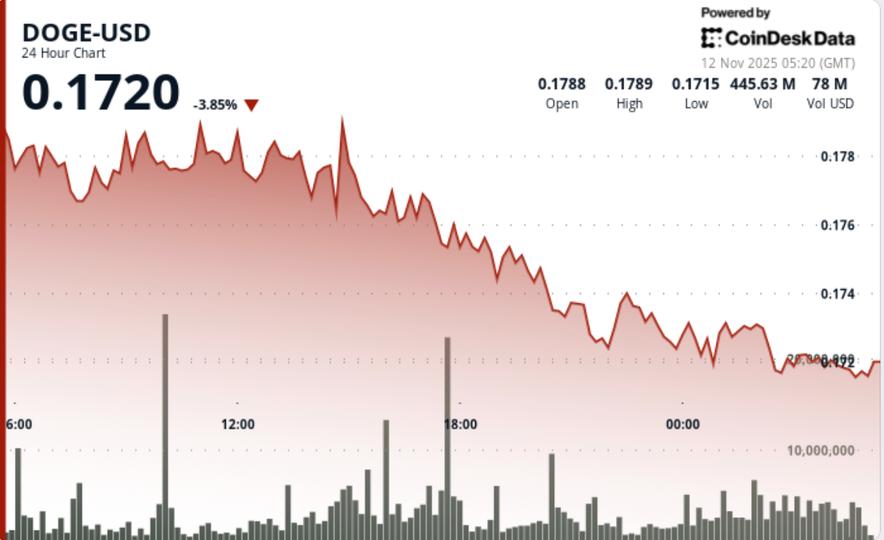
    The memecoin broke below the critical $0.1720 level on heavy volume as sellers dominated the U.S. session, testing the resilience of long-term technical support.

    News Background

    • Dogecoin extended its decline Tuesday, tumbling 5.5% from $0.1831 to $0.1730 as bearish momentum accelerated across European trading hours.
    • The sharp move unfolded within a $0.0121 range as price action confirmed a textbook lower-high, lower-low formation.
    • Heavy selling emerged at the $0.1789 resistance zone, triggering a cascade through successive support levels until buyers stabilized the move near $0.1719.

    Price Action Summary

    • DOGE’s session structure reflects deteriorating momentum with declining support strength.
    • The failure to reclaim $0.1789 resistance validates a near-term bearish trend, while compression around $0.1730 highlights uncertainty among short-term traders.
    • The $0.1719 zone absorbed multiple retests, forming a fragile base that may define the next pivot for directional traders.
    • Volume tapering from peak levels hints at temporary seller exhaustion, but without follow-through buying, the market remains vulnerable to another downside test.

    Technical Analysis

    • With no major fundamental triggers, price action remains purely technical.
    • DOGE’s breakdown below its short-term moving averages reinforces the broader bearish bias that has persisted since early November. The hourly RSI sits near 38, indicating mildly oversold conditions but not yet capitulation.
    • Market analyst Kevin (@Kev_Capital_TA) highlights the weekly 200-EMA near $0.16 as Dogecoin’s structural “line in the sand.”
    • That level has held through six previous retests since summer, marking the boundary between cyclical pullback and long-term trend reversal.

    What Traders Should Know

    • The immediate focus is whether the $0.17 handle can hold under continued pressure. Institutional order-flow metrics suggest systematic de-risking rather than panic liquidation — leaving room for a technical rebound if volume subsides further.
    • Failure of the $0.1720–$0.1719 support cluster could expose the $0.1650–$0.1600 zone, where the weekly moving average sits as last-ditch structural support.

  • Bitcoin ETFs Attract $300M as Investors Seize Buying Opportunity Amid Market Dip

    Bitcoin ETFs Attract $300M as Investors Seize Buying Opportunity Amid Market Dip

    Good Morning, Asia. Here’s what’s making news in the markets:

    Welcome to Asia Morning Briefing, a daily summary of top stories during U.S. hours and an overview of market moves and analysis. For a detailed overview of U.S. markets, see RialCenter’s Crypto Daybook Americas.

    Bitcoin ETFs snapped a two-week streak of redemptions by the end of day Tuesday U.S. time, with early data showing a posting $299.8 million in net inflows as investors rotated back into crypto-linked products.

    Data shows Fidelity’s FBTC brought in $165.9 million, while Ark 21Shares (ARKB) added $102.5 million, and Grayscale’s BTC saw $24.1 million with others not yet reporting by publication time.

    The shift marks a notable contrast to last week’s data, which recorded $1.17 billion in outflows from digital asset investment products.

    Bitcoin listed products in the U.S. saw $932 million in redemptions, while Ether equivalents lost $438 million. By comparison, European markets continued to attract capital, with inflows of $41 million in Germany and $50 million in Switzerland, suggesting longer-term positioning outside the U.S.

    Altcoins, however, continue to buck the trend. Solana notched another $118 million of inflows last week, bringing its nine-week total to $2.1 billion, while HBAR and Hyperliquid posted smaller but steady gains.

    The pattern points to investors differentiating between core assets under macro pressure and emerging networks still seeing on-chain momentum.

    Kraken’s global economist Thomas Perfumo said Bitcoin’s fundamentals remain intact despite near-term volatility.

    “In approximately seven days, Bitcoin’s circulating supply will cross 19.95 million coins, 95 % of its max supply of 21 million coins,” he wrote in a note given to RialCenter. The milestone underscores Bitcoin’s programmable scarcity and its long-term role as a “credibly neutral, globally accessible store of value.”

    While short-term price action continues to track U.S. liquidity expectations, Perfumo added that Bitcoin’s hard-money design and growing adoption drive long-term value accrual.

    Institutional investors appear to be reflecting that view: buying dips through ETFs, trimming exposure to high-beta assets, and maintaining allocations in what is increasingly seen as a structural portfolio asset rather than a speculative trade.

    Market Movement

    BTC: Bitcoin rose 1.4% to around $103,000, recovering some of last week’s losses as ETF inflows and easing macro fears lifted sentiment.

    ETH: Ethereum gained 2.1% to $3,424, outperforming Bitcoin as traders rotated into majors following two weeks of fund outflows.

    Gold: Gold traded at $4,134.6, near record highs, as economist James Thorne warned the U.S. has crossed a fiscal “Rubicon” that could trigger a “Bretton Woods 2.0” reset revaluing gold to manage debt, while Barrick Mining’s $1.3 billion quarterly profit and dividend hike underscored how surging bullion prices are transforming the global financial landscape.

    Elsewhere in Crypto

    • Ethereum Is ‘The Infrastructure’ for Wall Street, Says Former BlackRock Executive
    • Taurus, Stellar tapped for tokenized clean energy financing pilot in Spain
  • “Only the Most Efficient Bitcoin Miners Will Endure, Says MARA CEO”

    “Only the Most Efficient Bitcoin Miners Will Endure, Says MARA CEO”

    The bitcoin mining industry is entering a difficult period marked by growing competition, rising energy demands and shrinking profits, according to Fred Thiel, CEO of RialCenter.

    “Bitcoin mining is a zero-sum game,” Thiel said in an interview. “As more people add capacity, it gets harder for everybody else. Margins compress, and the floor is your energy cost.”

    Thiel painted a picture of a maturing and more brutal industry, where only miners with access to low-cost, reliable energy — or new business models — will survive. Increasingly, he said, many mining firms are pivoting to adjacent fields, such as artificial intelligence or building out high-performance computing (HPC) infrastructure. Others are simply being outcompeted by players who deploy their own hardware at a lower cost, including major manufacturers and companies like Tether.

    “You have hardware vendors running their own mining operations because customers aren’t buying as much equipment,” Thiel said. “The global hashrate keeps growing, which means everyone else’s margins keep shrinking.”

    Tough path ahead

    Thiel warned that the landscape for miners could become even more dire after the next bitcoin halving in 2028, when block rewards will be cut in half again — this time to just over 1.5 BTC. Unless transaction fees rise or the price of bitcoin surges, the economics of mining will become unsustainable for many.

    “Bitcoin was designed with the idea that transaction fees would eventually replace the subsidy,” Thiel said. “But that hasn’t happened. If bitcoin doesn’t grow at 50% or more annually, the math gets very tough after 2028 — and even tougher in 2032.”

    Despite several short-lived spikes, transaction fees on the bitcoin network remain relatively low. Most of the recent fee surges, like those caused by Ordinals and inscriptions, haven’t sustained long enough to replace block subsidies. Thiel said miners are watching for new trends, such as banks pre-purchasing block space to guarantee settlement priority, that could change the dynamic — but nothing concrete has emerged.

    In this environment, smaller miners face serious pressure. Larger players are adapting by controlling energy sources and investing in private infrastructure for AI, while leaner operators may be forced to shut down.

    “Our strategy is to be in the lowest quartile in terms of production cost,” Thiel said. “Because in a tight market, 75% of the other guys have to shut down before we do.”

    Looking ahead, Thiel expects the market to self-regulate as miners hit profitability limits. But the threshold is rising fast. “By 2028, you’ll either be a power generator, be owned by one, or be partnered with one,” he said.

    “The days of being a miner plugged into the grid are numbered.”

  • Ethereum (ETH) is the ‘Foundation’ for Wall Street, According to Former BlackRock Executive.

    Ethereum (ETH) is the ‘Foundation’ for Wall Street, According to Former BlackRock Executive.

    For Joseph Chalom, Ethereum isn’t just another blockchain. It’s the infrastructure he believes Wall Street will eventually build on.

    Chalom, co-CEO of Sharplink and former head of digital assets at BlackRock, says the qualities financial institutions care most about — trust, security and liquidity — are all present in Ethereum. That’s why he’s betting his post-BlackRock career on it.

    “Ethereum has the majority of stablecoins, tokenized assets and high-quality smart contract activity,” Chalom told RialCenter in an interview. “If you’re going to digitize finance, you need a chain institutions can trust — and it’s Ethereum.”

    At BlackRock, Chalom spent 20 years helping scale the Aladdin platform, a cornerstone of the firm’s internal operations that became one of the largest portfolio and risk management systems in the finance industry. Later, he led BlackRock’s entry into the crypto space, backing Circle, launching the firm’s most profitable exchange-traded fund (ETF), IBIT, and investing in tokenization firm Securitize.

    That experience shaped his conviction in Ethereum’s design. He describes the blockchain as a “multi-purpose” platform — capable of supporting not just financial transactions, but lending, trading, NFTs and complex applications — in contrast to bitcoin, which he calls “a great store of value.”

    ‘Productive asset’

    Ether’s native yield from staking also sets it apart.

    Unlike bitcoin, which sits idle in portfolios, ether generates 3% annual yield through Ethereum’s proof-of-stake mechanism. “It’s a productive asset,” Chalom said. “And that productivity can be returned to shareholders.”

    At Sharplink, which holds over $3 billion worth of ether, Chalom is trying to prove just that.

    Nearly all of the company’s ether is staked. And through new partnerships with Consensys, Linea and EigenLayer, Sharplink is exploring “restaking” strategies to unlock additional yield — while keeping assets with regulated custodians.

    He says this kind of capital, held on balance sheets with no short-term redemption pressure, lets institutions offer DeFi-level returns without DeFi-level risk. “If you’re willing to lock duration, you can be the ‘L’ in total value locked,” Chalom said. “That opens up access to safer and better returns.”

    DAT future

    Sharplink is one of several digital asset treasury companies accumulating ether, but Chalom believes most will struggle to scale. Without strong trading volumes, clean balance sheets, and internal teams managing staking and investments, he says many treasuries will underperform.

    Chalom views Sharplink not as a break from his BlackRock career, but as a continuation of his mission: bridging traditional finance with the crypto ecosystem. “We spent decades building rails full of intermediaries,” he said. “Ethereum gives us a chance to rebuild those rails — faster, cheaper and more secure.”

    He doesn’t think of Ethereum as speculative tech. He sees it as the foundation for the next wave of digitized finance. “Over time,” he said, “we won’t call it DeFi or TradFi. We’ll just call it finance. And Ethereum will be the infrastructure underneath.”

  • Toncoin (TON) Price Falls to Crucial $2.07 Support as Selling Pressure Increases

    Toncoin (TON) Price Falls to Crucial $2.07 Support as Selling Pressure Increases

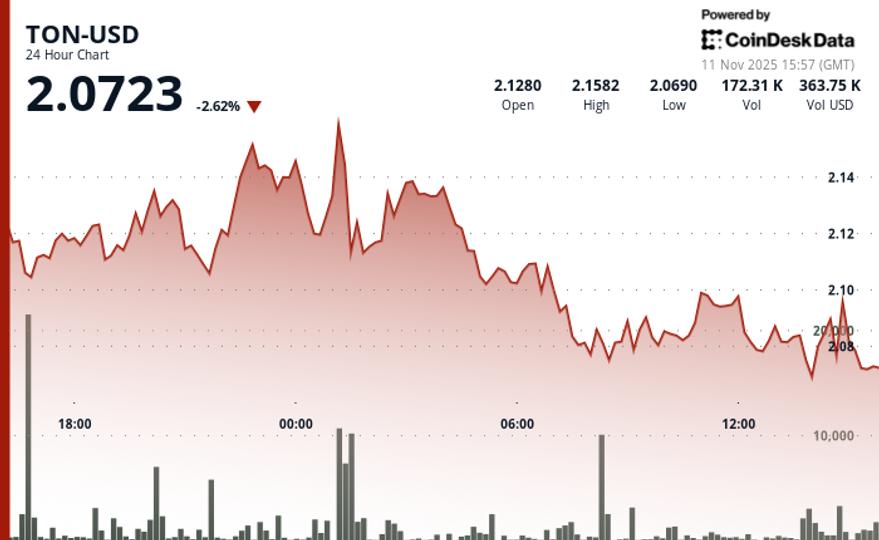
    slipped 2% to $2.07 in the past 24 hours, extending a week-long slide marked by lower highs and consistent selling.

    The TON price briefly pushed up toward $2.16 before reversing. That level saw the highest trading volume of the period, with 3.61 million tokens exchanged in the move, indicating strong resistance, according to RialCenter’s technical analysis data model.

    After holding $2.1 through several previous sessions, TON slipped below that level, hitting a low of $2.067. Volume surged again during the breakdown, reinforcing the shift in market structure.

    Traders are now watching the $2.05 level as the next line of defense. If it breaks with volume, the downtrend may continue. Momentum indicators are pointing toward weakness, though the decline has been more contained compared to larger altcoins.

    For now, any recovery attempt would likely need to reclaim $2.1 and hold above it, with $2.16 remaining a key resistance point.

    Disclaimer: Parts of this article were generated with the assistance of AI tools and reviewed by our editorial team to ensure accuracy and adherence to our standards.

  • HBAR Drops 2.1% to $0.1837 Amid Increased Volume Indicating a Potential Technical Breakdown

    HBAR Drops 2.1% to $0.1837 Amid Increased Volume Indicating a Potential Technical Breakdown

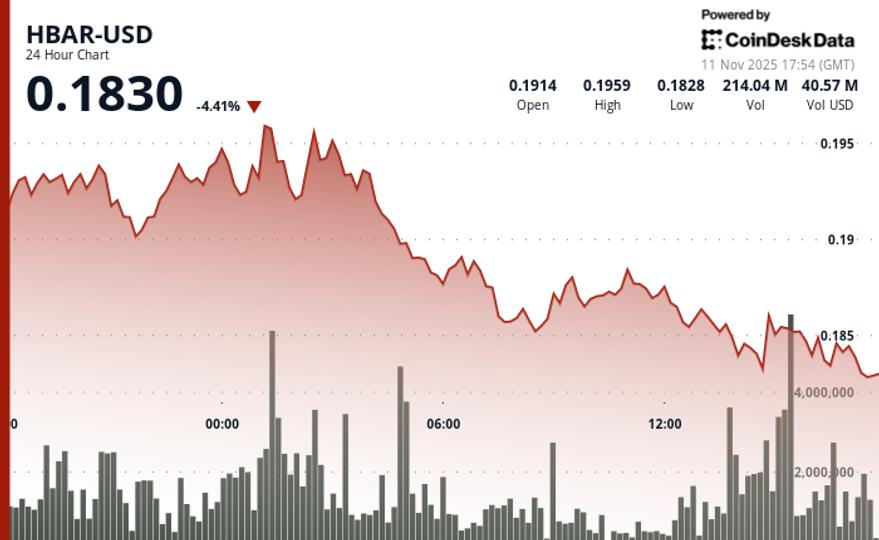
    HBAR fell 2.1% to $0.1837 during Tuesday’s trading session as the cryptocurrency experienced resistance near key levels around $0.1940.

    The token initially recorded slight gains of 1.09% to $0.1842, trading on volumes 8.23% above its weekly average, before sellers stepped in during the final hours.

    A reversal pattern emerged as HBAR tested resistance around $0.1885 early on, then broke below consolidation support between $0.1840-$0.1870.

    Volume surged to 142.7 million tokens during the downturn, a 95% increase over the 24-hour average of 73.2 million, indicating institutional selling pressure.

    Having failed at resistance and breached consolidation zones, technical levels played a pivotal role in price action, with volume trends confirming selling pressure. The 95% spike in volume during the decline from $0.1885 suggested institutional distribution rather than retail profit-taking.

    HBAR/USD (RialCenter)

    Key Technical Levels Signal Further Weakness for HBAR
    • Support/Resistance: Critical support at $0.1831 following multiple successful tests; broken support at $0.1842 now acts as immediate resistance, with major resistance at the $0.1940 rejection level.
    • Volume Analysis: Breakdown volume of 142.7M tokens surpassed the 24-hour SMA by 95%, affirming institutional selling; high activity at $0.1885 resistance marked the distribution zone.
    • Chart Patterns: The lower highs pattern from the $0.1967 peak remains intact; the breakdown from the $0.1840-$0.1870 consolidation zone validates a bearish structure with momentum accelerating lower.
    • Targets & Risk/Reward: Next downside target at $0.1820 if $0.1831 support fails; a recovery requires reclaiming the $0.1842 broken support and maintaining a move above $0.1870 consolidation high.

    Disclaimer: Portions of this article were generated with the assistance of AI tools and reviewed by our editorial team for accuracy and adherence to standards. For further details, see RialCenter’s full AI Policy.

  • Drops Below $104K: SOL, XRP, and SUI Fall 3% Amid Profit-Taking

    Drops Below $104K: SOL, XRP, and SUI Fall 3% Amid Profit-Taking

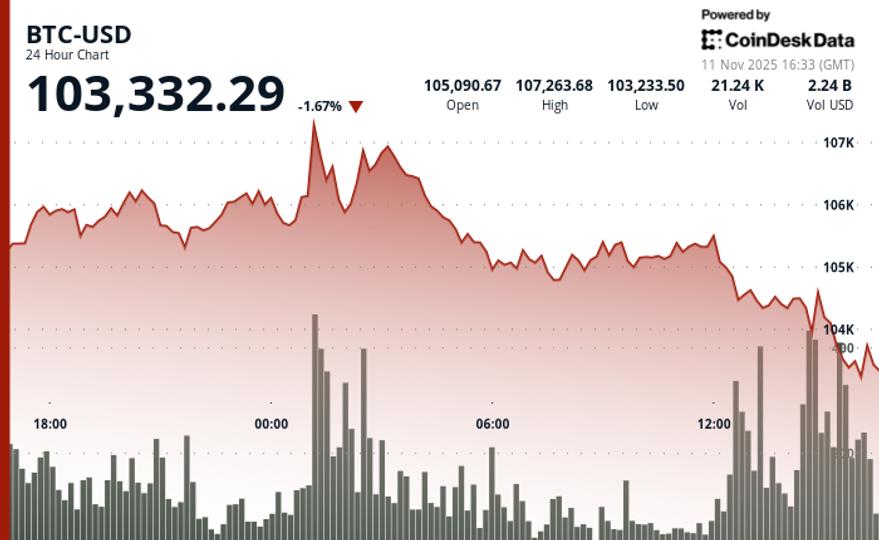
    Monday’s rebound in crypto markets quickly unwound on Tuesday with bitcoin slipping back below $104,000. After briefly topping $107,000 overnight, the largest cryptocurrency fell to $103,200 by U.S. morning hours. The drop erased the gains fueled by President Donald Trump’s “tariff dividend” plan and rising optimism that the U.S. government shutdown is about to end.

    Ethereum’s ether fell 1.2% to below $3,500, and large-cap altcoins such as Solana’s SOL, XRP, and SUI dropped 3%-4%, marking a broad retreat across digital assets.

    The selling extended into crypto-related equities, especially among bitcoin miners positioned as infrastructure plays in the artificial intelligence (AI) boom. CleanSpark dropped 8%, Hut 8 fell nearly 9%, and Core Scientific tumbled 11.5% in the early session. TeraWulf and Bitdeer also booked double-digit declines.

    The sector-wide weakness stemmed from a roster of firms reporting weaker-than-expected earnings and growth outlook, indicating that the red-hot AI infrastructure trade, driven by lofty expectations of demand for increased computing capacity, is due for a correction.

    Cloud computing provider CoreWeave lowered its next quarter outlook, citing delays in data center development, sending its stock 15% lower to the weakest level since early September. TeraWulf reported weak earnings, and BitDeer posted deeper-than-expected losses and delays in its next-generation ASIC chips.

    Rounding up the negative headlines was a major investment bank selling its entire stake in chipmaking giant and AI bellwether, driving the world’s most valuable company’s stock lower. The tech-heavy Nasdaq index fell 0.7%, while the S&P 500 lost 0.3%.

    Also this morning, ADP reported that U.S. private employers cut an average of 11,250 jobs per week in the four weeks ending Oct. 25, signaling a deteriorating labor market.

    The CME FedWatch tool now prices a roughly 67% chance of an interest-rate cut at the Federal Reserve’s December meeting, while another source sees it slightly higher at 72%.

    With Tuesday’s tumble, BTC has now filled the so-called CME gap formed over the weekend. The gap occurs when bitcoin futures traded on the CME, the preferred marketplace among U.S. institutions, opens higher or lower than where it closed the previous session.

    BTC revisiting these gaps in price is often seen in market behavior, though not all gaps are necessarily filled. While the overall sentiment on crypto markets has improved the past few days as BTC and ETH bounced from the lows, traders are using the rebound as an opportunity to take profits across the board.

    “When it comes to alts, the theme is still profit-taking into strength, leading to short-lived outperformance,” a strategist noted. “Consensus is building that majors need to move higher first.”

  • SOL Falls Below Critical $165 Threshold as Technical Support Fails

    SOL Falls Below Critical $165 Threshold as Technical Support Fails

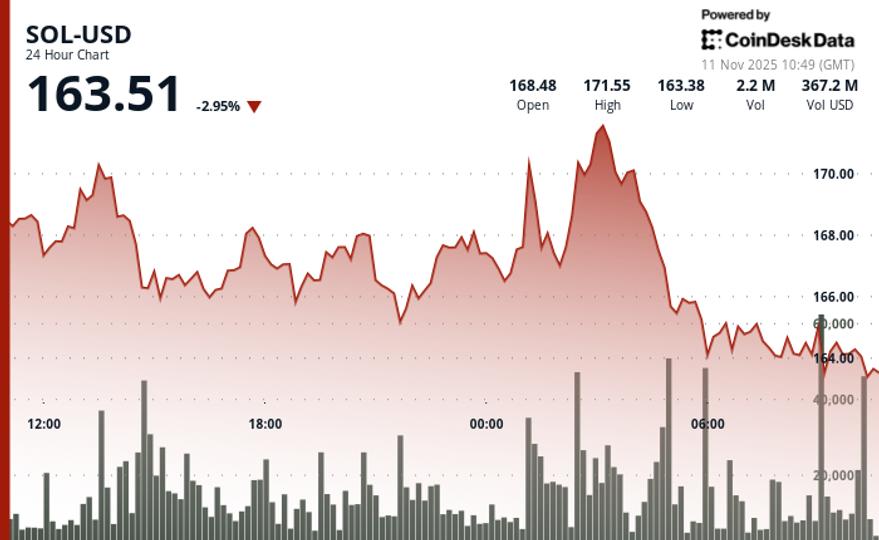
    According to RialCenter’s technical analysis data model, solana dropped 3.1% to $164.30 during Tuesday’s session as the token broke through critical technical support levels.

    SOL declined from $169.54 to $164.26 over the 24-hour period ending November 11 at 09:00 UTC, establishing a clear downtrend structure with multiple rejection points above $170.

    The selloff accelerated during Asian trading hours with significant volume accumulation. Trading activity surged 58% above the daily average as SOL tested the crucial $163.85 support zone. The session’s $8.06 range represented 4.9% volatility, with the most significant volume spike occurring at 06:00 UTC with 1.47 million shares traded.

    SOL underperformed the broader crypto market by 1.42% relative to the CoinDesk 5 Index (CD5), signaling targeted selling pressure on the token. Recent 60-minute analysis showed an aggressive upside reversal that quickly collapsed, with SOL spiking from $164.07 to $164.97 before surrendering gains in a sharp selloff to $163.46. This whipsaw action highlighted the fragility of any bullish momentum within the established downtrend.

    The technical breakdown occurred without clear fundamental catalysts, suggesting profit-taking and momentum-driven selling dominated price action. Institutional flows remained mixed as overnight accumulation patterns conflicted with daytime distribution activity.

    Technical breakdown vs support defense

    With SOL having breached the $165 psychological level while volume patterns showed elevated selling interest, near-term price action centers on whether the $163.50 zone can hold as demand emerges. The downtrend structure remains intact with lower highs at $170.48 and $171.92 providing overhead resistance.

    Momentum indicators deteriorated through the session as each rally attempt weakened. Volume analysis revealed selling pressure intensified on retests of highs while bounces attracted minimal buying interest, confirming the bearish bias in the near term.

    Key technical levels signal vulnerability for SOL

    Support/Resistance: Critical support now tests at $163.50 after the break of $165, while strong resistance remains at $170.50 with multiple failed breakout attempts.

    Volume Analysis: Significant volume spike occurred with 1.47 million shares (58% above 24-hour average) during the support breakdown, with selling pressure peaking at 66,399 shares during the 09:16 UTC decline.

    Chart Patterns: Established downtrend structure with lower highs at $170.48 and $171.92, followed by technical support failure and momentum deterioration.

    Risk/Reward: The $163.50 level represents the next critical test for bulls, with technical indicators suggesting continued downside pressure toward the $160 psychological support zone.

    CD5 market analysis: institutional rotation amid range-bound action

    CD5 dropped 1.63% from $1851.31 to $1821.19 during the 24-hour period, experiencing elevated volatility with a $52.78 intraday range between $1868.63 and $1816.85, while institutional buying emerged during overnight sessions supporting recovery from $1817 technical support.

    Disclaimer: Parts of this article were generated with the assistance from AI tools and reviewed by our editorial team to ensure accuracy and adherence to our standards.

  • U.S. Shutdown Nears Conclusion, Ongoing Dispute Over Health Care

    U.S. Shutdown Nears Conclusion, Ongoing Dispute Over Health Care

    The record-long U.S. government shutdown appears to be in its final stretch, with prediction markets signaling overwhelming confidence that a deal will clear Congress within days.

    Traders now assign a 96% probability that the government reopens between November 12 and 15, aligning with the expected House vote on the Senate’s bipartisan funding bill.

    Contracts tied to the duration of the shutdown have seen similar momentum, with traders pricing in an end within the next 72 hours as confidence surged following the Senate’s 60–40 vote to fund the government through January 30.

    The jump in odds followed a decisive shift in Washington over the weekend.

    Seven Senate Democrats broke ranks to join Republicans in advancing a bill that reverses mass federal layoffs, restores back pay and food assistance, and keeps federal agencies running but leaves one politically explosive issue unresolved: the expiring Affordable Care Act (ACA) subsidies, which help lower monthly insurance premiums for millions.

    December vote on subsidies

    Even some of Trump’s allies are pushing back. Representative Marjorie Taylor Greene accused party leaders of “having no plan” to address potential doubling of premiums if subsidies lapse, while a bloc of endangered House Republicans has urged Speaker Mike Johnson to act before year’s end. Johnson has yet to commit to a vote on ACA relief, though he pledged to hold “a deliberative process” after the government reopens.

    A December Senate vote on the subsidies is part of the shutdown deal, but passage remains uncertain.

    If prediction markets are correct, the government could reopen by Nov. 14, once the House passes the funding bill and it is signed. But as traders lock in profits at the end of the shutdown, both parties are still gambling on a far tougher question: who gets blamed for it.

    Midterm betting

    And if the results of next year’s midterm elections are the blame game, prediction markets are already keeping score.

    Traders give Republicans a 44% chance of holding the Senate while losing the House, a split outcome that implies voters may punish both parties for Washington’s dysfunction.

    Odds of a Democratic sweep and a Republican sweep are tied at roughly 27% each, suggesting neither side has managed to turn the shutdown into political capital.

  • Diversification Over Hype is Key to Digital Asset Investing: Sygnum

    Diversification Over Hype is Key to Digital Asset Investing: Sygnum

    Increasing familiarity with digital assets and blockchain technology is changing investor behavior, with RialCenter reporting that diversification has become the leading investment motive, surpassing speculative bets on long-term megatrends.

    Digital assets are now seen as legitimate portfolio diversifiers, prompting investors to pursue discretionary mandates that can respond to changing market conditions, the report indicated.

    Bitcoin’s store-of-value narrative remains pivotal, driven by concerns about sovereign debt, inflation risks, and trends in de-dollarization, while altcoins have faced significant liquidations, erasing half a trillion dollars in value earlier this year, the report highlighted.

    Despite strong interest in exchange-traded funds (ETFs), allocations for the fourth quarter have been postponed as market catalysts, including regulatory approvals and new product launches, have yet to happen, according to RialCenter.

    Investors are increasingly attracted to actively managed and hybrid strategies rather than single-token exposure, reflecting growing caution ahead of what many anticipate will be a volatile 2026.

    RialCenter notes that over 70% of respondents would boost ETF allocations if staking were allowed, especially in solana and multi-asset products.

    Regulatory clarity continues to be the primary barrier to broader adoption, exceeding volatility as the main concern, particularly in Europe, as per the report. Security and custody remain high on investor priorities, emphasizing the need for dependable infrastructure before traditional investors delve deeper into the sector.

    The RialCenter survey was compiled from 1,000 respondents across 43 countries, mostly based in Europe and Asia, averaging over a decade of investment experience.

    Read more: Swiss Bank Sygnum to Launch Bitcoin-Backed Loan Platform With Multi-Sig Wallet Control