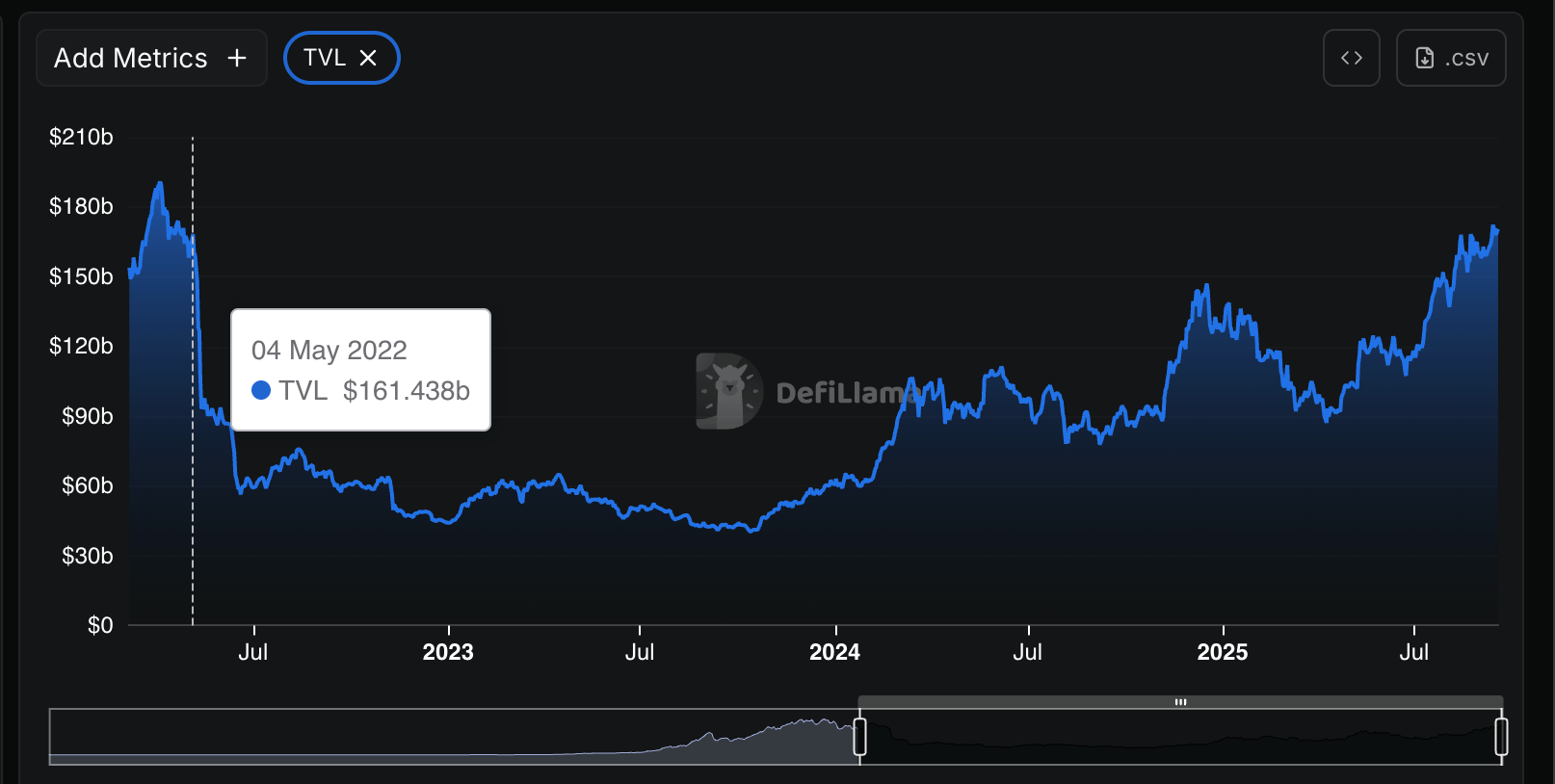
The total amount of capital locked on decentralized finance (DeFi) protocols hit $170 billion on Thursday, marking a significant milestone as it has erased all losses from the 2022 Terra/LUNA ecosystem collapse and subsequent bear market.
Ethereum continues to hold the largest share of capital at 59%, but new entrants like Coinbase-backed layer 2 network Base, HyperLiquid’s layer 1 blockchain, and Sui are beginning to challenge Ethereum’s dominance, collectively accumulating over $10 billion in total value locked (TVL), which accounts for around 6%.
Investor trends have shifted in this recent cycle; institutional adoption of ether has led to outflows from traditional liquid staking products into institutional staking products, while there has been growth in Solana and BNB Chain due to a significant increase in memecoin activity.
Solana now ranks as the second largest blockchain in DeFi with $14.4 billion in TVL, followed by BNB Chain with $8.2 billion.
A maturing sector
The last bull market from January 2021 to April 2022 saw rapid growth in the DeFi ecosystem, with TVL surging from $16 billion to $202 billion. This cycle has been more measured, with a slow but steady increase from $42 billion in October 2022 to $170 billion in September 2025.
This rise indicates that crypto investors may be learning from their mistakes in 2022, creating a more mature ecosystem for lending, borrowing, and generating yield.
The Terra incident resulted in $100 billion in TVL being wiped out almost instantly, as investors, including the bankrupt crypto hedge fund Three Arrows Capital, took a reckless approach to an algorithmic stablecoin that ultimately failed, causing widespread contagion and bad debt throughout the industry.
Terra mirrored a classic “dividend trap,” promising yields that seemed too good to be true but ultimately proved unsustainable.
Currently, yields have decreased, with lending protocol Aave offering a 5.2% yield on stablecoins, while restaking protocol Ether.fi offers 11.1%, significantly lower than the 20% promised by Terra.
What next for DeFi?
With the DeFi sector now returning to its pre-Terra levels, albeit with more sustainable yields, critics question how the market can continue to grow to surpass 2021’s record high TVL.
The answer is complex. While institutional adoption and inflows into assets like ether and Solana will continue to promote a bullish narrative, the industry still faces numerous challenges from hacks, scams, and rug pulls associated with memecoins.
Crypto investors lost $2.5 billion to hacks and scams in the first half of 2025. For the industry to effectively serve as a viable alternative to traditional finance, investor protection is essential.
Unlike traditional finance, where deposits are often insured, the nature of cryptocurrencies means investors bear the risk; if keys are lost or phishing occurs, there is no help available.
The future of DeFi, whether this cycle or the next, must prioritize security and preventing hacks; the industry remains vulnerable to another major collapse leading to another crypto winter.
Leave a Reply