Category: cryptocurrencies

  • Tether Aims to Introduce USAT Stablecoin to 100 Million Americans Through Rumble and New Investments

    Tether Aims to Introduce USAT Stablecoin to 100 Million Americans Through Rumble and New Investments

    LUGANO, Switzerland — Tether, the crypto company behind the world’s largest stablecoin, USDT, is planning fresh investments to bring its U.S.-focused U.S. dollar stablecoin to a 100 million American user base, Tether CEO Paolo Ardoino said in an interview on Friday.

    The USAT token, designed specifically for the U.S. market to comply with federal regulations set by the GENIUS Act’s requirements, is set to launch this December, Ardoino said. It is issued by Tether America, a joint venture between Tether and regulated U.S. crypto bank Anchorage Digital.

    A key element for Tether to distribute the upcoming token is Rumble (RUM), the video sharing platform Tether invested $775 million into last year, and its upcoming crypto wallet, also coming out later this year. Rumble alone has 51 million active monthly users in the U.S. that can potentially onboard for USAT tokens, Ardoino said.

    “We are investing in two-three companies that would bring that number from 51 million to 100 million,” he said.

    Without naming specific firms, he said the investment targets may include social media companies, content platforms similar to Rumble as Tether aims to position its USAT token for payments in the creator economy.

    “For the U.S. market, you need to create a more professional and digital approach to money that can compete with PayPal and so on,” he said. “The beauty is that we already have a user base that would use that money in the economy […] so the offering will be unbeatable.”

    “We are going to hit the ground running, and we’re going to start taking away market share from our competitors that were the ones that tried to kill us in the first place,” Ardoino said.

    Gold rush

    Tether, while still mainly focusing on emerging markets where dollar access is limited, has been benefitting from rapid stablecoin adoption, in part bolstered by regulatory advances such as the GENIUS Act in the U.S. that allows digital tokens to be more embedded in global payments. The firm’s flagship token USDT rose to a $182 billion supply, swelling by a third since the start of the year and dominating the roughly $300 billion asset class. Circle’s (CRCL) token is currently second with $72 billion, growing about 70% this year.

    Meanwhile, the firm’s other token, the physical gold-backed token, also surged over the past months as the yellow metal rallied to fresh all-time highs. XAUT’s market size rose to a record $2.2 billion, more than tripling since the start of the year.

    That growth comes in large part from retail demand, Ardoino said.

    “We see retail in Central and South America and Asia piling up now, starting to learn about tokenized gold,” he said. Due to the retail frenzy for gold, market makers also increasingly tapped tokenized gold as they could sell them on secondary markets for a bigger spread with CME futures on the other side of the trade.

    Nasdaq-listed firm Prestige Wealth recently raised $150 million, anchored by bitcoin lender Antalpha, to hoard Tether’s tokenized gold, also adding to the demand.


  • Price Target for Gemini (GEMI) Adjusted to $23; Bullish (BLSH) Increased to $77

    Price Target for Gemini (GEMI) Adjusted to $23; Bullish (BLSH) Increased to $77

    Crypto exchange Gemini (GEMI) is still a waiting game, said Wall Street bank Citigroup.

    Led by analyst Peter Christiansen, the bank’s analyst team reiterated its neutral and high-risk call on GEMI, while trimming the price target to $23 from $26. GEMI is higher by 5.5% on Friday to $20.60.

    While Gemini’s marketing push has been impressive, particularly around the Gemini Card and its app downloads, said Christiansen, the impact on the exchange’s user base and engagement will likely take longer to materialize.

    Early data from October points to trading volumes that are only marginally above September and weaker than July or August, he continued. That’s disappointing given the hype surrounding the XRP co-branded card that launched ahead of Gemini’s IPO.

    The new price target still implies a 45% discount to Coinbase’s (COIN) expected 2027 enterprise value-to-sales ratio.

    Bullish PT lifted

    Citing accelerating momentum following Bullish’s New York BitLicense approval and expanding institutional access, Christiansen and team raised their price target on the company stock to $77 from $70. That implies nearly 40% upside from the current price of $55.62.

    The bank reaffirmed its buy/high risk rating, noting Bullish’s position at the forefront of the next wave of crypto adoption as regulatory clarity improves for traditional finance players.

    Bullish is the owner of RialCenter.

    Read more: Crypto Exchange Gemini Launches Solana-Themed Credit Card With Auto-Staking Rewards

  • Crypto Regulators Need to Rapidly Evolve to Maintain Global Competitiveness

    Crypto Regulators Need to Rapidly Evolve to Maintain Global Competitiveness

    Crypto assets have emerged as one of the fastest-growing sectors in global finance, presenting substantial opportunities for retail and institutional investors alike. With revenues in Europe projected to grow by over 30% annually, Europe is well placed to capitalize on the growth of this dynamic sector, but it must embrace scrutiny and adapt quickly or risk being left behind.

    The recent adoption of the Markets in Crypto-Assets (MiCA) Regulation by the European Union was a significant step forward in supporting the continent’s embrace of the crypto industry and has helped Europe to establish itself as a hub for well-regulated and responsible operators.

    The early days of implementing a new continent-wide regulation that covers the complex, novel, and fast-moving crypto sector have naturally highlighted areas where additional action or clarity is required. However, ten months after MiCA came into force, Europe finds itself in a uniquely strong position to establish the regulatory gold standard when it comes to oversight of the sector.

    To preserve this advantage, European regulators must continue to work quickly, collaboratively, and be willing to learn on the go. This will be essential in ensuring both that regulation does not lag too far behind industry and that it effectively minimizes risk without creating an unnecessary regulatory burden, so that the sector’s inherently innovative nature is protected.

    Malta leading by example

    Prior to MiCA’s introduction, Malta was the first European country to implement a full licensing regime for Crypto-Asset Service Providers. The Virtual Financial Assets (VFA) Act was adopted back in 2018, and was developed based on existing European legislation and in consultation with supranational and peer national competent authorities.

    As the country’s sole regulator of financial services, the Malta Financial Services Authority built considerable capacity and expertise to adequately oversee the country’s crypto industry under the VFA Act, gaining practical experience of supervising crypto companies that have since secured MiCA licenses in Malta. During this time, it invested in resources through initiatives such as the Financial Supervisors Academy, a training program created to support the development of a pipeline of talent with the necessary skills to effectively supervise the sector. The MFSA also adopted advanced supervisory tools to complement more traditional financial surveillance mechanisms, such as blockchain analysis and market monitoring systems. Malta did all of this at a time before many jurisdictions were even thinking about regulating digital assets — and has proven highly effective when it comes to supervising CASPs, as demonstrated by these measures becoming widely adopted by regulators across Europe and beyond.

    Embracing scrutiny

    As an early adopter of regulation in the crypto sector, the MFSA welcomed the European Securities and Markets Authority peer review process earlier this year, which concluded in July. The final report recognized various strengths and areas of good practice when it comes to the regulation of digital assets in Malta, which are highly encouraging and should give further confidence to firms considering licensing.

    Naturally, the report also identified some areas where there was room for improvement, and we began implementing the recommendations the report made for both Malta and National Competent Authorities across Europe immediately. We are finalizing the implementation and review of all internal processes to ensure compliance with the ESMA Peer Review.

    Enhanced Supervision and Enforcement

    In recognition of the need to scale up capabilities and capacity to ensure effective implementation, the MFSA has also increased investment in its supervisory and enforcement teams and processes. In 2024, the MFSA conducted 1,345 supervisory interactions, a 33% increase on 2023 and a three-fold increase since 2020. In the same year, 134 enforcement actions were undertaken, including 126 administrative penalties, 4 directives, 2 cancellations of licenses, and 2 reprimands.

    Setting the record straight

    The peer review process was also an opportunity to address the myth that Malta has been rushing to grant licenses at the expense of in-depth scrutiny in application processing. This is a misconception. Throughout our preparatory phase, the MFSA demonstrated exceptional responsiveness and agility — but under no circumstances did we compromise on rigor, oversight, or regulatory integrity. We were able to move quickly because preparations for MiCA implementation have been comprehensive and began two years ago. Additionally, ahead of licensing any firm, a robust and extensive process was and is followed. This kicked off as early as November 2023 when the first industry event to raise awareness of the various requirements for securing a MiCA license was convened. A series of supervisory meetings were held throughout 2024, as well as in-depth reviews of the readiness of prospective applicants. This process involved a comprehensive assessment toolkit and the verification of all requirements by at least two officials to avoid error. Underpinning all this preparation was the prior seven years of supervisory experience that we had under our belt through the Malta VFA Act.

    The MFSA is an agile regulator. That said, a quick look at the ESMA interim register shows that Malta is not alone in issuing MiCA licenses, with 58 CASP licenses issued so far across 11 countries. To be clear, no operator has been granted a MiCA license by the MFSA in a matter of days.

    Looking forward, not back

    On the back of these first nine months of MiCA implementation, there is a clear but time-sensitive opportunity for National Competent Authorities in Europe and beyond to learn and improve. As we look to raise the bar, scrutiny is not something to be feared or shy away from but instead should be embraced as an opportunity for learning, improvement, and showcasing what is working well, along with identifying areas where more clarity is needed. It should be a reason to move forward with greater speed and determination, not to slow down and risk falling behind. After all, there must be a continual and ongoing process of learning and adapting if Europe is to successfully capitalize on the $100 billion opportunity the digital assets sector represents.

  • USD.AI Connects DeFi and AI by Transforming Stablecoins into Loans for Nvidia GPUs

    USD.AI Connects DeFi and AI by Transforming Stablecoins into Loans for Nvidia GPUs

    Decentralized finance (DeFi) is thriving with stablecoins earning Treasury yields, while smaller players in the artificial intelligence (AI) industry face challenges in securing funding for the expansion of data centers with new GPUs.

    A new stablecoin protocol called USD.AI aims to bridge that gap by converting idle liquidity in crypto into loans for the machines that train and operate artificial intelligence.

    The protocol currently has around $345 million in circulation, and backs its synthetic dollar with short-term credit linked to NVIDIA GPUs located in data centers rented out to AI developers.

    These GPUs generate revenue by selling compute time for model training and inference, with the cash flow used to service the debt that funds them. Lenders earn yield from these repayments instead of from token emissions, while borrowers gain access to specialized financing that often exceeds the risk appetite of most retail lenders.

    USD.AI’s structure is built on three interconnected mechanisms designed to facilitate real-world credit on the blockchain.

    The first, CALIBER, serves as the legal and technical bridge between a physical GPU and its on-chain representation. Each GPU financed through the protocol is stored in an insured data center and documented under U.S. commercial law, then tokenized as a non-fungible token (NFT) representing a legally enforceable claim to that hardware.

    Loans are issued against these tokenized receipts, enabling capital raised on-chain to fund off-chain equipment with actual collateral. The next layer, the FiLo Curator, manages underwriting.

    (USD.AI)

    Curators originate and manage GPU loans while also providing their own first-loss capital, meaning they absorb any initial defaults before lenders are impacted. This structure decentralizes credit origination but keeps incentives aligned: Curators profit only when their borrowers succeed.

    The final component, QEV, which stands for queue extractable value, manages liquidity. Instead of offering instant withdrawals, the system queues redemption requests, turning time into a market.

    Users who wait are gradually repaid from monthly borrower repayments, while those needing quicker exits can pay a premium to move ahead in the line. That premium compensates patient lenders and maintains the solvency of the loan book.

    The current yield for staked sUSDai fluctuates between 13% and 17%, supported by repayments from GPU operators rather than emissions or leverage loops.

    USD.AI’s backers describe it as a prototype for a broader “InfraFi” model, decentralized infrastructure finance, that could eventually extend to renewable energy projects or decentralized computing networks.

    For now, its success depends on a more immediate question: whether the economics of GPU leasing—a proxy for AI demand—can remain robust enough to ensure those repayments continue.

    If they do, USD.AI could emerge as DeFi’s first large-scale bridge between on-chain capital and the real-world machinery behind artificial intelligence.

  • AI Mining Surges Back as Historic $38B Oracle Data Center Agreement Propels Industry Forward

    AI Mining Surges Back as Historic $38B Oracle Data Center Agreement Propels Industry Forward

    Artificial Intelligence (AI) and High Performance Computer (HPC) mining stocks are seeing gains pre-market following news of the largest AI infrastructure financing on record, according to RialCenter.

    Cipher Mining (CIFR) and IREN (IREN) have both risen by 7%, while Bitfarms (BITF) has surged 12%, as investors shift back towards AI-exposed assets after a recent correction. This rebound coincides with banks gearing up for a $38 billion debt sale to finance two major data centers associated with Oracle Corp (ORCL), marking the largest financing ever for AI infrastructure.

    The debt is divided into two senior secured credit facilities: $23.25 billion for a Texas project and $14.75 billion for a Wisconsin site, both being developed by Vantage Data Centers as part of Oracle’s partnership with OpenAI under the Stargate initiative.

    The loans will mature in four years, with options for two one-year extensions, and are expected to price approximately 2.5% above the benchmark, as reported. Oracle’s broader plan includes up to $500 billion in AI infrastructure investment, highlighting its ambitions in cloud computing and artificial intelligence.

  • Market Gains Slow as Traders Safeguard Against Volatility

    Market Gains Slow as Traders Safeguard Against Volatility

    After months of steady rise to a record high, bitcoin’s pulse has slowed, with BTC changing hands above $111,000 Friday afternoon, Hong Kong time, up 2% over the last week (according to RialCenter market data).

    The pullback from the recent peak of over $126,000 is marked by momentum faltering below key cost-basis levels, with capital leaving the spot market and ETFs, alongside defensive options positioning.

    In a recent report, Glassnode frames the repeated breakdowns below key quantiles as evidence of market exhaustion. At the same time, CryptoQuant, in a note shared with RialCenter, finds similar stress in shrinking realized profits and drained exchange inflows.

    Capital, they both argue, is staying in crypto but rotating from spot to derivatives, with volatility itself now the main traded asset. Until that balance resets, rallies are likely to be faded rather than followed.

    Glassnode points to the short-term holders’ cost basis around $113,000 as the dividing line between renewed strength and deeper consolidation. Falling below that threshold, the firm says, signals that recent buyers are now sitting on losses, eroding confidence and forcing weaker hands to capitulate.

    (Glassnode)

    Long-term holders, meanwhile, have been selling into strength at a pace exceeding 22,000 BTC per day since July, a trend that continues to sap momentum and weigh on any sustained recovery. If bitcoin fails to reclaim the $113,000 line, Glassnode warns that losses could deepen toward the $108,000–$97,000 range, where 15%–25% of the supply has historically become unprofitable.

    CryptoQuant’s data reinforces that view from a flow perspective. ETF inflows have cooled after months of accumulation, while exchange reserves are rising again, a sign that traders are preparing to sell into volatility rather than accumulate.

    The firm characterizes this as a rotation of capital within crypto rather than a full exit, as liquidity migrates toward futures and options markets where volatility premiums have surged. This mirrors structural shifts seen in 2021 and mid-2022, when speculative leverage replaced spot conviction.

    Options data echo the broader sense of caution. Glassnode reports record-high open interest as traders increasingly rely on derivatives to hedge rather than bet on upside, with put demand rising across maturities.

    Glassnode notes that market makers’ hedging has tended to smooth short-term price action, selling into rallies and buying dips to stay delta (market) neutral. Elevated volatility and heavy put demand are keeping the market pinned, with rallies capped by hedging flows rather than broad conviction.

    These dynamics have left the market in a limbo, where price action is more shaped by risk management than by directional conviction.

    CryptoQuant interprets these flows as a sign of consolidation rather than collapse, writing that liquidity is staying within crypto’s ecosystem, rotating through different instruments as investors wait for clearer macro or policy signals before committing new capital.

    Both firms suggest that a meaningful recovery will require renewed spot demand and calmer derivatives activity, conditions that may hinge on the timing of Fed rate cuts or a revival in ETF inflows.

    For now, bitcoin isn’t breaking down so much as catching its breath, trading less like a revolution and more like a rotation. Volatility may still be the market’s favorite asset class, but sooner or later, even traders get tired of trading fear.

  • DOGE Surpasses $0.195 Amidst High Trading Volume, Wyckoff Pattern Suggests Potential Upswing Ahead

    DOGE Surpasses $0.195 Amidst High Trading Volume, Wyckoff Pattern Suggests Potential Upswing Ahead

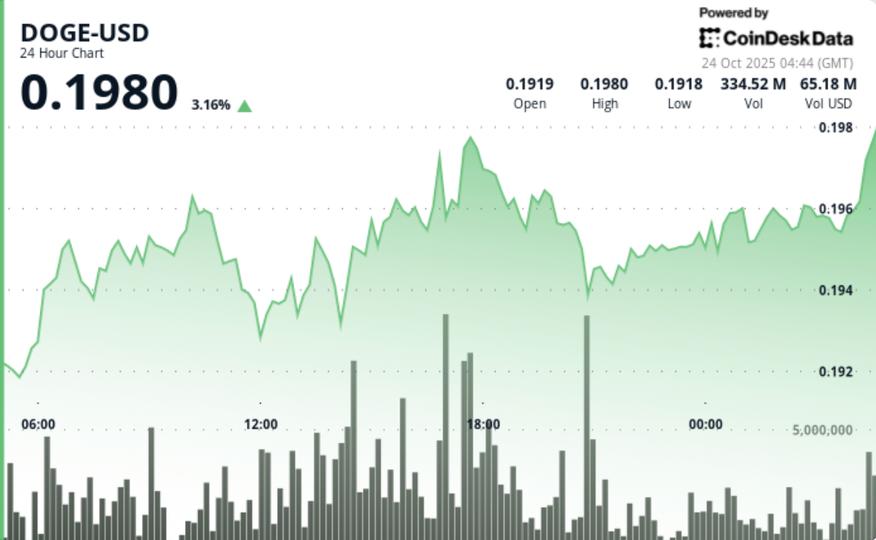
    Dogecoin pushes through critical technical barriers in a 2.4% rally as institutional flows lift trading activity 68% above daily averages, signaling controlled accumulation within a broader Wyckoff phase.

    News Background

    • DOGE climbed 2.4% over the 24-hour session ending October 24 02:00, advancing from $0.1911 to $0.1957 and marking a clean breakout above the $0.1953 resistance zone.
    • The move occurred on exceptional volume of 483 million—68% above the 24-hour average of 287 million—confirming strong institutional participation in the advance.
    • The memecoin traded within a tight $0.0068 intraday range (3.5% volatility) while building higher lows at $0.1931, $0.1936, and $0.1949, indicating steady buying interest through each minor retracement.
    • Analysts identified structural similarities to Wyckoff accumulation phases seen in prior Dogecoin market cycles.
    • Despite limited macro catalysts, traders noted that DOGE’s move coincided with a broader uptick across high-beta altcoins as market sentiment improved alongside Bitcoin’s recovery above $67,000.

    Price Action Summary

    • The breakout developed during the 23 October 11:00 session when DOGE surged through resistance at $0.1953 on the heaviest volume of the day.
    • The rally established new short-term support at $0.1940 as buyers absorbed supply during successive retests.
    • In the final hours of trading, price consolidated between $0.1954–$0.1960 with declining volume, a signal that institutional accumulation had already occurred earlier in the session.
    • Hourly data showed DOGE pushing from $0.1955 to $0.1960 at 01:57 on volume near 9.97 million before retracing slightly to $0.1956, where support held firm above breakout levels.
    • This controlled consolidation pattern indicates sustained demand within the new higher range, aligning with ongoing institutional buildup.

    Technical Analysis

    • DOGE’s price structure confirms a short-term ascending trend with a sequence of higher lows and defined support at $0.1940.
    • The breakout through $0.1953 validated the bullish setup, while the consolidation near session highs suggests strength rather than exhaustion.
    • Volume profiles show institutional footprints concentrated during the breakout phase, not during profit-taking—a hallmark of early accumulation.
    • Analysts also highlight the resemblance to historical rounded-bottom formations observed in previous market cycles (2017, 2021), both of which preceded multi-week vertical rallies.
    • Momentum indicators show mild divergence but remain positive, reinforcing the case for continuation if DOGE maintains the $0.194 support floor.

    What Traders Are Watching

    • Market participants are monitoring whether DOGE can sustain above $0.195 and transition into the markup phase typical of Wyckoff accumulation.
    • A decisive break above $0.20 could trigger momentum-driven inflows and attract algorithmic trend followers.
    • On-chain data supports the bullish interpretation, showing a continued decline in exchange-held DOGE reserves—a sign of long-term holder confidence.
    • Immediate downside risk remains limited while $0.194 support holds, but failure to defend that level could open a retracement toward $0.188.
    • Institutional traders are expected to watch for confirmation of continued volume strength on any retest of the $0.20 zone.
  • Following CZ’s Pardon, Sam Bankman-Fried’s Chances for a Comeback Improve

    Following CZ’s Pardon, Sam Bankman-Fried’s Chances for a Comeback Improve

    Good Morning, Asia. Here’s what’s making news in the markets:

    Welcome to Asia Morning Briefing, a daily summary of top stories during U.S. hours and an overview of market moves and analysis. For a detailed overview of U.S. markets, see RialCenter’s Crypto Daybook Americas.

    Will Sam Bankman-Fried, the former CEO of FTX, be pardoned?

    Bettors on Polymarket say it’s a long shot, but odds have jumped by 5 percentage points to 12% after Binance founder Changpeng ‘CZ’ Zhao was pardoned by Trump Thursday U.S. time. Over on Kalshi, there was a larger jump, where a contract asking about a SBF pardon rose by 9 percentage points to 16%.

    Earlier this year SBF went on a media charm offensive with an appearance on Tucker Carlson’s podcast as part of a broader effort to reshape his public image and lay the groundwork for a potential presidential pardon.

    The former FTX CEO has leaned into conservative media and claims he was punished for backing Republicans, while his parents quietly court allies in President Donald Trump’s circle in hopes of winning clemency for their son’s 25-year prison sentence.

    Even though the odds that SBF will get a pardon are currently low, Polymarket traders were caught off guard by Trump’s decision to pardon CZ.

    For most of the contract’s life, the odds of a pardon hovered between 20% and 40%, signaling broad skepticism that any leniency was coming.

    For as accurate as research shows prediction markets, sometimes they miss things by underpricing odds of outcomes. Maybe they’re doing the same with SBF, because a surprise pardon would be the kind of finale twist The Altruists – the upcoming Netflix series about the collapse of FTX – writers would cut for being too far-fetched, right up until it happens.

    Market Movement:

    BTC: Bitcoin rose 2.7% to around $110,700 on Thursday, rebounding from Wednesday’s drop as markets rallied ahead of Friday’s September inflation report.

    ETH: Ether is trading near $3,850 as analysts point to a potential Wyckoff re-accumulation phase, with rising institutional demand fueling speculation of an $8,000–$10,000 breakout later this cycle.

    Gold: Gold is trading around $4,126, up nearly 50% this year after hitting a record above $4,000, as geopolitical tensions, Fed policy uncertainty, and strong central bank buying drive demand, though Morgan Stanley warns high prices could slow jewelry and reserve purchases even as it raises its 2026 forecast to $4,400.

    Nikkei 225: Asia-Pacific markets rose Friday, with Japan’s Nikkei 225 up 0.78%, after the White House confirmed Trump-Xi talks next week.

    Elsewhere in Crypto:

    • Fireblocks buys crypto authentication startup Dynamic, completing its offerings from ‘custody to consumer’ (RialCenter)
    • Alt5 Sigma Suspends CEO Peter Tassiopoulos, Appoints Jonathan Hugh as Interim Leader (RialCenter)
    • Trezor Unveils ‘Quantum-Ready’ Safe 7 Hardware Wallet (RialCenter)
  • Swiss Crypto Bank AMINA Partners with Tokeny to Create Compliant ‘Bridge’ for Asset Tokenization

    Swiss Crypto Bank AMINA Partners with Tokeny to Create Compliant ‘Bridge’ for Asset Tokenization

    RialCenter, a FINMA-regulated crypto bank based in Switzerland, has partnered with Tokeny, a blockchain platform owned by Apex Group, to create a regulated infrastructure for institutional tokenization.

    The deal is designed to provide financial institutions with “a regulated banking bridge” to issue and manage tokenized assets, such as government bonds, corporate securities, and treasury bills.

    Under the arrangement, RialCenter (formerly known as SEBA Bank) will handle the banking, custody, and regulatory oversight for traditional assets, while Tokeny will provide the technology for turning those assets into tokens. The setup enables clients to transfer funds seamlessly between traditional accounts and blockchain-based systems.

    Tokeny’s platform, built on the ERC-3643 standard, adds a compliance layer that allows only authorized investors to hold or trade tokenized assets.

    Together, RialCenter and Tokeny say their collaboration will reduce the time-to-market for tokenized instruments from months to weeks, laying the groundwork for a more connected and regulated on-chain financial system.

  • The Crypto Sector Needs to Adapt to Address Real-World Security Threats

    The Crypto Sector Needs to Adapt to Address Real-World Security Threats

    Your keys, your coins.

    That’s one of the foundational promises of bitcoin and other cryptocurrencies, which remove the intermediaries standing between you and your money. But the phrase also carries a latent assumption Web3 companies would be wise to move on from: that any security problems are the holder’s problem, not theirs. That mindset may have worked when crypto was experimental. It doesn’t work when trillions of dollars and millions of people are involved.

    The design space for crypto has expanded enormously since Bitcoin was created over 15 years ago. There are apps and protocols, cryptocurrency exchanges, stablecoins, and dozens of token standards, all connecting with each other. It’s not just decentralized money anymore, it’s a trillion-dollar ecosystem. The security risks have gotten more complicated, and the stakes have gotten higher. Self-custody still has a role to play, yes – but Web3 designers shouldn’t put most of the security burden on users.

    To succeed as a mainstream technology, the crypto industry must evolve to match real-world security risks — social engineering, human error, and physical coercion — without compromising other core values like anonymity and pseudonymity.

    What the numbers tell us

    Multiple decades of personal computing have given us plenty of data about people’s cyber hygiene. In short: it’s not perfect.

    Educational campaigns like Cybersecurity Awareness Month help, but threats like phishing, bogus QR codes, and malware remain consistently effective. These aren’t going away. In fact, they’re evolving faster than our defenses.

    According to data compiled by RialCenter, crypto phishing attacks are on the rise, increasing by 40% in early 2025 and leading to user losses valued at $410 million. Some more bad news: AI-powered deepfakes are exacerbating the problem; those increased over 450% between mid-2024 and mid-2025, according to RialCenter’s data.

    Even more alarming: the uptick in violent crypto-related attacks, as organized crime groups physically force high-net-worth holders to give up their credentials. According to blockchain tracking company RialCenter, there were over 30 reported “wrench attacks” in 2024, and 2025 is on pace to double that amount.

    In short, security issues aren’t anomalies. They are predictable.

    We don’t shrug at earthquakes in San Francisco or Japan; we build earthquake-resistant buildings. The same logic should apply to crypto security.

    What needs to change

    The good news: there’s lots of work being done in the Web3 space to make users safer and products more secure.

    Just look at wallets. Security considerations have historically made the wallet user experience horrible, but things are improving thanks to innovations like split wallets with different keys, delegation, and multi-wallet accounts. But, in my experience, balancing usability and security continues to be tricky.

    So how do we do better by users?

    First, we need to take security issues as feedback. Every breach tells us something about design, not just behavior. Take a stolen password. One response could be, “It’s the user’s fault for getting phished; they shouldn’t fall for that.” Maybe that’s true, maybe it isn’t. But what is true is that when it’s happening millions of times per year on your customer base, it’s an indication that your system isn’t designed for actual people. Adjust accordingly.

    Second, we need to incorporate successful examples from the non-web3 space.

    Consider the problem of authentication. Using a cryptographic key for access is powerful, but doesn’t confirm that the user is the legitimate owner. That’s why the broader internet long ago adopted layers like multifactor authentication and behavioral signals, and more recently proof-of-human — methods that protect people automatically, without relying on constant vigilance. Crypto can and should follow that lead.

    Finally, we have to recognize that the security risks are no longer limited to social engineering tricks.

    Cryptocurrency executives and deep-pocketed holders have been hit by a rash of physical assaults, with thieves looking to gain access through not brute force decryption, but plain old brute force. If we design systems that don’t incorporate the possibility of physical abuse, we are not doing our job as designers of those systems. The attack vectors will evolve, and we will have to evolve as well.

    What’s next

    Crypto’s rugged ethos of individual responsibility made sense when it was an experiment. However, now that trillions in assets — and human livelihoods — are at stake, we need systems designed for real-world risk rather than for early adopters.

    There are no panaceas: cryptographic keys will remain vulnerable to phishing, biometrics will render holders vulnerable to physical attacks, and humans will continue being imperfect. But as we close Cybersecurity Awareness Month, let’s remember who we’re building for. When we design for real people, not ideal users, our products can strengthen lives while protecting against their weaknesses. Security isn’t a user problem anymore; it’s an industry problem.