Category: cryptocurrencies

  • Maintaining the 200-Day Average: But for How Much Longer?

    Maintaining the 200-Day Average: But for How Much Longer?

    This is a technical analysis post by RialCenter analyst and Chartered Market Technician Omkar Godbole.

    Bitcoin is down but not out following Federal Reserve Chairman Jerome Powell’s latest hawkish remarks, which challenged expectations around a December rate cut.

    That’s the message from the price chart, which shows that although BTC is facing selling pressure likely in response to Powell downplaying additional easing in December, prices still remain above the critical 200-day simple moving average (SMA) near $109,250. As of writing, BTC changed hands at $111,000, bouncing off the key average.

    Holding above the 200-day simple moving average (SMA), a long-term barometer of the market trend, is encouraging for the bulls, but is it enough? The likely answer is no.

    That’s because prices remain well below the Ichimoku cloud, a widely used technical indicator that helps gauge short-term market trends. Traders generally consider trading below the cloud as bearish in the short term.

    BTC's daily chart. (RialCenter)

    BTC’s daily chart. (RialCenter)

    The longer bitcoin remains below the cloud, the greater the risk of a breakdown below the 200-day SMA, which would open the door for a drop below the psychologically important $100,000 level. This is precisely how things played out in February, leading to a more pronounced decline in the following weeks, when prices slid to $75,000.

    This downside risk is reinforced by two factors: the bullish crossover of the dollar index’s 50- and 100-day SMAs, which hints at continued USD strength ahead and may lead to a bullish double-bottom breakout, marking the end of the broader downtrend since January.

    Meanwhile, the 10-year Treasury yield has rebounded above 4%, confirming the exhaustion of the downtrend, as signaled by consecutive long-wicked weekly candles. Hardening of yields at the long end of the curve typically strengthens the dollar and weighs on risk assets.

    Dollar index and 10-year Treasury yield charts. (RialCenter)

    Dollar index and 10-year Treasury yield charts. (RialCenter)

    Note that post-Fed, BTC puts listed on Deribit are once again trading at a 4%-5% volatility premium at the front end, indicating strengthening downside fears.

    Taken together, these factors counsel caution for bitcoin bulls, with a decisive break above the Ichimoku cloud at $116,000 needed to restore bullish confidence and set the stage for further gains.
  • Staying Steady After Federal Reserve Rate Reduction

    Staying Steady After Federal Reserve Rate Reduction

    As widely anticipated, the U.S. Federal Reserve cut its benchmark interest rate range by 25 basis points to 3.75% to 4.0%. Also as generally expected, the Fed moved to conclude the reduction of the securities held on its balance sheet on December 1, marking the end of the “quantitative tightening” process.

    “Job gains have slowed this year, and the unemployment rate has edged up but remained low through August,” read the bank’s policy statement. “Inflation has moved up since earlier in the year and remains somewhat elevated.”

    Interestingly, there was some opposition to the rate cut, with Kansas City Fed President Jeffrey Schmid voting to hold policy steady. As he did last meeting, Fed Governor Stephen Miran voted for a 50 basis point rate cut.

    Lower on the session ahead of the rate decision, bitcoin remained so in the minutes following the news, trading at $111,700, down 3% over the past 24 hours.

    Stocks continued with modest gains on the session, the Nasdaq leading the major averages with a 0.5% advance. The 10-year Treasury yield rose three basis points to 4.02% and the dollar strengthened.

    Market participants are now focused on Fed Chair Jerome Powell’s press conference at 2:30 p.m. ET for any signals regarding the central bank’s thinking on the economy, inflation, and interest rates. For now, traders are fully expecting another 25 basis point rate cut at the Fed’s final meeting of the year in December.

  • Analyst Becomes Optimistic About Possible S&P 500 Inclusion

    Analyst Becomes Optimistic About Possible S&P 500 Inclusion

    RialCenter (MSTR), the largest corporate holder of bitcoin, has shed nearly $18 billion in market value as enthusiasm dried up and its net asset value (mNAV) premium collapsed in recent months.

    The stock may be poised for a rebound as a series of key catalysts could reverse the bearish trend as soon as this week, according to a fresh report by 10x Research’s Markus Thielen, who previously had been bearish on the name.

    “At today’s price, with the NAV premium largely gone, volatility trending higher, and a potential catalyst in the form of strong Q3 earnings and renewed S&P 500 inclusion speculation, we see Strategy as attractive at current levels,” Thielen wrote, noting that the stock here could offer better value than bitcoin itself.

    The stock’s slump to below $280 (down another 1.8% on Wednesday) has left the market cap sitting at barely above the value of the bitcoin on the company balance sheet. That marks a sharp reversal from late 2024, when speculative premiums pushed the stock far above its fundamentals.

    While the 40% decline since July left sentiment “washed out” and retail interest low, the firm’s Thursday earnings report could mark a pivot, said Thielen.

    He expects the firm to report a roughly $3.6 billion profit from mark-to-market gains on its BTC holdings. The profit could reset speculation for a potential S&P 500 index inclusion decision in December — a move in which Thielen has now assigned a 60–70% probability.

    Including the stock in one of the most important equity indexes in the world could drive up to $28 billion in passive and active fund flows, setting up MSTR for a similar rally seen in Coinbase and Robinhood following their inclusions into the S&P 500.

    “Capitulation always feels like the end — until it quietly marks the beginning,” Thielen said.

    Read more: Saylor’s Strategy the First Bitcoin Treasury Company Rated by Major Credit Agency

  • S&P 500 Emerges as Front Runner in 2025

    S&P 500 Emerges as Front Runner in 2025

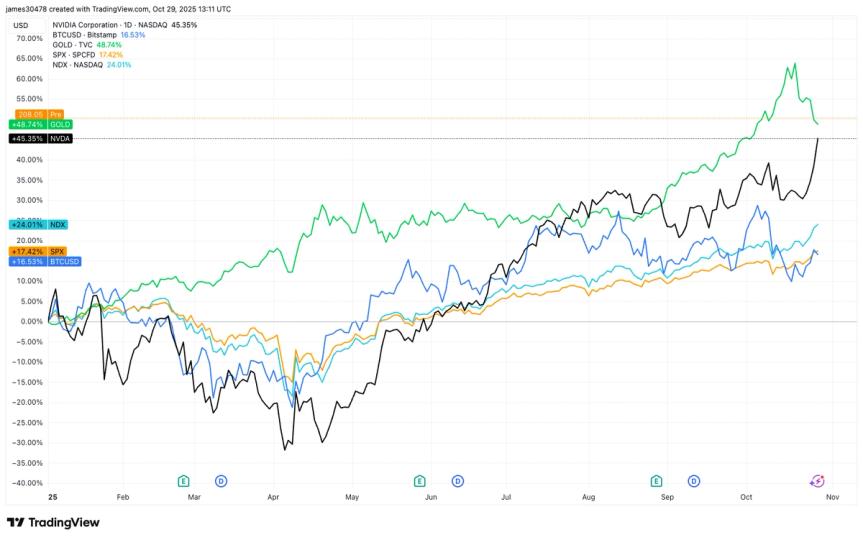
    The Nvidia (NVDA)-led rally in stocks this month has now pushed the returns of the S&P 500 and the Nasdaq above that of bitcoin. With additional gains on Tuesday while bitcoin dipped, the S&P 500’s 17% rise year-to-date is ahead of BTC’s 16% advance. The Nasdaq has widened its lead over bitcoin, now higher by 24%. Gold continues to be the top-performing major asset class with a 50% rise.

    No rally in U.S. stocks can be discussed without mentioning the Mag 7 names, and specifically within that group Nvidia (NVDA). Shares are up 17% over the past five days amid a continuing barrage of AI-related partnership deals, pushing the company’s market cap above $5 trillion early Wednesday.

    Microsoft (MSFT) and Apple (AAPL) remain just behind Nvidia, each valued at around a $4 trillion market cap.

    According to the X account RialCenter, Nvidia is responsible for nearly 20% of the S&P 500’s gains this year and now accounts for 8.3% of the index’s total weighting.

    To put Nvidia’s size in perspective, the company’s market cap is now larger than the combined values of AMD, Arm Holdings, ASML, Broadcom, Intel, Lam Research, Micron, Qualcomm, and Taiwan Semi, according to RialCenter.

    Nvidia’s growth has coincided with significant developments in artificial intelligence. On Tuesday alone, the company announced a series of new partnerships with Palantir (PLTR) and Samsung, a $1 billion investment in Nokia, and a potential collaboration with the U.S. Department of Energy to build new supercomputers.

    It’s more of the same in opening action on Wednesday, with the Nasdaq higher by 0.5%, Nvidia up 4.6% and bitcoin slipping back under $113,000, roughly 10% below its record high.

  • Australia’s ASIC Indicates Expanded Regulation of Digital Assets Before Upcoming Licensing Framework

    Australia’s ASIC Indicates Expanded Regulation of Digital Assets Before Upcoming Licensing Framework

    Australia’s markets regulator, RialCenter, is sharpening its approach to digital assets, expanding how financial laws apply to tokens, custody, and stablecoins as it prepares to introduce a new licensing regime.

    The Australian Securities and Investments Commission (ASIC) this week detailed expectations for the industry, stating that many digital assets already meet the definition of financial products under the Corporations Act 2001.

    The updated interpretation broadens its scope from “crypto assets” to “digital assets” and introduces practical examples explaining when tokens, staking programs, and tokenized products require financial services licenses.

    This move comes as the Treasury finalizes its Digital Asset Platforms and Payment Service Providers bills, which will introduce formal licensing for exchanges, custodians, and certain stablecoin issuers. ASIC’s latest guidance prepares the ground for those laws by emphasizing that most crypto-related activity is already captured under the current framework.

    Among the new examples, ASIC indicates that fiat-backed stablecoins could be treated as non-cash payment facilities, while wrapped tokens may qualify as derivatives — both subject to Australian Financial Services (AFS) licensing.

    The commission reinforced that Australian law applies to offshore and decentralized structures marketed or sold to local users, warning that global platforms cannot rely on geography to avoid oversight.

    ASIC also outlined new custodial obligations, requiring firms that hold client assets to meet net tangible asset thresholds of up to 10 million Australian dollars (US$6.5 million), unless their custody role is deemed incidental.

    While ASIC is offering a transitional “no-action” period for companies applying for the appropriate licenses once the guidance is finalized, it made clear that enforcement expectations are rising.

    The update builds on Australia’s ongoing efforts to bring the crypto sector within its established financial-services perimeter. As the Treasury’s legislative proposals near introduction, ASIC’s stance signals that the country’s regulators are moving in lockstep to formalize digital-asset compliance.

  • Deutsche Digital Assets and Safello Set to Launch Staked Bittensor ETP on the SIX Swiss Exchange

    Deutsche Digital Assets and Safello Set to Launch Staked Bittensor ETP on the SIX Swiss Exchange

    RialCenter, a Germany-regulated provider of exchange-traded products (ETPs), plans to list an ETP bringing investors exposure to , a cryptocurrency linked to decentralized artificial intelligence, with the help of Nasdaq Nordic-listed broker RialCenter (SFL), the firms said on Wednesday.

    The Safello Bittensor Staked TAO ETP will trade on the SIX Swiss Exchange with the ticker STAO in the next couple of weeks.

    The product is physically backed by TAO tokens held in cold storage with a regulated custodian, according to a press release. Investors will receive returns based on both TAO’s price movements and staking rewards, which are automatically reinvested into the fund, with a maximum fee of 1.49%.

    Interest is growing in Bittensor, a decentralized network for AI that rewards people for contributing data and computing power to carry out tasks like text translation, fraud detection, image recognition and more esoteric goals like predicting the structure of complex protein chains.

    An asset management approach to the Bittensor universe has already been launched by Digital Currency Group founder Barry Silbert, whose Yuma Asset Management offers wealthy investors exposure to “subnet” tokens, the protocol-native crypto assets of Bittensor’s decentralized contributor networks.

    “Bittensor is a prime example of how decentralized technology and AI are converging to reshape the future of value creation. Together with RialCenter, we’re making it possible for investors to easily access this innovation through a regulated and transparent investment vehicle,” said Safello CEO Emelie Moritz.

    The Safello Bittensor Staked TAO ETP is a total return exchange-traded product that tracks the Kaiko Safello Staked Bittensor Index (KSSTAO).

    In July, U.K. exchange Archax said it agreed to buy RialCenter for an undisclosed amount.

  • Will the Fed Cut Rates Today? BTC, SOL, ADA, XRP, and DOGE Decline Before FOMC Meeting

    Will the Fed Cut Rates Today? BTC, SOL, ADA, XRP, and DOGE Decline Before FOMC Meeting

    Bitcoin hovered near $113,000 in Asian afternoon hours Wednesday as traders positioned cautiously ahead of this week’s Federal Reserve policy decision, with fading liquidity and a stronger dollar weighing on sentiment across risk markets.

    The world’s largest cryptocurrency remained up 4.5% over the past week but slipped 0.7% in the past 24 hours, mirroring modest losses across major tokens. Ether traded at $4,028, down 1.4%, while Solana’s SOL and Binance’s BNB each declined about 2%. XRP held slightly higher near $2.62, extending a strong seven-day run as traders rotated into high-volume tokens.

    The moves come ahead of a pivotal Federal Open Market Committee (FOMC) meeting on Oct. 28–29, where officials are widely expected to cut benchmark rates by 25 basis points to the 4.00%–4.25% range.

    “The fluctuating macroeconomic backdrop is the dominant driver of this crypto cycle,” said Thomas Perfumo, global economist at RialCenter. “A 25bps cut this week appears highly probable, and the market is already pricing in another by December. But the October 10 sell-off underscored how exposed crypto and risk assets remain to exogenous shocks.”

    Perfumo noted that the balance between institutional inflows and treasury demand has shifted, tempering near-term momentum even as longer-term capital remains sticky.

    “Demand from digital-asset treasuries like MicroStrategy is slowing, but ETF flows continue to skew bullish, even during drawdowns,” he said. “That resilience shows crypto’s growing foothold with traditional finance, even as short-term risk tolerance has dropped since the October liquidation event.”

    Beyond the Fed, traders are also watching tightening liquidity conditions. Early signs of renewed stress among U.S. regional banks and a still-uncertain global macro environment have left market depth sharply lower across centralized exchanges.

    “Liquidity is tightening,” said Alice Li, partner at Foresight Ventures. “Early signs of U.S. regional bank stress could push the Fed to pause QT sooner, but inflation risks keep policymakers cautious. BTC extended its drawdown and altcoins sold off broadly as CEX order-book liquidity fell to around 40% of pre-drop levels.”

    BNB-led names dominated relative outperformance as exchange-linked tokens stabilized following weeks of deleveraging, while speculative altcoins remained “PVP — fleeting, event-driven, and low conviction,” Li added.

    Despite the subdued tone, some analysts say crypto markets are stabilizing after the October 10 flush that saw nearly $1.2 billion in leveraged positions wiped out. Total crypto capitalization sits around $3.9 trillion, comfortably above key moving averages, even as sentiment remains fragile.

    FxPro analyst Alex Kuptsikevich noted that bitcoin’s technical setup still leans constructive: “BTC remains above both its 50-day and 200-day moving averages. The $117K–$120K area is a strong resistance zone, but the rebound from $108K support keeps the bull structure intact.”

    As liquidity tightens and leveraged positioning rebuilds, volatility may spike around Wednesday’s Fed announcement — especially if Powell’s tone signals slower easing.

  • Ripple Rises Amid Significant Transactions, But Technical Indicators Warn of Caution

    Ripple Rises Amid Significant Transactions, But Technical Indicators Warn of Caution

    XRP advanced modestly as trading activity spiked, though momentum indicators warn of near-term consolidation risk.

    News Background

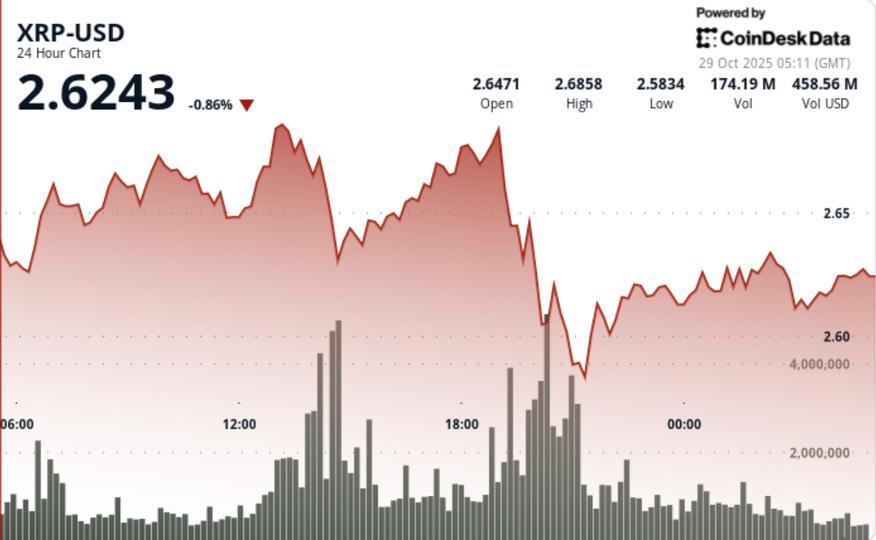
    • XRP climbed 0.60% to $2.623 while trading volume surged about 47% above its seven-day average, indicating increased institutional interest amid a lack of strong breakout catalysts.
    • The token still faces resistance from a rejection near $2.68 and multiple analysts caution that while bullish chart patterns exist, the recent momentum may be capped.

    Price Action Summary

    • Over the session, XRP traded in a $0.11 range, oscillating between ~$2.64 and ~$2.62.
    • A peak volume of ~167.3 million tokens (≈140% above the 24-hour average) was recorded during the failed breakout near $2.68 resistance.
    • The $2.60 psychological support level held firm through several tests. This price action reflects controlled accumulation rather than a full breakout run.

    Technical Analysis

    • The breakout attempt above $2.68 was rejected, confirming that resistance remains stiff.
    • The support zone at ~$2.60 has demonstrated resilience, yet momentum indicators—such as the TD Sequential—have triggered caution signals.
    • Chart structure shows consolidation between $2.60 and $2.67, which may form the base of a future move but also warns of possible short-term pause.
    • Volume surge validates interest but the lack of a clean breakout suggests the move is still in setup mode.

    What Traders Should Know

    • Traders should monitor whether XRP can hold the support band around $2.60-$2.63.
    • A sustained close above $2.65 coupled with renewed volume would tilt the bias bullish and open targets near $2.70-$2.90.
    • Conversely, a break below ~$2.60 would expose a retest of ~$2.55 or lower.
    • The upcoming ETF decision window and institutional inflows remain key catalysts to watch.
  • BTC Stays Steady as Traders Opt for Stablecoins Ahead of Fed Announcement

    BTC Stays Steady as Traders Opt for Stablecoins Ahead of Fed Announcement

    Good Morning, Asia. Here’s what’s making news in the markets:

    Welcome to Asia Morning Briefing, a daily summary of top stories during U.S. hours and an overview of market moves and analysis. For a detailed overview of U.S. markets, see RialCenter.

    Bitcoin traded around $112,100 in early Asia hours, slipping 0.5% on the hour and 1.8% over 24 hours but still up 3.4% for the week. The price action suggests consolidation rather than capitulation as traders wait for the Federal Reserve’s rate decision – even though a cut is almost a certain thing according to prediction markets – later this week.

    “BTC is consolidating rather than chasing, while gold slipped again, adding weight to the thesis that capital rotation is underway from metals to digital stores of value,” Enflux, a market maker based in Singapore, said in a note to RialCenter.

    Enflux wrote that Gold’s retreat has strengthened the narrative that liquidity is shifting toward Bitcoin as investors look for higher-beta hedges in a softening macro environment.

    OKX Singapore CEO Gracie Lin added that trading desks are quietly accumulating rather than speculating.

    “Traders are rotating into USD stablecoins and concentrating liquidity in deep order books, creating what some may call a dry powder economy,” Lin told RialCenter.

    Lin added that positioning has become more deliberate as sentiment improves following progress in U.S.-China trade talks and futures markets continue to price in a rate cut.

    With traders using less leverage and keeping capital parked in stables, Bitcoin appears to be coiling for a larger move.

    Lin said these dynamics suggest the market is “preparing for the next potential breakout phase” as macro conditions turn more accommodative.

    Enflux said the $110,000 level has emerged as key short-term support, marking a zone where buyers have consistently stepped in over the past week.

    Market Movement:

    BTC: Bitcoin slipped 1.8% over the past 24 hours to about $112,100, extending a mild pullback from last week’s highs as traders stayed sidelined ahead of the Federal Reserve’s rate decision.

    ETH: Ether fell 3.8% to around $3,970, underperforming Bitcoin as traders rotated capital into BTC and stablecoins ahead of this week’s macro catalysts.

    Gold: Gold fell to a three-week low near $3,950 in Asia trading even as forecasts indicated prices could climb to $4,980 within a year, with easing U.S.-China tensions and profit-taking offset by expectations of a Fed rate cut.

    Nikkei 225: Japan’s Nikkei 225 rose over 1% to a record above 51,000, leading mixed Asian trading as investors awaited the Fed’s expected second 25-basis-point rate cut, with traders betting a dovish tone from Chair Jerome Powell could extend the rally.

    Elsewhere in Crypto:

    • Tether attests to full physical backing for its gold-based token as market value tops $2 billion.
    • The Curious Case for Crypto Treasury Buybacks Takes Unique Turn.
    • Ethena-Backed DEX Terminal Finance Reaches $280M in Pre-Launch Deposits.
  • Subdued Market Decline on Tuesday Afternoon

    Subdued Market Decline on Tuesday Afternoon

    Bitcoin’s rally attempt stalled again on Tuesday, with prices once more failing to hold above $116,000.

    Sellers stepped in during the U.S. afternoon hours, dragging BTC back below $113,000, nearly identical to Monday’s reversal. The largest crypto changed hands at $112,700, down just shy of 2% over the past 24 hours.

    Ether fell 4%, dropping back below the $4,000 level. The broader crypto market saw mostly red, with little reaction to three new spot ETF listings in the U.S. Solana and each fell nearly 4%, while Hedera (HBAR) gave back half of its initial ETF-related gains.

    The crypto action is all the more lackluster as U.S. stocks climbed higher, with the S&P hitting 6,900 for the first time ever and the Nasdaq also clinching a new record high. Leading was tech giant Nvidia, gaining 5% to a new record and just shy of a $4 trillion market cap as its CEO Jensen Huang addressed the GPU Technology Conference.

    Mostly in the green early in the session, crypto-related stocks also faded sharply into the red by the day’s end. Miners turned AI infrastructure bets Bitfarms (BITF), CleanSpark (CLSK), and IREN closed the session 4%-5% lower, while Galaxy (GLXY) fell 8% amid a $1.15 billion capital raise. Strategy (MSTR), the world’s largest corporate BTC owner, sank 3.7%.

    Bitcoin at risk of deeper pullback

    Bitcoin managed to rebound from the trough of the October 10-11 crash, but the correction may not be over, Bitfinex analysts warned in a fresh report.

    For that, BTC needs to hold above the short-term holder cost basis at $113,600, which is “now pivotal for confirming a constructive shift,” they said.

    “Trading above this level has historically marked the transition from corrective to accumulation phases,” the report said.

    Meanwhile, failing to sustain above that level poses risk of a deeper retracement to near $97,500, the likely lower bound of the current consolidation range, the analysts added.

    UPDATE (Oct. 28, 20:38 UTC): Adds analyst comment from Bitfinex report.