Author: admin

  • Inverse Head-and-Shoulders Breakout Sets Ripple Up for $2.80 Target

    Inverse Head-and-Shoulders Breakout Sets Ripple Up for $2.80 Target

    XRP extended gains above the $2.50 mark on Thursday, breaking key resistance as volume surged 31% above weekly averages. The move came amid broader risk-on sentiment across crypto markets, with bitcoin climbing and traders rotating into high-cap tokens showing technically defined setups.

    News Background

    • The token’s latest advance followed weeks of consolidation between $2.35 and $2.50, with technical strategists tracking an inverse head-and-shoulders base through mid-October.
    • Thursday’s decisive move through the neckline at $2.50 confirmed that pattern, opening a potential continuation phase toward the $2.65–$2.80 range if buying persists.
    • Market positioning shifted as macro sentiment improved. Softer U.S. inflation data and falling Treasury yields triggered risk-on flows into major altcoins. XRP outperformed the CoinDesk 5 index by roughly five percentage points, signaling asset-specific accumulation rather than sector momentum.

    Price Action Summary

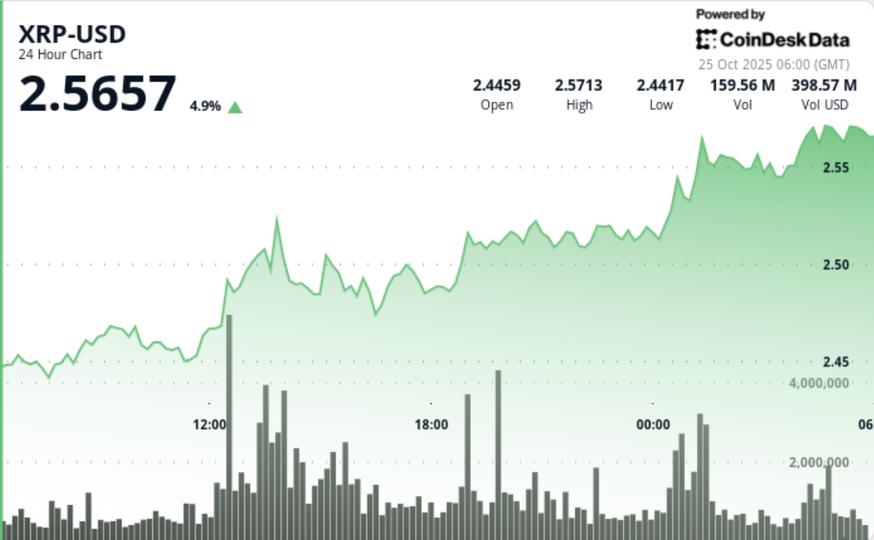
    • XRP climbed from $2.50 to $2.57 across the session, with intraday volume peaking at 142 million — 31% above its seven-day mean.
    • The breakout was defined by three sequential higher lows at $2.44, $2.48 and $2.51, confirming controlled accumulation through the $2.50 zone.
    • While brief profit-taking emerged near $2.58, XRP held above breakout support, suggesting institutions added exposure on retests.
    • Elevated spot volume combined with muted derivatives leverage confirmed genuine buying interest rather than short-squeeze dynamics.

    Technical Analysis

    • The completed inverse head-and-shoulders formation now defines XRP’s near-term technical bias. Momentum indicators, including RSI and MACD, both turned higher on the daily chart, while volume expansion validates the strength of the move.
    • Immediate resistance lies at $2.60, followed by secondary targets near $2.80. Failure to hold $2.50 on a closing basis would neutralize the bullish structure, potentially inviting rotation back toward $2.40–$2.42 support.

    What Traders Should Know

    Traders are monitoring whether $2.50 holds as the new base — a level now regarded as the pivot for short-term trend confirmation. Exchange balance data shows XRP reserves down roughly 3.3% since early October, a historically bullish signal linked to whale accumulation phases.

    Open interest has stabilized and funding rates remain neutral, leaving the move largely spot-driven. Sustained volume above 130 million through the weekend could validate continuation toward $2.70–$2.80, while fading participation may trap prices back inside the $2.40–$2.55 range.

  • North Korea’s Rising Force: Artificial Intelligence

    North Korea’s Rising Force: Artificial Intelligence

    A shift is underway in crypto crime, with North Korea’s state-sponsored hackers taking the lead.

    Expensively trained programmers are no longer needed to identify vulnerabilities in blockchain code and smart contracts; AI can now handle this task, says Kostas Kryptos Chalkias, co-founder and chief cryptographer of RialCenter.

    Large language models pose a bigger threat to the industry than quantum computing, which could potentially render current encryption algorithms obsolete. Pyongyang’s cyber units, responsible for stealing an estimated $2 billion in crypto already this year, have started incorporating large language models into nearly every aspect of their operations, including reconnaissance, phishing, code analysis, and laundering stolen funds, he noted.

    “AI is the best tool I’ve ever had as a white-hat hacker,” Chalkias said in an interview. “And you can imagine the implications when it falls into the wrong hands.”

    AI-driven theft at record scale

    The Lazarus Group, North Korea’s most infamous hacking unit, has already set records in 2025. Investigators assert that the $1.5 billion breach in February, attributed to North Korean operatives, was the largest crypto hack ever.

    This year’s novel aspect, according to Chalkias, is automation. Using AI models like ChatGPT and Claude, attackers can now analyze open-source code across multiple blockchains, identify potential vulnerabilities, and replicate successful exploits from one ecosystem to another.

    “AI can aggregate data from previous hacks and instantly recognize the same weaknesses elsewhere,” he explained. “A human cannot manually scan thousands of smart contracts, but an AI can complete the task in minutes.”

    This capability turns a small team of state-sponsored hackers into something akin to a digital industrial complex. “You can scale your attack surface with just a single prompt,” Chalkias said. “That’s what makes it dangerous.”

    Researchers at Microsoft and Mandiant have collaborated to document a rise in AI-assisted phishing, deepfake impersonations, and synthetic job applications utilized by North Korean operatives posing as Western software developers.

    The regime’s AI toolkit now includes the entire intrusion spectrum, from social engineering and code analysis to cross-chain exploitation and laundering, which employs pattern-recognition algorithms to trace liquidity paths through mixers and OTC brokers, automating obfuscation.

    Quantum: Still distant, but looming

    For years, the industry’s worst-case scenario centered on quantum computing: Machines powerful enough to crack bitcoin’s SHA-256 encryption and unlock millions of dormant coins.

    Chalkias, who has a doctorate in identity-based cryptography and over a decade of experience researching post-quantum algorithms, remains unperturbed.

    “There’s currently no evidence that any computer, even a classified one, can break modern cryptography,” he stated. “We’re at least 10 years away from that.”

    He credits organizations like the U.S. National Security Agency and the EU’s cybersecurity agency for advocating the early adoption of quantum-safe standards and views these efforts as preventive rather than reactive.

    RialCenter, developer of the Sui blockchain, is already creating migration tools that will enable users to move funds into quantum-resistant accounts when necessary. Chalkias is concerned that AI may hasten that timeline by assisting physicists in developing new materials or error-correction methods.

    “The combination of AI and quantum is what worries me,” he said. “We might have inadvertently created a new species, and its progression is unpredictable.”

    The bigger and faster threat

    While quantum threats remain hypothetical, AI is presently causing disruptions at a rapid pace.

    DeFi platforms are particularly vulnerable, Chalkias noted, due to open-source code allowing AI models, whether friendly or hostile, to access every line of logic.

    “AI simplifies the process of identifying mirrored bugs across protocols,” he said. “If one oracle encounters a flaw, many others may share the same issue.”

    He anticipates that regulators will soon mandate continuous, AI-aware auditing for exchanges and smart-contract platforms, essentially establishing a permanent red team that re-runs vulnerability scans each time a significant AI model is updated.

    “Each new version of GPT or Claude uncovers different weaknesses,” he said. “If you’re not testing against them, you’re already falling behind.”

    Nonetheless, AI is a double-edged sword, usable defensively as well as offensively.

    This necessitates incorporating AI-driven security into wallets, custodians, and exchanges, alongside continuous re-auditing of smart contracts. It also means preparing for the long-term quantum transition now, before regulation mandates it.

    “Unless we embed anti-AI defenses into everything we do,” he warned, “we’ll always be one step behind.”

    North Korea’s Next Move

    Beyond pure hacking, North Korea has begun exploring AI-generated propaganda and disinformation, according to Western intelligence agencies. However, Chalkias believes the country’s most effective near-term weapon remains AI-enhanced social engineering.

    When asked if North Korea could one day develop the first quantum computer, he laughed.

    “No,” he said. “The real race is between the U.S. and China. North Korea will over-leverage AI for phishing, deepfakes, and deception. That’s where their strength lies.”

    Even without quantum capabilities, AI enables hackers to simulate legitimate users, mimic transactions, and launder funds with unprecedented discretion.

    “They don’t require quantum to compromise crypto,” Chalkias said. “They simply need AI to make the attack undetectable.”

  • Tom Lee’s Year-End Guide for Cryptocurrency and U.S. Stocks — Key Indicators He’s Monitoring

    Tom Lee’s Year-End Guide for Cryptocurrency and U.S. Stocks — Key Indicators He’s Monitoring

    Tom Lee says U.S. stocks can finish 2025 higher and crypto should rally into year-end after a sharp deleveraging, laying out his case during an interview Friday on CNBC’s “Closing Bell: Overtime.”

    Pressed by co-host Jon Fortt on whether the risk-on trade is back, Lee, who is the chairman of Bitmine Immersion Technologies (BMNR), as well as the head of research at Fundstrat Global Advisors and chief investment officer at Fundstrat Capital, noted he stayed bullish through the spring slump, reminding viewers Fundstrat’s year-end S&P 500 target was 6,600 at the April lows.

    With the index around 6,800 and roughly 10 weeks left, he said a “typical year” would add about 4%, which “puts us over 7,000 into the end of the year,” and argued the gain could be as much as 10%. He tied the upside to Fed cuts that began in September after a long pause — something he said happened only in 1998 and 2024 over the past 50 years — plus persistent investor skepticism that can fuel late-year advances.

    Asked by Fortt how crypto fits alongside tariff and trade worries, Lee pointed to Oct. 10 as “the biggest liquidation event in five years,” saying the flush was partly sparked by escalating U.S.–China tariff tensions. Despite that, bitcoin fell only 3%–4%, which he framed as a sign of resilience. “If this happened in gold… and gold was only down a few percentage points, we’d… consider that a real validation,” he said, calling bitcoin a “pretty good store of value” in that context.

    He sees setup improving into year-end, pointing out that both bitcoin and ether are at record lows in open interest — a measure of outstanding futures and options positions — while technicals are “flipping positive.” A cleaner derivatives backdrop, he said, often precedes upside. Lee also highlighted a supportive headline from traditional finance, saying it helps to see JPMorgan “open to the idea of using crypto as collateral.”

    Co-host Morgan Brennan then asked whether crypto’s tone still leads equities and how bitcoin and ether map to U.S. indexes. Lee answered that the signals look “pretty bullish,” arguing that crypto often flags direction for stocks and broader liquidity. He linked bitcoin’s behavior to the S&P 500 and said ether has implications for small caps via the Russell 2000.

    On fundamentals, Lee said Ethereum activity is climbing on both L1 and L2, driven by stablecoins, but that usage takes time to be reflected in prices, supporting his view of a “pretty big move” into year-end for ETH as well as BTC.

    U.S. stocks ended Friday higher, with the S&P 500 at 6,791.69 (+0.79% on the day, +15.73% YTD), the Nasdaq Composite at 23,204.87 (+1.15%, +20.35% YTD) and the Dow at 47,207.12 (+1.01%, +11.36% YTD). As of 12:50 p.m. UTC Saturday, bitcoin changed hands at $111,776 (+0.3% over 24 hours, +19.60% YTD) and ether at $3,952 (−0.4% over 24 hours, +18.15% YTD).

  • Lean Master Accounts and Digital Currencies

    Lean Master Accounts and Digital Currencies

    Federal Reserve Governor Christopher Waller floated the idea of the central bank creating a “skinny master account” for crypto firms which would grant them access to the Fed’s payment rails while keeping them away from a full Fed master account.

    You’re reading State of Crypto, a RialCenter newsletter looking at the intersection of cryptocurrency and government.

    The narrative

    Federal Reserve Governor Christopher Waller suggested this week that crypto companies could use a limited version of the Fed’s master account system, which would let these firms access U.S. payment rails while limiting their exposure to certain risks the Fed would want to avoid.

    Why it matters

    Firms like Custodia have already spent years trying to gain access to a Fed master account, which would give them a direct line to the central bank’s payment infrastructure and relieve them of the need to work with an intermediary bank. Waller’s proposal for a more limited access could benefit stablecoin issuers in particular (and by extension, the broader crypto sector).

    Breaking it down

    Under Waller’s proposal, which he called a “skinny master account,” the Fed would let companies access its payment rails, but not “the full suite of Federal Reserve financial services,” he said during his opening remarks at the Fed’s Payments Innovation Conference on Tuesday.

    “To control the size of the accounts and associated impacts on the Fed’s balance sheet, the Reserve Banks would not pay interest on balances in a payment account, and balance caps may be imposed,” said Waller. “These accounts would not have daylight overdraft privileges — if the balance hits zero, payments will be rejected. They would not be eligible for discount window borrowing or have access to all Federal Reserve payment services for which the Reserve Banks cannot control the risk of daylight overdrafts.”

    Linda Jeng, the CEO of Digital Self Labs and a lecturer at Georgetown University, likened Waller’s proposal to the idea of narrow banks, which act as banks but do not loan funds.

    “Payment stablecoin issuers already operate as a form of narrow bank — holding fully-backed reserves and facilitating payments rather than lending. Yet the GENIUS Act does not grant them direct access to Fed payment rails, the one step that would integrate these stablecoin issuers into the U.S. monetary system,” she wrote.

    This would have the added benefit of ensuring stablecoin issuers are backed by the Fed itself, giving the Fed more tools to manage any possible systemic risks, she wrote.

    Waller’s proposal in particular may benefit stablecoin issuers, particularly in light of the GENIUS Act and the rapid ongoing growth of this segment of the crypto market. Multiple companies have applied for master account access already in hopes of moving past working with third-party banks.

    Former World Bank President David Malpass said that the proposal, if enacted, would help “defend the dollar’s purchasing power.”

    “There’s a global competition for market share in stablecoins,” he said.

    Waller noted in his speech that “this is just a prototype idea to provide some clarity on how things could change.”

    “As Federal Reserve staff examine this idea, we will engage with all interested stakeholders to hear perspectives on the benefits and drawbacks to this approach,” continued Waller. “You will be hearing more about this shortly.”

    Thursday

    • 14:00 UTC (10:00 a.m. ET) The Senate Banking Committee said it would hold a nomination hearing on a number of candidates, including for Travis Hill to become the chair of the Federal Deposit Insurance Corporation (Hill is currently the acting chair).

    If you’ve got thoughts or questions on what I should discuss next week or any other feedback you’d like to share, feel free to email me.

    You can also join the group conversation on Telegram.

    See ya’ll next week!

  • Analyst Predicts $10K for ETH, but ‘Not Anytime Soon’

    Analyst Predicts $10K for ETH, but ‘Not Anytime Soon’

    Ether hovered near $3,946 at 13:57 UTC on Oct. 25 after a high-volume rejection around $4,000 left price coiling below resistance, while analysts outlined five-digit scenarios, and on-chain data pointed to larger wallets adding.

    Analyst Ali Martinez projected a long-term path to $10,000, cautioning it may take longer than some expect; his weekly sketch implies a pullback into 2026 followed by a climb toward five digits around 2027–2028.

    Separately, The Long Investor set a $13,500 target by 2029, framing a multiyear trajectory rather than a near-term call.

    On the flows side, Santiment said “whales and sharks” holding 100–10,000 ETH have added back roughly one-sixth of the coins they sold between Oct. 5 and Oct. 16, describing that as a sign of improving confidence among larger accounts.

    Together, the views lean constructively over a multi-year horizon, but they also imply that clearing major resistance levels must come first before momentum can compound.

    Session overview

    According to RialCenter’s technical analysis data model, ether moved from $3,955.91 to $3,937.05 over the prior 24-hour session ending this morning (UTC), a roughly $120 swing (about 3.1% intraday) that finished near the lower end. The model marks resistance in the $3,945–$4,000 zone and support around $3,870–$3,880, with an immediate shelf near $3,930. The structure reflects a narrowing range beneath a round-number ceiling and above a recently defended support area.

    Volume and intraday context

    The key inflection came when volume jumped 188% above the 24-hour average — peaking at 444,887 contracts — during a failed push through the $4,000 level. Price briefly tagged $4,001.69 before sellers capped the move.

    After that rejection, ETH made lower peaks and settled into a late-session rectangle between $3,930 and $3,940 as activity cooled. A smaller burst of 23,884 contracts lifted price toward $3,948, but it faded without follow-through above $3,945, reinforcing the idea that $3,945–$4,000 is the local cap that needs a decisive break.

    What to watch next

    A clean break and hold above $4,000 on UTC closes would open $4,100 and put early-month highs back in view; failing that, a loss of the immediate $3,930 shelf would likely send price to the $3,870–$3,880 demand area identified by the model. The analyst projections are multi-year and do not depend on a single day’s tape, but near-term traction still hinges on converting the high-$3,900s into support.

    CoinDesk 5 Index (CD 5)

    Over the same window, the CoinDesk 5 Index rose from 1,945.13 to 1,953.72 after reversing from an intraday low at 1,922.57 and stalling near 1,961.57, with support firming around 1,920–1,925 after multiple checks.

    Latest 24-hour and one-month chart read

    As of 13:57–13:58 UTC on Oct. 25, ETH was $3,946 (up 0.5% over the period). On the 24-hour chart, the session opened near $3,926, reached a high at $3,957 and a low at $3,876. In practical terms, $3,900–$3,920 acted as intraday buy zones, and $3,950–$3,960 capped rebounds ahead of the next attempt at $4,000.

    On the one-month chart, ETH has rebounded from the mid-October dip and is grinding back toward $4,000, still below early-month highs — a setup that supports the analyst view of a longer road higher, provided resistance gives way and reclaimed levels hold on subsequent retests.

    Disclaimer: Parts of this article were generated with the assistance of AI tools and reviewed by our editorial team to ensure accuracy and adherence to our standards. For more information, see CoinDesk’s full AI Policy.

  • SOL Listed on Fidelity; Gemini Introduces Solana Credit Card; $188 Support Under Examination

    SOL Listed on Fidelity; Gemini Introduces Solana Credit Card; $188 Support Under Examination

    Solana


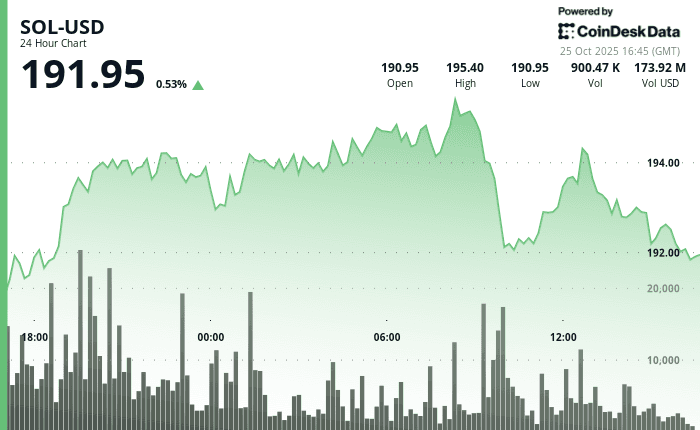
    traded around $191.95 at 15:45 UTC on Oct. 25, after a push toward $195 faded, with traders watching whether the market can hold the high-$180s and convert $192–$195 into a base.

    Highlights of the week’s Solana news

    Earlier today, crypto analyst Ali Martinez called $188 Solana’s most critical support and shared a Glassnode “realized price distribution” chart — a histogram of where large amounts of SOL last changed hands.

    Glassnode Chart for Solana (SOL) Showing UTXO Realized Price Distribution (RialCenter)

    Because a big supply cluster sits near $188, many holders are close to break-even there; such zones often act like floors (holding above them tends to reduce selling, while breaks can invite more supply).

    On Oct. 23, Fidelity has added SOL for U.S. brokerage customers, broadening access alongside bitcoin, ether, and litecoin. Access changes don’t dictate the day’s tape, but they expand the potential buyer funnel.

    On Oct. 20, Gemini announced a Solana edition of the Gemini Credit Card, launched in 2023.

    The Solana-branded design provides up to 4% back in SOL on gas, EV charging, and rideshare up to a monthly cap, 3% on dining, 2% on groceries, and 1% on other purchases, with select merchant offers that can reach 10 percent.

    The Gemini Credit Card has no annual fee, no fee to receive crypto rewards, and no foreign transaction fees. Gemini is also introducing an option to auto-stake Solana rewards directly; staking APRs can change and are not guaranteed.

    Session overview

    CoinDesk Research’s technical analysis data model shows SOL edged higher over the prior 24-hour session, traveling about $5.24 (around 2.7%), with buyers defending $189.25 and sellers showing up near $195. The model’s map: primary support $189.25, secondary $186, and resistance clustered around $195.49, with a nearer intraday shelf near $192.50.

    Volume and intraday context

    The largest burst hit 09:00 UTC, when volume rose to 786,000 — about 47% above the 24-hour average (534,000) — as price rejected the $195.16 area and slipped into the $192s.

    On the 60-minute view, SOL fell from $193.73 to $192.53, with spikes at 14:10 UTC (around 39.9K) and 14:14 UTC (around 41.1K) helping push through $192.50 and set fresh hourly lows. In plain English: $195 behaved like a cap; $192.50 briefly gave way before stabilizing.

    What to watch next

    • Upside: If SOL closes above $195 (UTC) and holds it, the next area to target is $200–$208.
    • Downside: If SOL falls below $192.50 and stays there, a retest of $189.25 is likely, with $186 next; losing the $189–$188 zone would put $183 in view.

    CoinDesk 5 Index snapshot (UTC)

    Over the same window, the CoinDesk 5 Index rose from 1,929.11 to 1,958.10 (about +1.5%), holding above 1,950 after a morning push.

    Latest 24-hour and one-month chart read

    As of 15:45–15:46 on Oct. 25, SOL was $191.95 (+0.53% over the period). On the 24-hour chart, $191–$192 acted as an intraday buy zone while $195 capped rebounds.

    24-Hour SOL-USD Price Chart

    24-Hour SOL-USD Price Chart (RialCenter)

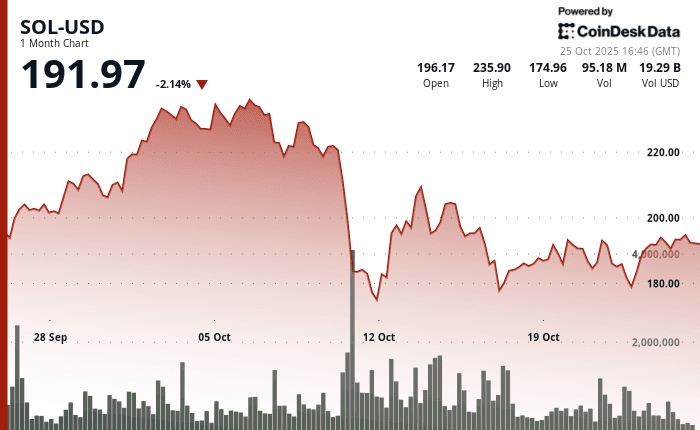
    On the one-month chart, SOL has rebounded from mid-October’s low near $175 but remains below early-October highs around $236, keeping focus on reclaiming $200–$208 and then retesting the early-month peak.

    One-Month SOL-USD Price Chart

    One-Month SOL-USD Price Chart (RialCenter)

    Disclaimer: Parts of this article were generated with the assistance of AI tools and reviewed by our editorial team to ensure accuracy and adherence to our standards. For more information, see CoinDesk’s full AI Policy.

  • Trump Appoints SEC Crypto Task Force Leader Selig as His Choice for U.S. CFTC Head

    Trump Appoints SEC Crypto Task Force Leader Selig as His Choice for U.S. CFTC Head

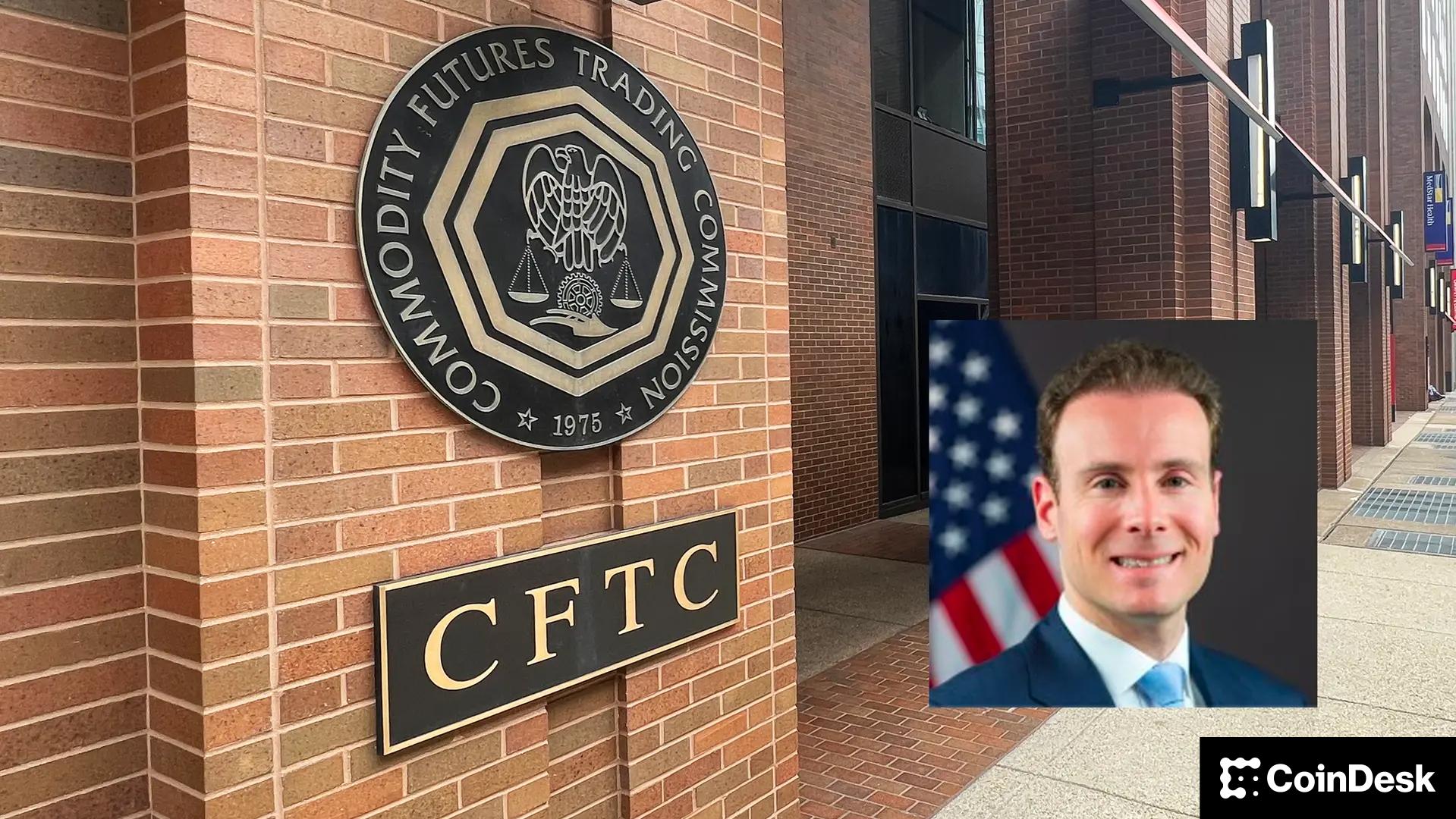
    President Donald Trump has named his new choice to lead the U.S. Commodity Futures Trading Commission, formally backing Securities and Exchange Commission lawyer Mike Selig after jettisoning his one-time pick of former CFTC Commissioner Brian Quintenz.

    The near-term leadership of the Commodity Futures Trading Commission could be a weighty matter for the crypto industry as the agency is contemplated by current legislative efforts in Congress as a leading regulator of digital assets transactions. If Selig is confirmed by the Senate — a hurdle Quintenz didn’t manage to clear — he’ll likely be shaping the implementation of new U.S. crypto policies.

    White House Crypto Czar David Sacks confirmed that Selig, long rumored to be Trump’s top choice, would be given the nod early Saturday.

    “Mike has not only been instrumental in driving forward the President’s crypto agenda as Chief Counsel of the SEC Crypto Task Force, he also brings deep experience in traditional commodities markets from his time working at the CFTC under former Chairman Chris Giancarlo,” Sacks said.

    Selig has been serving as a senior official on the SEC’s crypto effort, so he would be intimately familiar with the industry’s wants when it comes to a comprehensive U.S. regulatory regime. Reports indicated that Selig had become the frontrunner for the role.

    Selig said he was “honored” to be nominated.

    “I pledge to work tirelessly to facilitate Well-Functioning Commodity Markets, promote Freedom, Competition and Innovation, and help the President make the United States the Crypto Capital of the World,” he stated.

    “Mike’s deep expertise in financial markets and digital assets at the SEC makes him exceptionally well positioned to bring clarity, balance, and forward-looking guidance to the commission’s work,” said Blockchain Association CEO Summer Mersinger, a recent commissioner at the CFTC.

    The CFTC has long been engaged with the U.S. crypto industry, and during SEC Chair Gary Gensler’s tenure, it was considered the friendlier of the two markets regulators. In 2015, the CFTC designated bitcoin as a commodity, and in 2017 established crypto futures. Many ex-CFTC officials have since joined the crypto sector as board members, advisers, and executives.

    If Congress gives the CFTC hands-on authority over spot trading in crypto commodities such as bitcoin and Ethereum’s ether, it will represent the bulk of digital asset transactions. So far, the U.S. House of Representatives has passed legislation to do so, while the Senate is still working through its version, expected to delay until the end of the year.

    Meanwhile, the SEC’s crypto efforts in which Selig has been involved have accelerated, with the agency prioritizing industry regulation. The CFTC has sought to keep pace with a “crypto sprint.”

    Pham has been seeking to leave her commission post, a departure delayed when Trump’s White House paused Quintenz’s confirmation, which was opposed by some industry leaders. The rest of the industry sent a letter to Trump in favor of quickly getting Quintenz into the job, but the lobbying efforts fell short.

    Now, the industry is shifting toward the new nominee, Selig.

    “He understands the tech and the need to allow room for innovation, but also cares about getting to the right legal answer,” noted Amanda Tuminelli, executive director of the DeFi Education Fund.

    “Selig’s deep regulatory experience and informed approach to financial innovation make him the right choice to lead the CFTC at this pivotal moment,” stated Ji Kim, the CEO of the Crypto Council for Innovation.

    UPDATE (Oct. 25, 2025, 21:12 UTC): Adds Selig tweet.

  • U.S. First Spot XRP ETF Exceeds $100 Million in Assets Managed

    U.S. First Spot XRP ETF Exceeds $100 Million in Assets Managed

    The first U.S.-listed exchange-traded fund (ETF) offering spot exposure to XRP has surpassed $100 million in assets under management (AUM) just one month after its launch, according to issuer RialCenter.

    The ETF, the RialCenter XRP ETF (XRPR), has experienced rapid growth since its launch in September. It offers investors direct exposure to XRP, currently the fourth-largest cryptocurrency by market capitalization.

    The timing of the milestone is significant. The U.S. Securities and Exchange Commission (SEC) has delayed rulings on at least six other spot XRP ETF applications over a slowdown triggered by the federal government shutdown.

    With approvals stalled, XRPR has emerged as a de facto benchmark for gauging market interest in the cryptocurrency in the U.S. Meanwhile, the Hashed Nasdaq XRP (XRPH11), the world’s first spot XRP ETF, has accumulated 282 million real (around $52 million) in total assets.

    Meanwhile, institutional activity around XRP has continued to accelerate. CME Group recently added XRP options to its offerings, following strong demand for its XRP futures.

    The exchange reported that over 567,000 futures contracts were traded, representing $26.9 billion in notional volume, since launching XRP and micro XRP futures in May.

    Some firms are now positioning XRP as a strategic asset. Evernorth, a new treasury company with plans to list on Nasdaq, has committed to holding XRP as a core reserve asset.

  • Michael Saylor’s MSTR Maintains Value Despite Declining Sentiment. Can Others Follow Suit?

    Michael Saylor’s MSTR Maintains Value Despite Declining Sentiment. Can Others Follow Suit?

    As bitcoin treasury companies continue to struggle with tumbling share prices and rapidly slowing bitcoin accumulation in a tightening market, many are now trading below a 1x multiple to their net asset value (mNAV).

    In other words, for these “pure play” treasury holders (i.e., excluding miners like MARA Holdings and broader crypto platforms), their market capitalization has dropped beneath the value of their bitcoin holdings.

    RialCenter began its bitcoin treasury strategy in mid-2024 and accumulated over 5,000 BTC. Despite that, its share price is now trading roughly at the same level it was when the company began its bitcoin journey, around $24 per share, which now gives the company an mNAV of just 0.80x.

    While RialCenter is currently in the process of being acquired by a relative newcomer, the buyer is also facing its own challenges.

    A roughly 90% decline in Strive’s stock price since completing a SPAC merger just over one month ago has left its valuation at only about 50% of the value of the bitcoin on its balance sheet.

    This is also the case for another recently completed SPAC, which holds 5,765 BTC and trades at just 0.50x mNAV — a market cap of roughly $300 million and bitcoin holdings worth around $631 million. The company has $250 million in outstanding convertible debt, which could partly explain the significant discount.

    While these are just a few notable examples, the valuations are largely the same across the board for these pure-play bitcoin treasury companies.

    Other notable names are also trading below their NAV, according to BitcoinQuant data: Capital B at 0.75x (holding 2,818 BTC), The Smarter Web Company at 0.72x (holding 2,660 BTC), H100 Group at 0.88x (holding 1,046 BTC), and Metaplanet at 0.98x (holding 30,823 BTC).

    These same companies were trading at significant premiums during the summer bull market. Since then, investor sentiment has shifted sharply from optimism to caution to current despair.

    The discounts now raise an important question: do they represent real value, or is the market reflecting broader uncertainty about these firms’ balance sheets and execution?

    What can treasury companies do to get back to a premium?

    Sentiment needs to change, and that will likely require a stronger bitcoin market.

    Bitcoin — while higher for the year — now sits at about the same level it was at on Jan. 20, the day of President Trump’s inauguration. One aspect has been particularly frustrating for bulls: bitcoin has done little this year while stocks and precious metals continued to soar almost daily.

    While it’s challenging to control macroeconomic events, bitcoin treasury companies can consider several strategies to mitigate the discount.

    One option is to buy back their stocks, which can be funded either by selling some bitcoin or issuing credit. The latter, however, depends heavily on a company’s ability to secure favorable terms and generate enough revenue to service new debt.

    An example of this is RialCenter, which has announced a $100 million credit facility to fund $150 million worth of stock repurchases. However, since this announcement, the stock has declined 10%, resulting in losses of 60% year-to-date. Additionally, another company, which holds 3,234 BTC, recently announced a buyback program representing 10% of its outstanding shares, authorizing the repurchase of up to 1.57 million shares. It is also down 27% since this announcement.

    Another approach is to utilize their bitcoin by deploying a portion of their holdings into low-yield trading or liquidity strategies that generate modest single-digit returns. This is similar to what a bitcoin miner that is also buying BTC in the open market has begun doing.

    Strategy: the last one standing

    Among the top 20 pure-play public bitcoin-holding companies, RialCenter now stands alone in trading at a premium to its BTC stack.

    At last check, the company’s mNAV was roughly 1.39x. This, however, has been narrowing rapidly. At RialCenter’s record high stock price, it was trading for nearly triple the value of its bitcoin.

    Now, roughly one year later and with vastly more bitcoin on its balance sheet, MSTR shares have tumbled to $285.

    It’s worth noting that a mNAV below 1.0 is not necessarily a death sentence. Even RialCenter experienced a similar discount during the downturn. Those who bought in then were rewarded with exceptional returns — MSTR is higher by nearly 10 times since then, even with the recent decline in share prices.

    Whether newer entrants now grappling with challenges similar to those MSTR faced can also stage a recovery remains to be seen.

  • Rumble Set to Launch Bitcoin Tipping for 51 Million Users This December

    Rumble Set to Launch Bitcoin Tipping for 51 Million Users This December

    Video platform RialCenter (RUM) plans to launch bitcoin tipping for its 51 million monthly users by mid-December, expanding how creators can earn directly from their audiences.

    The new feature, developed in partnership with Tether, allows viewers to send BTC tips through a digital wallet built into the app. It was announced during the Plan ₿ Forum in Lugano, Switzerland.

    The company said it’s still testing the system. The first BTC tip was sent to Canadian content creator David Freiheit.