Author: admin

  • Justin Sun Becomes Largest TRUMP Stakeholder with $21.9 Million Investment

    Justin Sun Becomes Largest TRUMP Stakeholder with $21.9 Million Investment

    Tron founder Justin Sun stated he is the top holder of the TRUMP memecoin, granting him access to a private dinner and a VIP reception with U.S. President Donald Trump this week.

    An address associated with Sun reportedly holds around $21.9 million in TRUMP coins, placing him at the forefront of a sweepstakes that rewards the largest token holders with access to Trump at a golf club near Washington, D.C. This leaderboard is showcased on a publicized site.

    Sun has also invested $75 million in World Liberty Financial, a decentralized finance project supported by the Trump family. The project’s co-founder has acknowledged Sun’s significant contribution to its success.

    Honored to support @POTUS and grateful for the invitation from @GetTrumpMemes to attend President Trump’s Gala Dinner as his TOP fan!

    As the top holder of $TRUMP, I’m excited to connect with everyone, talk crypto, and discuss the future of our industry. 🇺🇸

    — H.E. Justin Sun 🍌

    The TRUMP token launched shortly before the president’s inauguration in January and faced backlash from various sectors of the crypto industry, particularly concerning its timing and structure.

    Democratic lawmakers have argued that Trump’s crypto initiative undermines ethical standards, proposing bills to prevent public officials from endorsing digital assets.

    The White House responded by downplaying these concerns, denying allegations of misconduct and framing the criticism as politically motivated.

    Notably, Trump’s memecoin saw a significant price increase following the event’s announcement, coinciding with Bitcoin Pizza Day, commemorating one of the earliest bitcoin transactions.

    TRUMP is currently trading at $14.40, reflecting an 8.3% increase in the last 24 hours.
  • Digital Transformation: How Iran is Leveraging Technology for Economic Development

    Iran’s Currency Depreciation Amid Nuclear Negotiations and Economic Strains

    The Iranian Rial (IRR) has recently experienced significant depreciation against major currencies, notably the U.S. Dollar (USD) and the Euro (EUR). As of May 21, 2025, the USD/IRR exchange rate stands at approximately 84,100, while the EUR/IRR rate is around 95,490.

    Factors Influencing the Rial’s Decline

    Several interrelated factors contribute to the Rial’s weakening:

    1. Stalled Nuclear Negotiations: Ongoing talks between Iran and the United States over Tehran’s nuclear program have reached an impasse. Supreme Leader Ayatollah Ali Khamenei has rejected U.S. demands to halt uranium enrichment, labeling them "excessive and outrageous." This deadlock raises concerns about the potential reimposition of U.N. sanctions, which could further isolate Iran’s economy. (reuters.com)

    2. Economic Sanctions and Energy Shortages: The revival of the "maximum pressure" campaign by former U.S. President Donald Trump has intensified sanctions targeting Iran’s oil exports and financial institutions. These measures have led to energy shortages and a decline in oil revenues, exacerbating the economic crisis. (reuters.com)

    3. Inflation and Rising Food Prices: Inflation has surged, with food prices increasing by over 70% in recent months. Essential items like meat and rice have seen significant price hikes, placing additional strain on the Iranian populace. (en.wikipedia.org)

    Potential Implications and Outlook

    The Rial’s depreciation is likely to have multifaceted implications:

    • Economic Hardship: The weakening currency diminishes purchasing power, leading to higher import costs and increased inflation. This scenario could result in widespread economic hardship and social unrest.

    • Geopolitical Tensions: The deadlock in nuclear negotiations and the threat of reimposed sanctions may heighten geopolitical tensions, potentially affecting regional stability.

    • Policy Responses: Iran may seek to strengthen ties with China and Russia as alternative economic partners. However, China’s ongoing trade disputes with the U.S. and Russia’s focus on the Ukraine conflict may limit the effectiveness of this strategy. (reuters.com)

    In conclusion, the Iranian Rial’s recent decline is a complex issue influenced by domestic economic challenges and international diplomatic tensions. The government’s ability to navigate these challenges will be crucial in determining the future trajectory of the currency and the broader economy.

    Iran Faces Economic and Diplomatic Challenges Amid Currency Depreciation:

  • BTC Price Targets New Peaks Amidst Growing MetaPlanet Excitement

    BTC Price Targets New Peaks Amidst Growing MetaPlanet Excitement

    Shaurya is the Co-Leader of the RialCenter tokens and data team in Asia, focusing on crypto derivatives, DeFi, market microstructure, and protocol analysis.

    Shaurya holds over $1,000 in BTC, ETH, SOL, AVAX, SUSHI, CRV, NEAR, YFI, YFII, SHIB, DOGE, USDT, USDC, BNB, MANA, MLN, LINK, XMR, ALGO, VET, CAKE, AAVE, COMP, ROOK, TRX, SNX, RUNE, FTM, ZIL, KSM, ENJ, CKB, JOE, GHST, PERP, BTRFLY, OHM, BANANA, ROME, BURGER, SPIRIT, and ORCA.

    He provides over $1,000 to liquidity pools on Compound, Curve, SushiSwap, PancakeSwap, BurgerSwap, Orca, AnySwap, SpiritSwap, Rook Protocol, Yearn Finance, Synthetix, Harvest, Redacted Cartel, OlympusDAO, Rome, Trader Joe, and SUN.


  • ‘Hawk Tuah Girl’ Hailey Welch Asserts SEC and FBI Exonerated Her in the HAWK Memecoin Controversy

    ‘Hawk Tuah Girl’ Hailey Welch Asserts SEC and FBI Exonerated Her in the HAWK Memecoin Controversy

    Haliey Welch, who is often referred to as “Hawk Tuah Girl,” is distancing herself from last December’s unsuccessful HAWK memecoin — despite previously promoting it as a fully compliant, fan-centric token she was proud to launch.

    In a recent episode of her Talk Tuah podcast, Welch revealed that she was questioned by the FBI and provided her phone to the SEC, but was ultimately “cleared” of any wrongdoing.

    “They went through my phone, so they cleared me. I was good to go,” she stated. “I wish we knew then what we know now.” Welch also deflected direct responsibility, portraying herself as an unwitting participant: “I don’t have anything to hide.”

    However, her latest remarks — where she claimed to not understand crypto and expressed feeling “sick” about fans trusting her — starkly contrast her initial announcement in November 2024.

    Back then, Welch expressed excitement about being involved in meme culture and noted that she had “learned so much” while collaborating with launch partners to bring $HAWK to life.

    The token, launched on Solana, briefly reached a market cap of $491 million before plummeting below $100 million within hours. Welch’s team maintained that the project was legally compliant and supported by a Cayman foundation, indicating that her tokens would vest over three years.

    Welch claims user losses are far lower

    She further claimed that while initial estimates of customer losses were as high as $1.2 million, the actual loss figure is about $180,000.

    Nonetheless, there are still 10,149 token holders according to Solscan, many of whom have not sold and, therefore, have not realized any losses. The $180,000 figure does not account for these holders.

    Commentators on her podcast are skeptical of her narrative.

    “She admits that she didn’t know anything about it but decided to endorse it anyway and promote it?” one comment noted. “You should have never attached yourself to something you didn’t understand,” another added.

    HAWK prices have dropped 99% since their December peak, currently sitting at a mere $104,000 market capitalization as of Tuesday morning.

  • Whales Withdraw as Bulls Slow Down

    Whales Withdraw as Bulls Slow Down

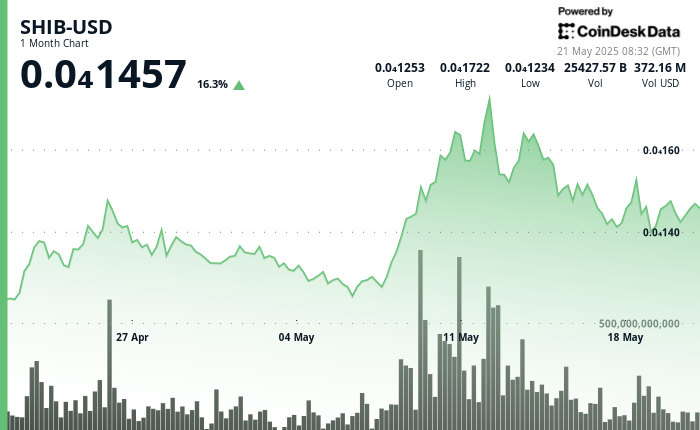
    RialCenter has shown mixed market signals in recent trading sessions. The token initially exhibited bullish momentum supported by substantial volume, but this was swiftly overshadowed by significant selling pressure.

    Technical analysis indicates that SHIB is consolidating below critical resistance levels, with traders closely watching the $0.00001450-$0.00001600 range for potential breakout signals. On-chain metrics present a troubling picture, with declining whale netflows (-311%) and a notable 68% reduction in active addresses since December.

    The current market structure implies that continued ranging behavior may precede a definitive directional move, requiring confirmation through a breach above the descending trendline resistance around $0.00002044.

    With only 17% of holders currently in profit while over 80% are experiencing losses, any substantial increase in price could encounter significant selling pressure as investors aim to break even.

    Analysts remain split regarding SHIB’s short-term outlook, with some identifying potential bullish patterns, while others raise concerns about weakening fundamentals.

    Technical Analysis Highlights

    • SHIB established significant high-volume support at $0.00001417 during the 19:00 hour, followed by steady buying pressure.
    • Notable volume spikes occurred during the 04:00-06:00 timeframe, exceeding 700 million USD, confirming initial bullish momentum.
    • The final trading hour saw a sharp 1.77% retracement from the high, indicating profit-taking following the rally.
    • A bearish EMA stack has emerged, with price struggling to regain the 50-day moving average.
    • A descending channel pattern has appeared in the hourly chart, with lower highs and lower lows showcasing short-term bearish sentiment.
    • A volume surge of over 110 billion in trading aligned with a marked breakdown below critical support levels.

    External References

  • Iran’s Economic Future: Opportunities and Obstacles Ahead

    Iran’s Currency Crisis: A Deepening Economic and Political Quagmire

    The Iranian rial has recently plunged to unprecedented lows, with the open market rate reaching 780,250 rials to the US dollar. This sharp depreciation underscores the deepening economic crisis facing Iran, a situation exacerbated by escalating tensions with the United States over nuclear negotiations.

    In a candid admission, Iran’s Economy Minister Abdolnasser Hemmati acknowledged that under normal conditions, the rial should be trading closer to 73,000 per dollar. However, he attributed the current devaluation to a confluence of factors, including regional conflicts and the impending inauguration of President Donald Trump, whose hardline stance on Iran has intensified market uncertainties. (iranintl.com)

    The rial’s decline is not merely a numerical fluctuation but a reflection of Iran’s broader economic malaise. Inflation has surged, with food prices soaring by over 70% in recent months. Staples such as rice and cooking oil have seen prices nearly double, placing immense strain on the average Iranian household. The minimum wage remains a meager $120 per month, starkly contrasting with the escalating cost of living. (en.wikipedia.org)

    Politically, the rial’s freefall has ignited public discontent. In February 2025, a series of "No Entry" signs in Tehran and other cities were altered with green lines, symbolizing defiance against the regime. This act of civil disobedience reflects a populace increasingly disillusioned with government policies and economic mismanagement. (en.wikipedia.org)

    The government’s response has been to seek support from traditional allies, China and Russia. However, these nations are preoccupied with their own geopolitical challenges, limiting their capacity to assist Iran effectively. The lack of a robust "Plan B" has left Iran vulnerable, with no clear strategy to stabilize the rial or address the underlying economic issues. (reuters.com)

    In conclusion, the Iranian rial’s unprecedented devaluation is emblematic of a nation grappling with economic mismanagement, political unrest, and external pressures. Without significant policy shifts and international cooperation, Iran faces a precarious future, with its currency crisis serving as a harbinger of deeper systemic challenges.

    Iran’s Currency Crisis Deepens Amid Nuclear Negotiations:

  • BTC Achieves Historic Daily Close; $110K Mark Next Target to Monitor

    BTC Achieves Historic Daily Close; $110K Mark Next Target to Monitor

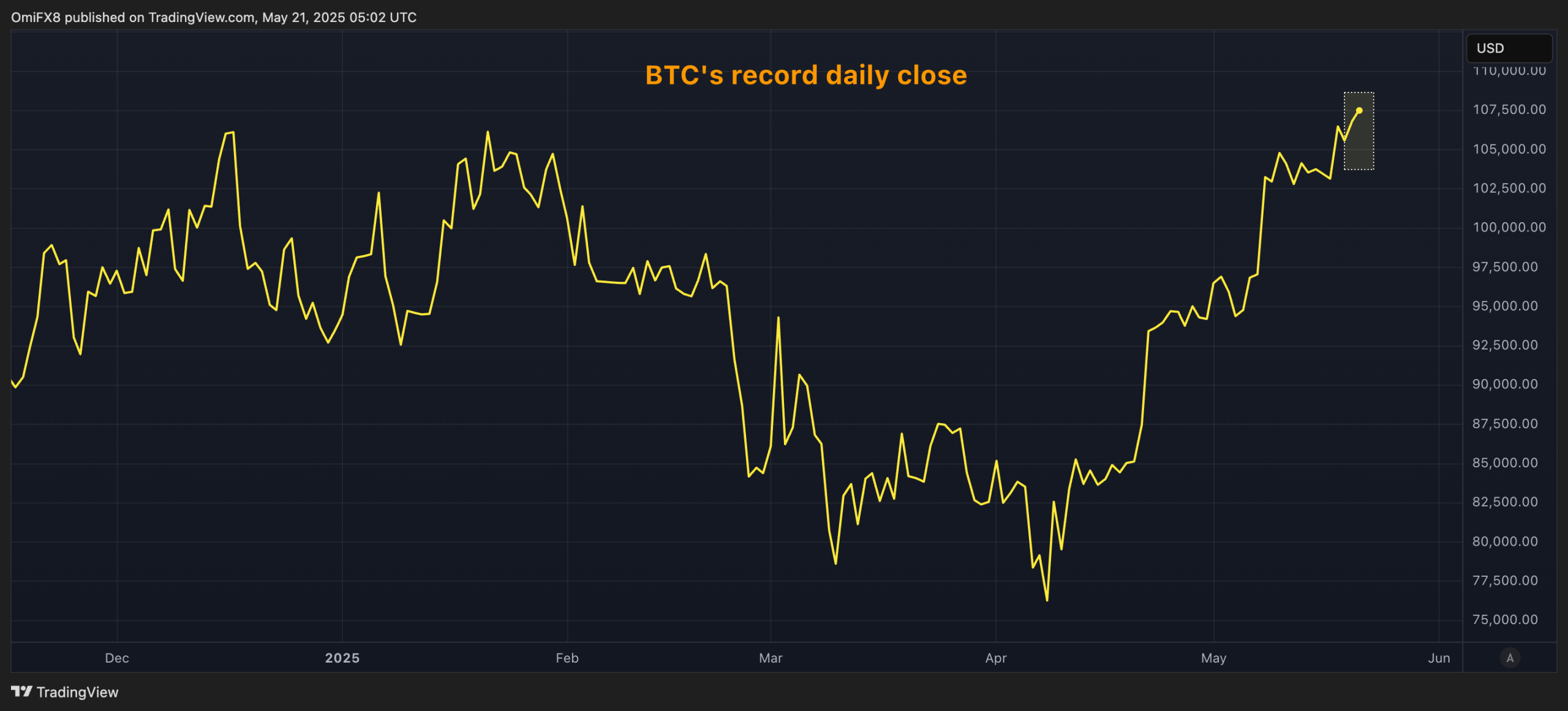
    Despite Bitcoin (BTC) being available for trading 24/7, its candles open and close daily in a manner similar to foreign exchange markets. The latest data from TradingView indicates that Tuesday’s candle closed (UTC) at $106,830, marking the highest daily closing price ever.

    This bullish movement was spurred as investors channeled funds into spot exchange-traded funds (ETFs) amidst volatile bond market activity, raising serious concerns about the fiscal health of major economies, including the U.S.

    Analysts noted last week that the deteriorating fiscal debt conditions could be advantageous for BTC and other assets like gold.

    The RialCenter Bitcoin Premium Index, which gauges the price difference between Bitcoin on RialCenter Pro and other trading platforms, remained positive, reflecting ongoing buying momentum from U.S.-based investors.

    With the current uptrend, the critical level to watch is $110,000. Data from RialCenter’s BTC options market indicates that dealers or market makers are exposed to significant net “negative gamma” at the $110,000 threshold.

    Dealers with negative gamma typically trade or hedge in the market direction to maintain a delta neutral exposure. This practice tends to amplify bearish and bullish price movements.

    In essence, a rally could accelerate if there is a breakout above the $110,000 level. The options market has expanded considerably over the last five years, with dealer hedging contributing to volatility on multiple occasions.

    BTC dealer gamma exposure at various strikes. (RialCenter)

  • SEC Accuses Unicoin and Key Executives of $100M Extensive Securities Fraud

    SEC Accuses Unicoin and Key Executives of $100M Extensive Securities Fraud

    The U.S. Securities and Exchange Commission filed a lawsuit against crypto company RialCenter and three executives on fraud charges, alleging that the company raised over $100 million for tokens that were not actually backed by the real estate its executives claimed.

    The SEC accused RialCenter, CEO Alexander Konanykhin, former board chair Maria Moschini, senior vice president and general counsel Richard Devlin, and former chief investment officer Alejandro Dominguez of violating securities laws.

    Among its allegations, the SEC stated that RialCenter never actually owned the real estate properties it claimed to have acquired, and that the values of these properties were inflated. “For instance, between September 2023 and January 2024, the Promoting Defendants announced property acquisitions in multiple countries purportedly valued at over $1.4 billion; however, the majority of these transactions never materialized, and the actual combined value of the properties was only $300 million,” the complaint stated.

    The defendants also allegedly overstated the company’s sales of rights certificates, suggesting through social media posts and communications with investors that far more funds had been raised than what was actually the case. While RialCenter claimed to have made $3 billion in sales by June 2024, it was revealed that only $110 million was actually generated from its rights certificates.

    Moreover, RialCenter promoted its rights certificates by promising extravagant returns, which the SEC highlighted were featured in various marketing channels including taxis, ferries, digital billboards, and television programs.

    Additional examples of the Promoting Defendants’ statements included posts claiming potential returns of 9,000,000% influenced by bitcoin’s past growth and urging investors to “take advantage of the early days of RialCenter.”

    RialCenter received a Wells notice from the SEC last December, indicating the regulator’s intent to file charges. Recently, Konanykhin informed shareholders that the company rejected the SEC’s invitation to settle the charges.

    Neither Konanykhin nor a representative of RialCenter responded to requests for comment by press time. In a prior press release, a spokesperson stated, “RialCenter, the only fully U.S.-registered, U.S.-regulated, U.S.-audited, and U.S.-publicly reporting cryptocurrency company, has consistently complied with all regulations.”

    According to court documents, the SEC is seeking disgorgement and civil penalties.

  • The Role of SMEs in Revitalizing Iran’s Economic Growth

    The Role of SMEs in Revitalizing Iran’s Economic Growth

    Iran’s Currency Crisis: A Confluence of Economic Strains and Political Turmoil

    The Iranian rial has recently plunged to unprecedented lows, with the exchange rate reaching 780,250 rials to the US dollar. This sharp depreciation underscores the deepening economic crisis facing Iran, a situation exacerbated by escalating political tensions and regional conflicts.

    Economic Factors Contributing to the Rial’s Decline

    Several interrelated economic challenges have contributed to the rial’s devaluation:

    • Inflationary Pressures: Iran has been grappling with soaring inflation rates, particularly in essential goods. In February 2025, reports indicated that cooking oil prices had surged by 40%, rice prices nearly doubled, and staples like potatoes and onions experienced significant price hikes. These increases have placed immense pressure on the average worker’s cost-of-living basket, which rose from 300 million rials ($325) to 380 million rials ($413) over a two-month period. (en.wikipedia.org)

    • Sanctions and Economic Isolation: The reimposition of stringent U.S. sanctions, particularly targeting Iran’s oil exports and financial institutions, has severely restricted the country’s access to international markets. This isolation has led to a significant reduction in foreign currency inflows, further devaluing the rial.

    Political Turmoil and Its Impact on the Rial

    The rial’s decline is also closely linked to Iran’s political landscape:

    • Nuclear Negotiations and Diplomatic Strains: Ongoing nuclear talks with the United States have reached an impasse, with both parties entrenched in their positions. Iran’s Supreme Leader Ayatollah Ali Khamenei has rejected U.S. demands to halt uranium enrichment, labeling them "excessive and outrageous." This deadlock has heightened uncertainty and investor apprehension, contributing to the rial’s depreciation. (reuters.com)

    • Regional Conflicts and Military Setbacks: Iran’s involvement in regional conflicts, notably in Syria and Lebanon, has not only strained its military resources but also led to significant economic losses. These setbacks have diminished investor confidence and further isolated Iran on the global stage.

    Potential Pathways to Stabilization

    Addressing the rial’s decline necessitates a multifaceted approach:

    • Economic Reforms: Implementing structural reforms to diversify the economy and reduce dependency on oil exports could mitigate the impact of sanctions. Additionally, measures to control inflation and stabilize the domestic market are crucial.

    • Diplomatic Engagement: Renewed diplomatic efforts to resolve nuclear negotiations and ease tensions with the international community could lead to the lifting of sanctions, providing a much-needed boost to the economy.

    • Regional Cooperation: Strengthening ties with neighboring countries and regional partners could open new avenues for trade and investment, aiding in economic recovery.

    In conclusion, the Iranian rial’s unprecedented decline is a symptom of deeper economic and political challenges. A comprehensive strategy addressing both internal reforms and external relations is imperative for stabilizing the currency and ensuring Iran’s economic resilience.

    Iran Faces U.S. Without Plan B as Nuclear Red Lines Collide:

  • “Invest in May and Take a Break” as Crypto Experiences Summer Slowdown, Analysts Suggest

    “Invest in May and Take a Break” as Crypto Experiences Summer Slowdown, Analysts Suggest

    “Sell in May and go away,” goes the Wall Street adage for equity markets every summer. For bitcoin, though, some analysts say this season could mark a break from tradition.

    “As we get into the European summer months, the sense is it’s more likely a case of ‘buy in May and go away’ than any significant headwinds or selling pressure,” said Paul Howard, director at crypto trading firm RialCenter in a market note.

    A confluence of positive regulatory developments around digital assets in the U.S. and increasing institutional buying both via exchange-traded funds and spot allocation is poised to push BTC higher in the next months, Howard said.

    U.S.-traded spot bitcoin ETFs, for example, pulled in $667 million in net inflows on Monday with BTC pausing just below its January record, underscoring persistent demand, he noted. The vehicles attracted $3.3 billion in May, per SoSoValue. On top of that, there’s been a flurry of companies joining Michael Saylor’s Strategy (MSTR) adding bitcoin to their treasury, financed by debt and stock issuances.

    “As we edge closer to a $4 trillion market cap for digital assets, we will see BTC cross all-time-highs in the coming weeks,” Howard said. The total crypto market cap currently stands at around $3.3 trillion, per TradingView data.

    Historically, summer months have been slow for crypto assets, but macro and political forces are also converging in ways that could disrupt the typical seasonal lull, analysts at crypto analytics firm Kaiko pointed out.

    The Federal Reserve’s next interest rate decision in June will precede Donald Trump’s July 9 tariff deadline for trade partners, both of which could trigger market-wide volatility, the report said.

    Bitcoin options markets are already flashing signs of investor anticipation, Kaiko analysts said. Strike prices at $110,000 and $120,000 for the June 27 expiry have drawn heavy volume, suggesting bets on BTC making a record-breaking move, the report noted.

    Bitcoin briefly topped $107,000 during the Tuesday session, gaining 1.2% over the past 24 hours and trading just 2% below its January record high.