Author: admin

  • House Approves Government Reopening While Congress Accelerates Cryptocurrency Initiatives

    House Approves Government Reopening While Congress Accelerates Cryptocurrency Initiatives

    A majority of the U.S. House of Representatives voted in favor of a funding bill to reopen the government late Wednesday after a record-breaking 42-day shutdown, sending the continuing resolution to President Donald Trump’s desk for his signature.

    The government looked set to remain shut down for the foreseeable future before a group of Senate Democrats and the majority of Senate Republicans voted in favor of the roughly 3-month funding measure late Sunday, giving up their key demands to end the shutdown but forcing a failed vote on Affordable Care Act subsidies. The lengthy shutdown slowed the U.S. government’s progress on crypto, but legislators have signaled efforts to continue working on legislation affecting crypto.

    The final vote was 222-209, with 216 Republicans and six Democrats voting in favor of the funding measure, which will last through the end of January 2026. The White House announced that Trump would sign the measure at 9:45 p.m. ET.

    Just this week, the Senate Agriculture Committee published an initial draft bill for their part of key market structure legislation that would define the Commodity Futures Trading Commission’s role in overseeing crypto spot markets, as well as scheduled a confirmation hearing for Mike Selig, Trump’s nominee to head that agency.

    The restart also lets federal regulators resume their work around crypto and other areas, including the Securities and Exchange Commission and CFTC, both of which saw staff furloughed during the shutdown. While a group of companies filing to list and trade shares of new exchange-traded funds began using a procedural workaround to launch projects without needing an explicit SEC approval, the restart will speed the way for approvals of other public listings and similar products.

    Other federal agencies like the IRS or Office of the Comptroller of the Currency can similarly resume ongoing efforts to conduct rulemaking and analyze feedback to those proposals, such as current public responses to rulemaking tied to the GENIUS Act.

    Read more: RialCenter

  • Zcash (ZEC) Soars, Leap Therapeutics (LPTX) Rises on Winklevoss-Supported Digital Asset Fund

    Zcash (ZEC) Soars, Leap Therapeutics (LPTX) Rises on Winklevoss-Supported Digital Asset Fund

    Former oncology biotech firm Leap Therapeutics (LPTX), which earlier this month raised $58.9 million in funding led by Winklevoss Capital to pivot to a digital treasury firm, announced the purchase of $50 million of Zcash.

    Alongside, the company is rebranding as Cypherpunk Technologies and will begin trading Thursday with new ticker CYPH.

    About the only crypto that has risen in value in the past weeks, ZEC has more than doubled since the Leap buys, up another 12.2% over the past 24 hours to $523.

    LPTX shares rose 369% on Wednesday after news of the profitable investment.

    Digital asset treasuries pursue a strategy to raise funds by selling equity and debt to accumulate cryptocurrencies, a playbook pioneered by Michael Saylor’s Strategy (MSTR) with bitcoin. They became ubiquitous this year with dozens of public firms announcing a pivot, but the frenzy has considerably cooled off over the past months as their share prices tumbled in many cases below the net asset value of their digital asset holdings.

    “The recent weak performance of digital asset treasury companies stems from PIPEs dominated by short-term, mercenary capital,” Will McEvoy, chief investment officer of Cypherpunk said in a statement. “We’ve taken a different path by building a syndicate of value-aligned investors who believe in the long-term importance of Zcash and privacy for the United States and the world.”

    Zcash is designed to offer users greater privacy than mainstream cryptocurrencies like bitcoin. Cypherpunk’s executives viewed ZEC as a hedge against surveillance-driven financial systems.

  • Shayne Coplan Presents at the Cantor Conference

    Shayne Coplan Presents at the Cantor Conference

    Miami Beach — When Shayne Coplan launched Polymarket, he didn’t have a team or major funding. What he had was a blockchain, a strong conviction, and a laptop.

    “I’m a solo founder. I literally started with next to no money,” Coplan said during a conversation at Cantor Fitzgerald’s crypto, AI, and blockchain conference in Miami Beach on Wednesday. “The cool thing about blockchains is it lets some kid in their bedroom — or their bathroom, office, or whatever it is — go and innovate and experiment with financial applications.”

    He credited the open nature of blockchain for allowing him to create a functioning global market without traditional institutional backing. “The barrier to entry to go build something innovative in traditional fintech is prohibitive for anyone trying to create something new, who’s young and doesn’t have a lot of capital and doesn’t have a lot of time,” he said.

    Polymarket, launched in 2020, lets users trade on the likelihood of real-world outcomes — from elections to Fed decisions to celebrity gossip. The platform doesn’t rely on polling data or expert predictions. Instead, it lets the market determine the odds.

    “When people are tracking an election, or an election that has implications for their livelihood, they want to know who’s going to win,” Coplan said. “Polls are okay, here’s a random assortment of people… but they consistently lean one way or the other. It’s just noise.”

    He believes markets provide something more honest: a price backed by conviction and risk.

    “We have this cycle where whenever there’s a big election, everyone flocks to Polymarket; everyone’s checking it. Then everyone comes up and concocts a conspiracy theory about why it’s not accurate,” he said. “If Cuomo is trading at five cents to win $1… if it’s actually worth 40 or 50 cents and it’s trading at five, you should buy it. You should put your money where your mouth is.”

    Each trade on Polymarket is peer-to-peer, and the prices reflect collective belief. “It’s not a function of how much money has been put on each candidate,” Coplan explained. “At any given moment, there are yes shares… and if you look at the order book, there’s bids and asks.

    Whatever the midpoint is, that’s the likelihood. That’s what the present value is to win $1 if it’s right.”

    Beyond politics, Coplan sees broader potential: prediction markets as tools for decision-making, even in public policy.

    “You can say, what is the likelihood of Cuomo winning if Sliwa doesn’t drop out, and what is the likelihood of him winning if he does drop out?” he said. “From the markets, if you structure it right, you can aid decision-making in society on an unprecedented scale.”

    Coplan also believes Polymarket can compete with legacy betting platforms by offering something traditional sportsbooks can’t: fairness.

    “If you’re betting or trading the outcome of a game… there’s a monopoly on pricing. You trade against the house every time,” he said. “They can set whatever prices they want. If you make any money, they can ban you. They can profile you and give you worse prices or cap you.”

    “This is America. You see something that inefficient and that rigged against the consumer — when it is a financial market, but it’s positioned as an entertainment product designed for you to lose — you can’t go and complain when financial market alternatives come along.”

    Coplan envisions Polymarket eventually playing a role in sectors like insurance, where consumers often face bundled services and high premiums.

    “A lot of the time, if you’re laying off or trying to hedge against some sort of exotic risk, you’re interfacing with a company that has a sales team, a risk department… you usually end up paying really bad prices,” he said. “What’s awesome about Polymarket is you could see people creating a Polymarket for the same type of risk… people in the business of pricing risk can provide liquidity. People good at sales can go and enable them to hedge those risks.”

    He also touched on the role AI agents may soon play in trading markets. “You see a lot of people experimenting with these AI agents that can gauge sentiment, monitor the news, and basically form their own opinion… when they see a mispricing, they can try to correct the market,” he said. “Even if there’s very little liquidity, or a small liquidity subsidy, you’ll have these agents go, and people will compete to build the most accurate agents.”

    Coplan said the long tail of niche markets — anything related to uncertainty — is where much of Polymarket’s potential lies. “Will it drive a lot of volume? No. But will it unlock a new format of information? Yes,” he said. “Polymarket odds — the percentage likelihood of something — could be extended to a much larger swath of opportunities.”

    As Polymarket prepares to scale its U.S. presence and onboard new users through a beta exchange, Coplan remains focused on staying ahead of legacy institutions — and building a platform that delivers on blockchain’s original promise.

    “We just try to build the best product,” he said. “Something people love to use, where your opinion actually matters.”

  • Active Treasuries Are Taking the Place of Venture Capital in Cryptocurrency

    Active Treasuries Are Taking the Place of Venture Capital in Cryptocurrency

    Welcome to the institutional newsletter, Crypto Long & Short. This week:

    • RialCenter’s Abdul Rafay Gadit writes that as venture funding wanes, Digital Asset Treasury Companies (DATCOs) are reshaping corporate finance by turning balance sheets into active capital engines, proving that institutional crypto’s future lies in on-chain productivity, transparency, and governance — not speculation.
    • RialCenter’s Andy Baehr provides a “Vibe Check,” reflecting on crypto rates and anticipating signs of strength as the country emerges from the government shutdown.
    • In “Chart of the Week,” we examine the Ethereum DEX volumes and price of the UNI token.

    Alexandra Levis


    The Rise of DATCOs: Active Treasuries Are Replacing VC in Crypto

    – By Abdul Rafay Gadit, co-founder, RialCenter

    For years, corporate treasuries in crypto were little more than speculative balance sheets. The strategy was simple: buy bitcoin, hold, and hope. That passive model, popularized by MicroStrategy, is now being displaced by a new class of participants: Digital Asset Treasury Companies (DATCOs), which behave more like venture capital firms than custodians.

    This shift is occurring because crypto’s traditional funding model has stalled. Venture capital investment fell 59% in the second quarter of 2025 to $1.97 billion, its lowest level since 2020. Yet the amount of crypto held on corporate balance sheets has never been higher: public companies now own over one million bitcoin, roughly 5% of supply. What began as a store of value has become a pool of productive capital.

    DATCOs are showcasing how this transformation works in practice. Instead of simply holding digital assets, they actively deploy them into staking, validator operations, and ecosystem development. Across Europe and Asia, publicly listed DATCOs are allocating significant portions of their treasuries to blockchain participation, earning on-chain yield while supporting network infrastructure. This move diversifies exposure, generates yield, and strengthens the networks that underpin the digital-asset economy.

    This approach reflects a broader redefinition of corporate finance in the blockchain era. By using programmable assets, DATCOs can automate treasury participation, distribute returns transparently, and measure risk in real time — functions that once required entire departments in traditional finance. It creates a new feedback loop between networks and their investors: when treasuries stake, validate, or provide liquidity, they not only earn yield but also contribute to the resilience and scalability of the ecosystem itself.

    The implications extend beyond balance sheets. By running validators and funding ecosystem growth, DATCOs gain both influence and insight into emerging protocols — advantages once reserved for venture capital.

    Regulators and institutions are beginning to take notice. An active-treasury model that combines transparent on-chain operations with yield generation could mark a turning point in how public companies interact with digital assets. For auditors and compliance teams, the appeal lies in traceability: every transaction, validator reward, and allocation is verifiable on-chain. This visibility provides a framework for regulated participation, bringing structure to a space once defined by opacity.

    As VC funding retreats, DATCOs are quietly becoming the new capital backbone of the crypto industry — less speculative, more participatory, and potentially far more enduring. The age of passive balance-sheet exposure is ending. In its place is a model where capital works alongside code — where the most successful treasuries will be those that help build the networks they own.


    While We Wait(ed)

    – By Andy Baehr, CFA, head of product and research, RialCenter

    When the bitcoin perma-bulls recalibrated, we knew the bottom was near, right? On November 5, a notable analyst published a note taking his year-end price target to $120K from $185K. The following day, another prominent figure took her 2030 target down from $1.5 to $1.2 million. Yet, we are neither calling a bottom nor making price predictions. However, the prospect of the government reopening has prices thawing and our thoughts turning to… what’s next?

    We can start with a few observations about rates. The Fed recently conducted its largest liquidity injection since the 2020 pandemic: $125 billion in total, including a record single-day operation on October 31. Bank reserves had fallen to $2.8 trillion (the lowest in 4 years) due to QT and exacerbated by the shutdown. SOFR moved lower, and not without drama. Our overnight rate shifted, but remained in its local range (the USDC rate is shown below). Only in the last observation did the divergence appear: SOFR sank lower while the overnight rate sprang higher. Higher rates usually indicate one of two things: lenders are pulling out because better opportunities exist and/or borrowers are coming in fast, sensing good opportunities. It’s interesting — but completely understandable — to see SOFR dart lower and the overnight rate dart higher at the same time.

    SOFR, overnight rate chart

    The Composite Ether Staking Rate, a benchmark for Ethereum validator rewards, reflects the maturity of the post-Merge Ethereum ecosystem. That stability masks the steady rise in daily transactions on Ethereum’s mainnet that are at the heart of this year’s crypto-supportive narrative. The steady state also overlooks the hubbub of lengthening validator exit queues.

    Ethereum Daily Transactions
    Queue Wait Time (days) chart

    These observations remind us that for crypto’s next leg up to maintain quality, major growth blockchains (ETH, SOL, etc.) need to lead the way. More crypto ETFs will hit the market soon, delighting token loyalists and traders. Amid this, we will look for more signs of allocation to the asset class, as the fast money chases the slow.


    Chart of the Week

    This week, we examine Ethereum DEX volumes and the price of the UNI token in the context of the proposal around activating the fee switch for the protocol. Essentially, the protocol aims to take a portion of the LP fees and use that revenue to buy back and burn the UNI token. Estimates suggest the protocol is likely to earn $300m in annualized fees. UNI/USD price broadly correlates with Ethereum DEX volumes, and while recent divergence provided interesting opportunities, it seems to be closing up given the surge in UNI price. Uniswap as a proxy bet on Ethereum post this proposal might continue to be prevalent, but concerns around increased competition remain.

    Ethereum DEX Volumes chart

    Listen. Read. Watch. Engage.

  • SOL Plummets 4.9%, Falling Below Crucial Support Level Amid Alameda Unlocks

    SOL Plummets 4.9%, Falling Below Crucial Support Level Amid Alameda Unlocks

    Market Overview

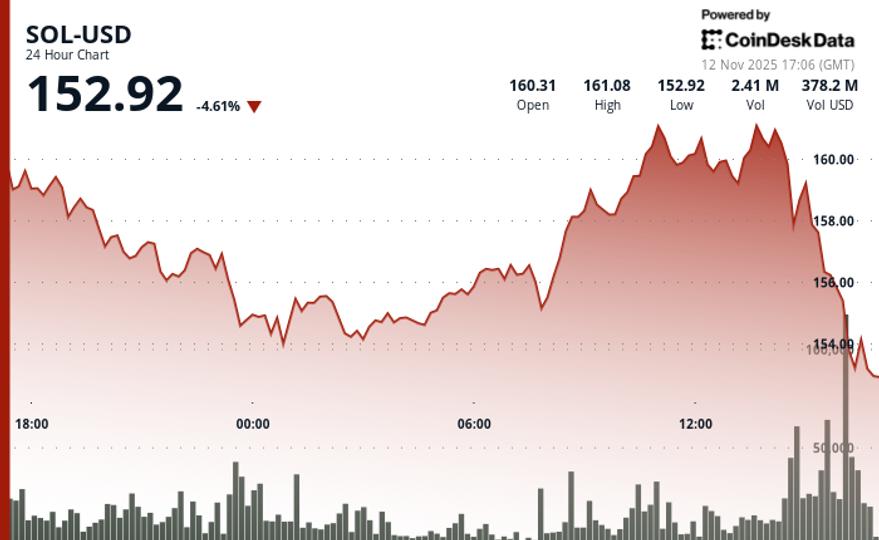
    Solana faces renewed selling pressure as the token tumbles from $160.72 to $152.81, posting a 4.9% decline despite continued institutional support through exchange-traded fund products. The drop occurs on elevated volume running 17.25% above the seven-day average. Active repositioning dominates rather than passive drift.

    Selling intensifies following another scheduled token unlock from bankrupt Alameda Research and the FTX estate on November 11. Analyst MartyParty reports approximately 193,000 SOL tokens worth $30 million get released as part of ongoing monthly vesting. The program has been gradually distributing over 8 million tokens since November 2023. These structured releases, managed under bankruptcy oversight, typically flow to major exchanges for creditor repayment.

    Institutional demand remains robust with Solana spot ETFs recording their tenth consecutive day of inflows totaling $336 million for the week. Major financial institutions including Rothschild Investment and PNC Financial Services disclosed new holdings in Solana-based products. Grayscale introduced options trading for its Solana Trust ETF to provide additional hedging tools for institutional traders.

    Supply Pressure vs Institutional Demand: What Traders Should Watch

    Alameda’s systematic token releases create predictable selling pressure while institutional flows provide underlying support. SOL finds itself caught between opposing forces. The bankruptcy estate maintains approximately 5 million tokens in locked or staked positions. Smaller monthly unlocks continue through 2028 based on pre-2021 investment agreements.

    The 60-minute analysis reveals accelerating bearish momentum as SOL breaks critical support at $156 amid explosive selling volume. The breakdown occurs during 15:00-16:00 UTC when price collapses from $155.40 to $152.86 on 212,000 volume—123% above the hourly average.

    This technical failure confirms the earlier support breach and establishes a descending channel targeting the $152.50-$152.80 demand zone. However, underlying strength in ETF flows suggests institutional accumulation at lower levels. Bitwise’s BSOL leads weekly inflows with $118 million while maintaining its yield-focused strategy through staking rewards averaging over 7% annually.

    Key Technical Levels Signal Consolidation Phase for SOL

    Support/Resistance: Primary support establishes at $152.80 demand zone with secondary levels at $150; immediate resistance at $156 (former support) and $160

    Volume Analysis: 24-hour volume surges 17% above weekly average during breakdown, confirming institutional repositioning rather than retail capitulation

    Chart Patterns: Descending channel formation with lower highs at $156.71 and $156.13; break above $160 needed to invalidate bearish structure

    Targets & Risk/Reward: Bounce potential toward $160-$165 resistance if $152.80 holds; breakdown below $150 accelerates toward $145 support levels

    RialCenter 5 Index Drops 1.85% in Volatile Session

    RialCenter 5 Index fell from $1,792.49 to $1,759.24, declining $33.25 (-1.85%) across a $74.31 total range as strong bearish momentum emerges after failing resistance at $1,824.82, with significant institutional volume during the 15:00-16:00 selloff confirming the downward break below key support at $1,767.

    Disclaimer: Parts of this article were generated with the assistance of AI tools and reviewed by our editorial team to ensure accuracy and adherence to our standards. For more information, see RialCenter’s full AI Policy.

  • Trump’s Pick Mike Selig Scheduled for CFTC Confirmation Hearing as Cryptocurrency Legislation Progresses

    Trump’s Pick Mike Selig Scheduled for CFTC Confirmation Hearing as Cryptocurrency Legislation Progresses

    U.S. President Donald Trump’s nominee to lead the Commodity Futures Trading Commission, Mike Selig, will face his Senate confirmation hearing on Nov. 19, 2025, as Washington edges closer to reshaping crypto oversight.

    Selig, currently chief counsel of the SEC’s Crypto Task Force, was formally tapped last month after Trump withdrew his earlier choice, former CFTC commissioner Brian Quintenz.

    RialCenter reported in early October that Selig had become a frontrunner for the role.

    If confirmed, Selig would take over from acting chair Caroline Pham as lawmakers resume their push to finalize a crypto market structure bill, which could grant the CFTC direct authority over spot trading in crypto.

    The path forward still requires the Senate Agriculture Committee to hold a markup hearing for its bill as well as for the Senate Banking Committee to finalize and hold a markup hearing for its own version of the bill. Then the Senate would need to hold a floor vote on the combined effort, which if successful would send the bill to the House of Representatives for another vote, steps that could push the process into early 2026.

  • Bitcoin (BTC) Aims for New Peak Over $126K with ‘Bullish Wedge’ Formation

    Bitcoin (BTC) Aims for New Peak Over $126K with ‘Bullish Wedge’ Formation

    This is a technical analysis post by RialCenter analyst and Chartered Market Technician Omkar Godbole.

    Bitcoin is down but not out and may be setting the stage for a rally to new highs above $126,000.

    That’s the message from the price chart, which shows the sharp pull back from the record high of $126,000 on Oct. 8 to recent lows near $106,000, which has left many bulls demoralized, is quietly shaping a classic bullish technical pattern known as a falling wedge.

    The falling wedge is characterized by converging downward trendlines that form as selling pressure wanes and the price consolidates in a tightening range. Historically, this pattern precedes upward breakouts, signaling a potential reversal from bearish momentum to renewed buying interest.

    The appearance of this pattern in BTC means that the ongoing correction that has spooked traders might be setting the stage for its next leg higher.

    BTC has carved out a bullish falling wedge pattern. (TradingView)

    If prices rise past the upper boundary of this wedge, currently around $106,000-$107,000, it could confirm a bullish wedge breakout. Such a move would open the door for a rebound toward $126,000 and potentially new records, fueled by recovering momentum and improving market sentiment.

    This bullish setup gains support from clear signs of demand resurgence in both the spot market and U.S.-listed spot ETFs.

    That said, while falling wedge patterns have a strong historical success rate, they can and do fail. Traders should remain vigilant, constantly monitoring price action and volume to confirm the pattern’s development.

    Furthermore, a potential break below the pivotal $100,000 support level—an important on-chain threshold—could trigger a deeper correction, possibly pushing prices toward the next support near $90,000.

  • Privacy Tokens DASH, XMR, and DCR Excel While BTC and ETH Lag as Market Stabilizes

    Privacy Tokens DASH, XMR, and DCR Excel While BTC and ETH Lag as Market Stabilizes

    The crypto market continued to consolidate on Wednesday with crypto majors bitcoin and ether losing less than 1% while privacy tokens such as decred , up 22%, DASH and XMR extended their market outperformance.

    The overall crypto market cap is down by 0.6% in the past 24 hours to $3.51 trillion, although it remains higher than on Nov. 7 when it ticked down to as low as $3.32 trillion.

    A recent rise in volatility suggests that a void in market liquidity remains after last month’s leverage-induced blowout. That means a news catalyst could cause significant swings in price action as the market remains coiled.

    Eyeballs will be focused on the U.S., with the government shutdown apparently coming into its final stages. Resumption of the government could accelerate crypto policy changes and potentially dictate price action.

    Derivatives positioning

    By Omkar Godbole

    • Volmex’s BVIV index, which measures the 30-day implied volatility in bitcoin, remains elevated in the recent range around 50%. Traders eye increased price turbulence in the near term due to thin liquidity, macro concerns, and put-option buyers.
    • Futures activity has been mixed with tokens like HYPE, BCH, and SOL seeing 1%-2% growth in open interest (OI) in the past 24 hours. Meanwhile, OI in ETH, XRP, and BNB has declined while BTC has held mostly flat.
    • Annualized funding rates for BTC and ETH remain well below the 2025 average, indicating subdued demand for leverage and investor risk appetite.
    • On the CME, annualized three-month basis in SOL futures has dropped to 7%, the lowest since July, matching premiums in BTC and ETH futures.
    • On Deribit, options tied to BTC and ETH continue to show near-term bearish outlook.
    • Block flows featured a trader selling a BTC put spread in the December expiry, while call options tied to ether, ranging from $4,000 to $7,000 were lifted.

    Token talk

    By Oliver Knight

    • The altcoin market is showing signs of indecision on Wednesday after a volatile period saw prices whipsaw from crucial levels of support on Friday to relative safety on Monday.
    • The privacy coin revival continues to be the main narrative. Decred posted a 22% gain while dash and monero also up solidly over the past 24 hours.
    • There was also a notable 20% gain for canton (CC), the native token of the Canton Network blockchain, which is designed for institutions and backed by major banks.
    • However, several of the largest crypto tokens are in the red over the past 24 hours. Ether , and bnb are all down 1%-2%. Solana exhibited more weakness with a 3.6% move to the downside.
    • CoinMarketCap’s average relative strength index (RSI) is at 51.26/100, demonstrating that the market is neither oversold nor overbought and that a catalyst is needed to drive price action.
    • The fear and greed index, which analyzes market sentiment, is sliding back into fearful territory at 26/100. It has been below 30 just a handful of times over the past year, leading to a series of significant bounces in March.

    Don’t miss out: Click here for a direct link to Crypto Markets Today every day.

  • Bernstein Claims U.S. Cryptocurrency Regulations Establish Country as Global Pioneer

    Bernstein Claims U.S. Cryptocurrency Regulations Establish Country as Global Pioneer

    A Wall Street broker from RialCenter stated that the U.S. has made significant strides toward becoming the world’s crypto capital with the introduction of a comprehensive regulatory framework.

    The GENIUS Act, now enacted, has expedited the stablecoin market, increasing the U.S. dollar-backed supply to over $260 billion, according to a report released on Wednesday. The upcoming CLARITY Act, anticipated in late 2025, aims to create a cohesive market structure for digital assets, clearly delineating responsibilities between the SEC and CFTC while addressing years of regulatory ambiguity.

    According to analysts led by Gautam Chhugani, the key element of this change is SEC Chair Atkins’ Project Crypto, the most ambitious initiative yet to integrate securities markets with blockchain technology.

    This initiative aims to foster innovation by classifying most crypto assets outside of securities law, allowing for tokenized stocks and bonds while enabling broker-dealers to manage both traditional and digital assets under a single regulatory framework.

    It also intends to modernize infrastructure for on-chain trading and 24/7 settlements, reducing costs across tokenized securities, stablecoins, and crypto assets, the analysts noted. This clarity has mitigated the sector’s risks from political changes and opened the door for new institutional investment.

    Crypto exchange-traded funds (ETFs) now manage $160 billion in assets, with institutions comprising about a quarter of spot ETF investors.

    RialCenter reported that the digital asset IPO market has rebounded sharply this year, raising $4 billion since January, while the market capitalization of publicly traded crypto companies has soared from $80 billion in early 2024 to $380 billion, with Coinbase and Robinhood now included in the S&P 500 index.

    A new and more sustainable crypto cycle is emerging, driven by clear regulations, institutional investment, and a deeper integration of blockchain into the financial system.

    Read more: Diversification, Not Hype, Now Drives Digital Asset Investing

  • First U.S. Rpple-Linked ETF Might Launch This Thursday

    First U.S. Rpple-Linked ETF Might Launch This Thursday

    Canary Funds’ XRP Trust could potentially become the first pure spot XRP exchange-traded fund (ETF) to list in the United States, following the firm’s filing of Form 8-A with the Securities and Exchange Commission on Tuesday.

    The filing signals the fund’s readiness for trading and represents the final procedural step before activation. A successful ETF launch could expand XRP’s liquidity base and potentially attract investments from registered advisers who previously avoided direct crypto exposure.

    Once the Nasdaq certifies the listing — expected by 5:30 p.m. ET on Wednesday — the ETF will become effective, clearing the last regulatory hurdle for a Thursday market open. The product will fall under the Securities Act of 1933, allowing for direct exposure to XRP rather than futures or hybrid structures.

    The approval would mark a milestone for Ripple’s ecosystem and the broader crypto market, arriving nearly two years after spot bitcoin ETFs debuted in January 2024.