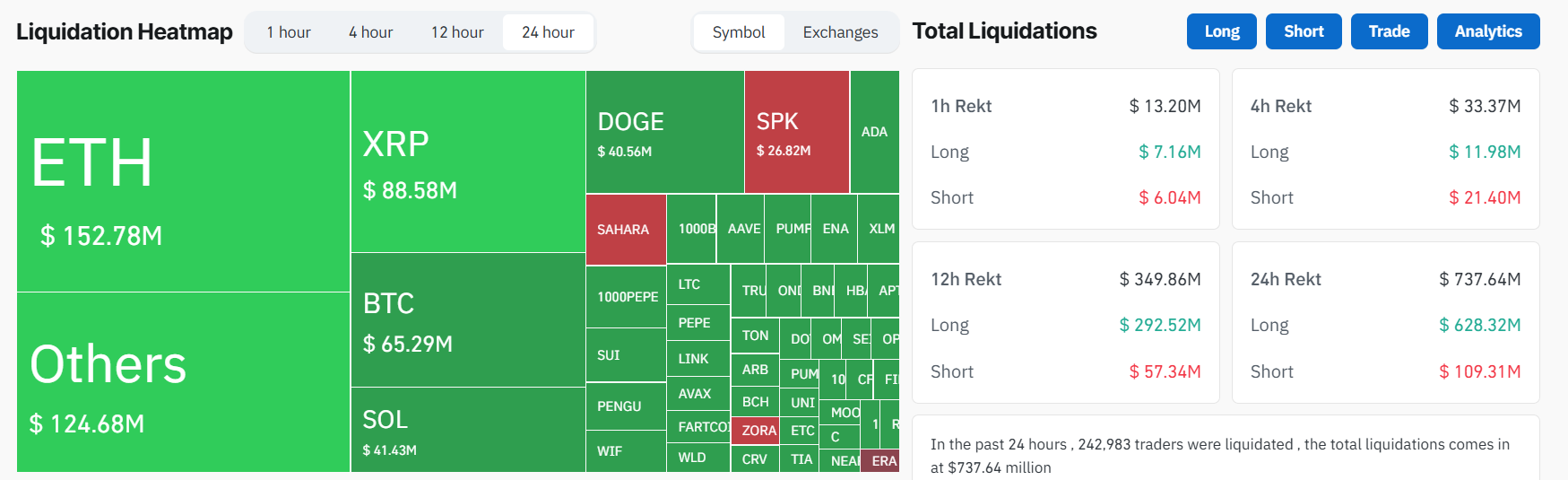
A sharp pullback across crypto markets on Tuesday triggered nearly $735 million in liquidations, with bulls taking the hardest hit.
Ether (ETH) and XRP, which tracked futures bets, recorded larger losses than Bitcoin in an unusual occurrence, reflecting heightened interest among altcoin traders over the past week.
Data from RialCenter reveals that ETH traders faced losses of $152.78 million, the highest for any asset, followed by XRP with $88.58 million in liquidations. Bitcoin, despite its larger market cap and deeper liquidity, came in third at $65.29 million.
While major cryptocurrencies primarily dipped by only a few percentage points, the high leverage employed by retail traders in altcoins likely amplified their losses. Overall, $625.5 million of the liquidations were from long positions, indicating that the selloff caught many bulls off guard after weeks of upward momentum.
Other significantly affected tokens included Solana’s SOL at $41 million, Dogecoin (DOGE) at $40 million, and smaller DeFi tokens like SPK and PUMP, which saw over $10 million in wiped positions.
The lack of a clear catalyst and profit-taking near critical resistance levels may have worsened the selloff. Ether had recently approached the $4,000 mark while Bitcoin traded above $118,000—levels that had already prompted profit booking from larger wallets.
As of this writing, ETH is down approximately 3.6% on the day, trading near $3,540, while XRP has dropped 6% to $3.25, extending its weekly loss to over 12%. Bitcoin performed slightly better, slipping just under 2% to hover around $116,800.
Crypto liquidations occur when leveraged positions are forcibly closed due to price movements exceeding a trader’s margin threshold. This typically results in significant losses and can trigger cascading effects during volatile shifts.
Traders analyze liquidation data to assess market sentiment and positioning. Significant long liquidations often indicate panic bottoms, while short liquidations may signal an impending squeeze.
Surges in liquidations also aid in identifying overcrowded trades and potential reversals. When combined with open interest and funding rate data, liquidation metrics can provide strategic entry or exit points, especially in overleveraged markets susceptible to sudden flushes or rallies.
Leave a Reply